Trump’s tariffs: A Primer
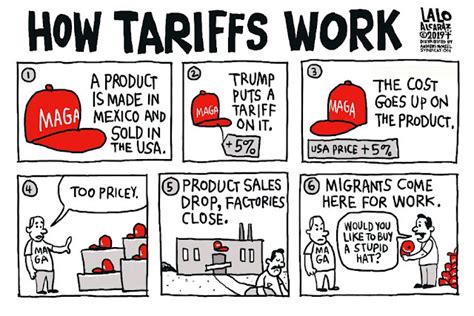
Trump who calls himself the Tariff Man loves tariffs. He wants a 60% tariff on Chinese goods, an across the board 20% tariff on imports, a 100% tariff on Mexican goods produced by US firms and in some cases 200% tariffs on other goods. Trump calls tariffs “the greatest thing ever invented.” He has asserted that tariffs will save factory jobs, force companies to produce domestically, shrink the federal deficit, lower food prices and promote world peace. For some reason he did not include cure cancer and the common cold. He has also suggested replacing the income tax with the revenue from tariffs. Penn should rescind Trump’s economics degree.
Trump is making a common political mistake. He is assuming that behavior will not change when there is a change in prices. If imported goods are subjected to a tariff then the price of those goods will increase, decreasing the quantity of goods demanded domestically. Trump is assuming that the decrease in the goods imported will be replaced by domestically produced goods. He ignores two things. First, the decreased imports mean less money flows to the government from foreign goods. Second, he forgets the reason why the goods are manufactured in foreign countries in the first place, comparative advantage. For those goods to be produced domestically would mean a significant increase in the cost of production, meaning higher prices to consumers. In either case, the real income of consumers fall. Notably, the poor and working class families will suffer the greatest fall in real incomes since they consume greater proportions of imported goods than do higher income households.
Can tariffs replace the income tax? In a word, no. Given the predilection of the press to scrutinize every utterance of Trump, I am surprised, shocked, that they have failed to do the math. In 2023, the federal government collected $2 trillion in personal income taxes. The amount of imported goods was around $4 trillion. If Trump enacted a tariff of 20% it would raise “only” $800 million assuming perfectly inelastic demand for all imported goods (no change in demand when prices change). In order to completely replace the income tax, a tariff of 50% would have to be enacted. However, since the demand for imported goods would fall as prices increased by 50%, much less would be collected, necessitating an even larger increase in tariffs. I wonder if Trump learned about the Smoot-Hawley Act at Penn? It was enacted in 1930, signed by President Hoover and placed tariffs on over 20,000 imported goods. Our trading partners retaliated resulting in a 70% reduction in imports and exports. Mind you, this was during the Great Depression which shows that stupidity amongst politicians is endemic regardless of era. Let us assume that a similar reaction would take place today and there would be a 70 percent reduction in US imports and exports. Imagine the impact on those domestic manufacturers who rely on imported raw materials. Imagine the impact on consumers – especially low income households. Imagine the impact on prices and on jobs. And Trump thinks tariffs are “the greatest thing ever invented”?
 haroldblackphd.com