Blog

Trump saves lives! Jared and Ivanka are doing what?

Trump saves lives! Jared and Ivanka are doing what?

Trump saves lives! Trump saves lives!

Remember when the president said that for every boat blown up in the eastern Caribbean, 25,000 lives were saved? Well there have been at least 61 strikes on alleged drug boats since Trump’s shoot to kill order. That means that Trump (and the navy) have saved 1,525,000 lives! The CDC reports that on average around 70,000 people die from drug overdoses each year. So the president has saved on average 70,000 people a year for the next 21.7 years! Additionally, most of the drug running in the eastern Caribbean has been in cocaine and not fentanyl which comes across the Mexican border. Synthetic opioids, primarily fentanyl, accounts for approximately69% of all overdose deaths or 48,000 per year. This means that “only” 22,000 deaths were caused by cocaine. And since the narco boats are transporting cocaine, that means that the president has saved 22,000 a year for the next 60 years! Way to go Donald!

So the president slightly misspoke only he doesn’t realize it. Trump’s shoot to kill order started in September 2025. What was ironic is that drug deaths had already dropped significantly for the two years prior. The CDC reported that the drug overdose death rate decreased an astounding 26.2% from 2023 to 2024. The so-called experts offer only speculation as to the reasons why. However, the two year trend in the decline in deaths is predicted to continue – until it doesn’t.

But going back to the cocaine-related deaths, 22,000 total deaths are less than what the president says is saved by blowing up one narco-boat much less 61. Given that small number, economics tells us that the supply of drugs on the street must have not be adversely affected by the navy’s actions and that street prices should be about the same. On the other hand, if the navy’s interdiction caused a restriction in the supply, then street prices should have increased dramatically. Trump’s head of the Drug Enforcement Agency says that cocaine prices are increasing 30% – 45% per kilo in Puerto Rico, Dominican Republic, Guatemala, Honduras and Central America. However, the Coast Guard commander in the region disagrees saying that there has not been “any noticeable difference” in the flow of cocaine in the region. Trump’s guy at DEA can’t be lying – could he?

As noted before, the drugs being run out of the eastern Caribbean typically do not go to US markets. Rather other Latin American countries, Asian and Europe are the markets. So there should be little impact on US market prices. A study of Chicago markets by a local television station, found that fentanyl use and overdoses have dropped. But cocaine usage is increasing. “Here in Chicago, as fentanyl use and overdoses plunge, a full-fledged cocaine comeback is well underway, with suburbancounties and northwest Indiana especially reporting cocaine and crack arrests, seizures and hospitalizations increasing.”  Again The reason there is minimal impact on U.S. cocaine imports is because analysts say the cargo on these vessels isn’t headed to U.S. ports and transshipped to Chicago. Drugs on these boats are destined for everywhere else in the world, mostly Europe.

However, as recently as January 29th, the president said “With our action in the Gulf of America, that sounds so nice when I hear the Gulf of America, drugs entering our country by sea are down 97%. So when you see the boats being hit, those boats kill on average 25,000 people a boat.” Oops. Serious misspeak here. Trump obviously meant the eastern Caribbean and not the Gulf of Mexico, er America. Also, the 61 nacro boats carried a miniscule amount of drugs while the Coast Guard is the unit that seizes most of the drugs confiscated in the eastern Caribbean. 

The New York Times says that blowing up those boats has not “slowed cocaine traffic to the US.” https://www.nytimes.com/2026/05/29/world/americas/us-boat-strikes-cocaine-trump-south-america.html

Well, come now, it had to slow even if just a wee bit don’t you think? Regardless, pesky supply and demand would say that street prices should have increased but according to University of North Carolina drug researcher Nabaruun Dasgupta, “street prices for cocaine remain between $60 [and] $100 per gram in many U.S. cities, about where they were before the boat strikes began.”

So the president keeps repeating a fantasy seconded by his Defense secretary, Pete Hegseth who says “The boat strikes are a “highly effective” way to “stop lethal drugs.” But of course, Hegseth has little integrity and knows better than to contradict the president, else he will be back on Fox News. Whenever Hegseth speaks I am reminded of Etta James singing a Delbert McClinton song “Lie no better.” 

“Makin’ me out your clown. Lookin’ for excuses that you know can’t be found. If you can’t lie no better. If you can’t lie no better. If you can’t lie no better than that you might as well tell the truth.”

Now Jared and Ivanka are doing what?

The Washington Examiner, normally a reliable Trump mouthpiece, has actually published an anti-Trump article! It is entitled “As Trump bomb drug cartels, Jared and Ivanka are happy to lauder hundreds of millions of dollars for them.” 

https://www.msn.com/en-us/news/world/as-trump-bombs-drug-cartels-jared-and-ivanka-are-happy-to-launder-hundreds-of-millions-of-dollars-for-them/ar-AA25YInn

What! The author, Tom Rogan says that the resort planned by Kushner’s Affinity Partners to develop Albania’s Sazan Island at a cost of $1.5 billion will ease money laundering for Albanian organized crime. Kushner received “strategic investor status” to develop the island which is the same status used by the drug cartels to establish front companies in Albania. The author states “Ask any objective expert on Albania, and they will tell you there is no question that a sizable portion of that $1.5 billion, and any future profits from the project, will end up with organized crime. The rot starts at the very top. As the Washington Examiner has previously reported, Albanian Prime Minister Edi Rama has directly facilitated Sinaloa Cartel money launderer Luftar Hysa (the Trump administration has now sanctioned Hysa). And one key mechanism via which Sinaloa and Albania-based organized crime groups launder their billions of dollars in annual proceeds is via, you guessed it, luxury resorts.”

Rogan ends by saying: “The president should not-so-kindly tell his daughter and son-in-law to abandon their indirect effort to assist the world’s worst criminals in laundering hundreds of millions of dollars.”

I am sure that the president is in no way involved with money laundering money from the very cartels he has targeted  – right?

Georgia Drops Its Proposed Racial Gerrymander – for now

Georgia Drops Its Proposed Racial Gerrymander – for now

In Georgia on June 17, republican leaders in the state legislature abruptly decided to shelve a proposal that would have redrawn two of the state’s four congressional districts represented by black members of Congress. The proposal also included changes to state legislative districts that would have reduced the number of majority-black State House districts from 54 to 37 and majority-black State Senate districts from 17 to 9.

Currently, democrats hold 80 seats in the state House, 75 are held by black legislators, while republicans hold 99 seats. In the state Senate, democrats hold 22 seats,12 by black legislators, compared to 33 for the republicans.

Not surprisingly, the proposal sparked a strong backlash from the black elected officials and civil rights activists. Hundreds of demonstrators gathered at the state capitol, chanting, “Black voters matter!” and “You can gerrymander a map, but not a movement!” Amid the growing controversy, state House Speaker Jon Burns announced that legislators would not consider redistricting during the current session.

The decision was driven more by political calculation than by a sudden change of heart. Republicans fear that pursuing the redistricting plan would energize democratic voters—particularly black voters—and increase their turnout in this year’s elections. But they may be energized none the less with former Atlanta mayor Keisha Lance Bottoms being the democrat nominee for governor. Her opponent is businessman Rick Jackson who spent $50 million of his own money in his race against the state’s lieutenant governor, Burt Jones. But the primary concern of the state’s republicans and national republicans too is to defeat the incumbent democrat senator Jon Ossoff by republican Congressman Mike Collins. 

The Ossoff-Collins contest will have the nation’s attention and has already become highly contentious. Ossoff quickly launched attacks on Collins saying of Collins “His rich daddy, a former congressman and career politician himself, handed Mike the keys to a company with dozens of employees, making multimillionaire Mike richer while real truckers did the actual work. Maybe that’s why Trump likes him so much.” Ossoff himself tweeted calling Collins a bigot, an antisemite and a crook.

Collins shot back in an ad, “Ossoff voted with Biden 98% of the time. The deciding vote for Biden’s inflation disaster. Higher taxes on gas and groceries. Crazy far-left bills to let men compete in girl sports. No wonder California crazies gave him three times as much money as the entire state of Georgia.” Note however that Collins did not call Ossoff the “S” word.

Also Newt Gingrich chimed in

Collins also calls Ossoff, the beneficiary of family wealth, a “trust-fund socialist” who has never held a real job.

Ossoff admits there are some advantages he received from his upbringing:

“I openly acknowledge that the opportunity I’ve had is a function of my parents’ hard work … the opportunity to get a great education without debt, the opportunity to do what I love and pursue my passion, which is confronting and exposing injustice and the abuse of power.”

But one must question Ossoff’s accusations of antisemitism. Whereas his fellow Georgia senator Raphael Warnock has said of Maine’s Graham Platner “These allegations are deeply concerning. And I think the people of Maine deserve answers. And this kind of abuse is something to be taken very, very seriously.” Ossoff is Jewish and has been noticeably quiet on the antisemitism in his own party. A republican official said “Graham Platner is rotten to the core and Jon Ossoff must immediately disavow him. Anything less is an endorsement of Platner and his disgusting comments.” I am certain this will be brought up over and over again during the campaign.

Financially, Ossoff enters the race with a substantial advantage. He has raised more than $31 million, much of it from out-of-state donors, compared with approximately $3.5 million raised by Collins. But the GOP-aligned Senate Leadership Fund is planning to spend $44 million investment in support of Collins in what will likely be the most expensive Senate race of 2026.

All indications suggest that Georgia voters are headed for a lively and hard-fought political season both in the governor’s race and especially in the Senate—alongside the state’s traditional fall passions of football and deer hunting.

Alan Greenspan

Alan Greenspan

March 6, 1926 – June 22, 2026

Alan Greenspan, one of the most consequential figures in modern American economic history, has died. Nominated by President Reagan in 1987, he served as Chairman of the Federal Reserve for nearly two decades — a tenure surpassed only by William McChesney Martin. Renominated four times across administrations of both parties, Greenspan shaped monetary policy through a period of remarkable economic expansion. Before the Fed, he had already distinguished himself as chairman of the Council of Economic Advisers under President Gerald Ford and as founder of a highly regarded economic forecasting firm. I remember him, too, for something more personal: he was a fellow clarinetist having attended Juilliard before deciding on a career in economics.

The Greenspan Era

Greenspan is remembered with something approaching mystical reverence. During his eighteen years at the Fed, the economy encountered only one serious shock — the sharp drop in equity prices in October 1987. His response was swift and decisive. He assured financial markets that the Fed would provide whatever liquidity was necessary to prevent a broader crisis and it worked. Two mild recessions followed in subsequent years, but neither was major. In hindsight, timing favored him. His predecessor, Paul Volcker, had inherited runaway double-digit inflation, high unemployment, and punishing interest rates, and had tamed them only through a painful contraction of monetary policy that reshaped institutions like the savings and loan industry. His successor, Ben Bernanke, would face the financial crisis of 2008. Greenspan’s years in between were, by comparison, relatively calm.

Controversy and the Financial Crisis

When the 2008 financial collapse occurred on his successor’s watch, critics wasted little time in assigning Greenspan a share of the blame. The Financial Crisis Inquiry Commission was particularly pointed, arguing that decades of deregulation — which Greenspan had championed — had stripped away the safeguards that might have prevented catastrophe. Even Greenspan himself acknowledged being shaken by the collapse, conceding that he may have been mistaken to trust that banks could effectively regulate themselves in advance of the housing market’s collapse.

Yet Greenspan never abandoned his fundamental faith in free markets. He never called for heavy re-regulation. Instead, he turned to the concept of “irrational exuberance” — a phrase he had coined years earlier — to explain what had gone wrong. He argued that traditional economic forecasting was ill-equipped to account for the irrational risk-taking that feeds asset bubbles. “Bubbles go up very slowly as euphoria builds,” he observed. “Then fear hits, and it comes down very sharply.” He posed the question he had long grappled with publicly: how do you know when irrational exuberance has unduly inflated asset values, and how do you factor that into monetary policy? It was a question he never fully answered but one that may be arising in the form of AI.

Governor Don Kohn, who served alongside him, perhaps captured Greenspan’s worldview most clearly: “Greenspan was a fervent believer that free market capitalism, including free trade, was the best available system for promoting economic progress. His confidence that people acting on private incentives fostered public good extended into the financial markets. He embraced financial innovations like derivatives to manage risk and pushed for the Basel 2 bank capital rules, which allowed big banks to use their own risk models in the determination of minimum capital requirements.”

The Man Behind the Mystique

Greenspan was notoriously inscrutable — and proud of it. I had kept a sign on my desk at the National Credit Union Administration that read “Eschew Obfuscation.” Greenspan was the living embodiment of the opposite philosophy. On a visit to his office when I served as chairman of the Atlanta Fed’s Nashville Branch, he had framed two newspaper clippings from the same congressional hearing in which reporters had interpreted his testimony in completely contradictory ways. He displayed them with undisguised satisfaction. “That,” he told me, beaming, “was the perfect testimony.” He had perfected the art of answering questions from reporters and members of Congress in such long, circuitous, qualification-laden prose that by the end, the original question had been thoroughly forgotten.

He also ran a tight ship. Greenspan made clear that no one connected with the Fed — board members, reserve bank presidents, governors — should ever make a public statement capable of moving markets. When a regional bank board member made an offhand comment about the discount rate in a local newspaper, Greenspan had him fired. It was a rule without exceptions. He would be aghast at all the statements flowing almost daily from governors and reserve bank presidents.

And yet he was not a tyrant. I often sat in the back of the room at Open Market Meetings watching the sausages being made. He listened carefully to governors, staff and reserve bank presidents alike. He read staff papers and reports thoroughly. I can attest personally to the density of his workspace —his office was lined with computer screens and covered in charts. He had an encyclopedic command of data, and it showed.

A Colleague Worth Remembering: Wayne Angell

Greenspan’s thinking was sharpened significantly by one of his governors, Wayne Angell, who served from 1986 to 1994. Angell may have been my favorite governor of all time. He was unconventional in the best sense. He was a farmer and held a PhD from the University of Kansas in agriculture economics. He harbored a near-obsessive interest in commodity markets as inflation indicators. No one wore the mantle of inflation hawk more earnestly. Angell believed the Fed’s inflation target should be zero, not two percent and that the institution should pursue sound monetary goals rather than political ones. He was the perfect foil to Greenspan and has been called the most influential governor never to have served as chairman.

Toward Transparency

Despite his penchant for opacity, Greenspan did move the Fed incrementally toward greater transparency, in part due to persistent pressure from Congress — particularly from Representative Henry Gonzalez of Texas. Under Greenspan, the Fed began releasing a summary of Open Market Committee decisions shortly after each meeting, followed by condensed minutes a few months later. It was a modest but meaningful step for an institution that had long treated its deliberations as sacred.

A Personal Memory

My fondest memory of Greenspan is not from a hearing room or a policy meeting, but from a morning before a meeting with the Chairman at the Federal Reserve Bank of Atlanta. I had ridden my beloved Honda ST1100 down from Knoxville — the same bike I’d taken to the four corners of the country, from Key West to San Isidro, California, to Blaine, Washington, to Madawaska, Maine, and back to Knoxville. I pulled up to the downtown Ritz-Carlton in full leathers just as Greenspan and Atlanta Fed President John Forrestal were waiting outside for their car. I greeted them with “Hello Bob. Hello, Mr. Chairman.” Forrestal — a man of impeccable propriety — looked as though he might faint. Greenspan, however, broke into a grin. “I like it!” he said. “The only other board member who arrived on a motorcycle was Malcolm Forbes on his Harley. But he had Elizabeth Taylor on the back!”

That was Alan Greenspan — formidable, knowing, and occasionally capable of catching you completely off guard with a flash of warmth and wit.

Rest in peace, Mr. Chairman.

Random thoughts #81

Random thoughts #81

The Obama Tomb

Apparently, President Obama is a Raiders of the Lost Ark fan. How else to explain the obelisk tomblike structure passing for his presidential library? I wonder if it has crypts in it for him and Michelle? A friend sent me a picture of the Obama tomb alongside Trump Tower saying both cost $850 million. That’s not fair since Trump tower was built in 2009 which would be $1.3 billion in today’s dollars. But seriously the architect must have been inspired by Stonehenge or a trip to a local cemetery or some ancient tomb. I would say it looks spooky but don’t want to be accused of making a racist slur.

Paraguay 1 Türkiye 0

In the World Cup, the US won its qualifying round when Paraguay beat Türkiye despite having a player given a red card for talking while covering his mouth. Two things here. First, Türkiye is how the Turks want their country to be called. Tired of being mistaken for a Thanksgiving bird, Turkey’s er Türkiye’s strongman Reccep Tayyip Erdogan dictated in 2021that the world now call his country Türkiye. The UN recognized the change and apparently so has FIFA. Türkiye translates to “land of the Turks” and has been used since the founding of the country in 1923 out of the Ottoman Empire. Second, why the red card for covering one’s mouth? Turns out that that is an automatic red card put in place when players started using racial epithets to opponents but covering their mouths not to be understood by onlookers. I wonder if the player from Paraguay called the Türkiye a “jive Türkiye”?

Drones over Moscow

Remember that embarrassing meeting where Trump sic-ed Vance on Zelenskyy trying to force him to sign over territory to the Russians saying “Either you make a deal, or we are out?” That was the confrontation where Trump said “You’re in no position to dictate what we’re going to feel … You’ve allowed yourself to be in a very bad position … You don’t have the cards right now with us.” Well Ukraine apparently does have the cards with its drones. It has kept the far greater Russian army at bay, has recovered 600 kilometers of lost ground and is now attacking the Russian infrastructure as far away as Moscow. Russia has increased its attacks on Kiev and other cities but Ukraine is repaying the favor attacking Moscow shutting down the city’s four airports.  Ukrainian drone attacks on oil refineries and processing facilities have threatened a fuel shortage with rationing being implemented at gas stations. You have to admire the Ukrainians for their ingenuity in advancing the technology and production of drones which have saved that country. Now the Ukrainians are advising the Americans and Gulf allies who are being hit by Iranian drones. I guess Zelenskyy can tell Trump “No cards? I guess you didn’t notice that ace up my sleeve.”

DC joins the socialist column

The new mayor-elect of Washington, DC Janeese Lewis George is a member of the Democratic Socialists of America. Well at least the press can’t blame her election on college educated white women. Like her socialist brethren or sisteren (?) she makes all the required socialist clucking noises. In a town that is 92 percent democrat and with a city council with nothing but libs her election is no surprise. That she is a socialist is good street cred in a town where a fifth of the city is on food stamps and forty percent are on Medicaid. They are living in a socialist world so why not elect a real live socialist as mayor?

Naturally she is antisemitic saying she will not attend “events focused on obfuscating the realities ofoccupation or promoting Zionism and apartheid.” Mamdani would be proud. She pledges to end all cooperation with Immigration and Customs Enforcement. I really don’t know what she can do because although DC has city rule, it is still the stepchild of the federal government. Trump threatens to take it over. Hey, but Trump threatens to take over everything. In response Lewis George said “We are not going to get ICE off our streets by fearing this president. We are not going to protect our rights or Home Rule by obeying in advance. Threatening Home Rule because you do not like how residents vote is an attack on democracy itself. The people of DC elect the mayor of DC. And they want someone who will stand up to Donald Trump.” Trump knows that he would need congressional approval to take over the city. He is legally barred from unilaterally trying to take it over. But hey, where has the formality of legality stopped him before?

Happy Fathers’ Day!

Happy Fathers’ Day!

Note: My Dad loved corny jokes. So Happy Father’s Day Dad. I sure do miss you.

My wife always complains that I have no sense of direction. So I packed up my stuff and right.

I love my furniture. My recliner and I go way back.

I hired a handyman and gave him a list of 6 things that needed fixing, but he only did jobs 1, 3, and 5. I guess he only does odd jobs.

What word can you make shorter by adding two letters? Short.

It’s not easy being a mom. Otherwise, dads would do it.

I ordered a chicken and an egg from Amazon. I’ll let you know.

What do Alexander the Great and Winnie the Pooh have in common? Same middle name.

Where do dads go to dance on Father’s Day? Golf clubs.

How do dads like their steak on Father’s Day? On a plate.

What kind of test is just for dads? A pop quiz!

What do you call a dad who falls through the iced? A popsicle.

Why do dads take an extra pair of socks when they go golfing?
In case they get a hole in one.

What’s Dad’s favorite kind of music? Pop.

What did the baby corn say to the mama corn? “Where’s popcorn?”

My dad said he wanted something groundbreaking for Father’s Day. So I got him a shovel.

I took my dad camping for Fathers’ Day. It was in-tents.

For Father’s Day I got my dad a book on gravity. Now he can’t put it down.

My dad opened a gym once . But it didn’t work out.

My dad is really bad at golf. I told him to join the club.

My dad used to be addicted to the hokey pokey. But then he turned himself around.

My dad fell into a vat of invisible ink. He now is at the hospital waiting to be seen.

Dad wanted to listen to some music while we were fishing. So I put on something catchy.

Why are fathers so great? Because they are dad-u-cated.

Random thoughts #80

Random thoughts #80

Behold! The three handed lib! Right handed! Left handed! And underhanded too!

Would you believe that the US spent $360,000 storing contraceptives that would have been sent to Africa through USAID? Now only $1.7 million of the original $9.7 million remain usable and those have expiration dates looming soon.

Seems like everyone wants us old folk to downsize. Southern Living says that 1,500 square feet is the ideal size. Maybe for some but not for me. I happen to be emotionally attached to my home. I designed it myself. It is perfect. It even has a place for me when I get too old to climb the stairs to my office and bedroom. I had a first floor two bedroom apartment incorporated into the plans for my aging parents. Of course, they refused to leave Atlanta. But I can move into there – unless I decide to die at the family farm in Georgia where I designed a space that even Southern Living would be proud. It is 1,100 square feet with a 900 square foot garage apartment.

A bit of sad news, A B-52 crashed shortly after takeoff from Edwards Air Force Base in California killing all 8 crew members. I misted up. My late brother was a B-52 pilot who also flew out of Edwards. The commanding officer said “My thoughts are with the bomber and test communities during this difficult time. I am keeping the families, friends, and loved ones affected in my prayers.” I too send out my deepest condolences as well. My brother loved that plane.

Did you see the report where a majority of law professors say that they keep their opinions to themselves for fear of backlash from the students? I was shocked. Most of the law professors I know are liberal and I would have thought that their views would be in line with those of their students. However, for those few law professors who are conservative, I can see where some might want to avoid controversy. I was not a law professor. I was still one of very few conservatives – even in the business school. I was never shy about tying real world examples of harm done by laws such as minimum wages and usury ceilings. I even would say when some employees were protesting for a “living wage” that it was curious because none of them appeared to be dead and yet they were managing to work – however badly. One student later said that her sociology professor kicked her out of class for saying “My finance professor said……” So basically, I have concluded that the “majority of law professors” citied were wimps. BTW, fittingly the article appeared in “Legal Insurrection.” https://legalinsurrection.com/2026/06/survey-majority-of-law-professors-self-censor-to-avoid-backlash/

Something called the World Inequality Lab released a perfectly stupid report saying that to narrow income inequality and to fight climate change, the developed countries should stop growing so the “resulting ecological space” would allow poorer countries to grow. Did AOC pen this nonsense? The report calls for caps on economic growth in rich countries, top income-tax rates of 90 percent, and a World Sovereign Fund to redistribute wealth to poorer countries. – probably distributed by the authors of the report. This again is the Marxist notion of a fixed economy where if one portion grows it is at the expense of the others.

George Mason’s Veronique De Rugy rightly tears the argument to shreds. She calls it an exercise in envirodictatorship. How apt. Importantly she references a paper by Pritchett and Lewis that debunks this nonsense. https://www.theunseenandtheunsaid.com/p/more-pritchell-less-piketty

Pritchett and Lewis find the following:

The relationship with GDP per capita has four features that hold across every specification:

  • The relationship is strong. GDP per capita alone predicts basic human wellbeing with a correlation of around 0.90. The statistical significance is, in the authors’ own word, ‘astronomical.’
  • The relationship is non-linear. Growth matters most where countries are poorest. For the world’s bottom billion, an extra dollar of GDP per capita does two to eight times as much for basic human well-being as the same dollar does in a middle-income country. The poorer you are, the more growth transforms your life, which is precisely why capping it is most cruel to those Piketty claims to be helping
  • Third, GDP per capita is empirically sufficient. There are no countries with high GDP per capita that have low scores on basic human wellbeing.
  • Fourth, GDP per capita is empirically necessary. There are no countries with low GDP per capita that have achieved high scores on basic human wellbeing. You cannot get there without it. No combination of targeted programs, clever NGOs, redistribution schemes, or foreign aid has produced a poor country with rich-country health, nutrition, and education outcomes.

Despite always being debunked, most academics will continue to be leftist and produce poorly crafted papers to justify it. I am reminded of what the sainted Milton Friedman said on why academics tended to the left. He said it was not the sharing of ideas but rather the desire to impose them on others was why academics were on the left. I also think that the almost total absence of real world experience comes into play. Many, if not most academics, went straight through school from kindergarten to PhD to the college classroom. Very few even have work experience in the areas where they teach. I was often asked in seminars “where do you get your ideas?” The answer was always real word experience on corporate boards and from regulating financial institutions – rather than reading about it.

The president’s words come back to bite him

The president’s words come back to bite him

In January 2020, Donald Trump posted “Iran never won a war, but never lost a negotiation!” The Iranian embassy in India mocked that media post in which Trump was ridiculing Barack Obama, over the 2015 US-Iran nuclear deal in which, as per Trump, Iran managed to extract more than the US. The Iranian embassy in India then tweeted that not only has Iran “never lost a negotiation”, it “also recently won a major war” against the US.

Now with the memorandum of understanding just signed by the president, his words have resurfaced. Fox’s Peter Doocy recently reminded the president of his words. Doocy said I just want to ask you about this — a wise man once said, in January of 2020, ‘Iran never won a war, but never lost a negotiation.” The president said “Who said that?” Doocy said “Donald Trump,’ to which Trump responded “That’s what I thought you were going to say.” The president then said “Well, look, here they lost militarily, okay? It’s very tough, because I know that no matter what — if I would go, by the way, if I’d go another three or four weeks, those same people that are critical would say he went too long, he shouldn’t have, you know — no matter what.”

I am not going into all the details here but none of the reasons given by the president for launching his attack on Iran have been accomplished. But the agreement did bring back memories of John Negroponte’s comment after Nixon’s 1972 bombing campaign over North Vietnam (in which my brother’s B-52 was a participant) ““we bombed them into accepting our concessions.”

Israel Hayom says “The deal gives the Iranian regime a lifeline from the lowest point it has reached and resources to rebuild its capabilities. Instead of forcing Tehran to sever its ties with Lebanon, it strengthens Iran’s hold there. With an outcome like this, the Trump administration is making itself a laughingstock in the countries of the region.” Israel is unhappy. Vice President Vance basically told them too bad and “the interests of the US in an agreement with Iran may be different from those of Israel. Israel will like it or not like it, but this is the interest of the US.” This is because the agreement tells Israel to stand down its campaign against Hezbollah in southern Lebanon. But as the article concludes “
“Israel is not a party to the deal. It must adhere to its traditional position, according to which it will do what is necessary to defend its security. This applies to all fronts, and certainly to the Lebanese one.”

https://www.israelhayom.com/2026/06/15/iran-never-won-a-war-but-never-lost-a-negotiation

Here is what the president posted after signing the agreement:

I wondered how the president’s own fake news press would report the agreement. Red State’s editors wrote: Editor’s Note: For decades, former presidents have been all talk and no action. Now, Donald Trump is eliminating the threat from Iran once and for all. 

Now that is a singular opinion if ever there was one!

https://redstate.com/jenniferoo/2026/06/18/peace-through-strength-president-donald-trump-officially-signs-the-memorandum-of-understanding-with-iran-n2203467

The president at the G7 meetings made clear that the reason for signing the agreement was the impact of the closing of the Strait of Hormuz on the world economy. Trump said that “the alternative would be a worldwide depression” arguing that if he had not struck a deal, “the strait [of Hormuz] would never have been opened.” Trump called it a victory for the US. Iran and Hezbollah disagreed. Iran’s chief negotiator, Mohammad Bagher Ghalibaf, said: “The agreement is a record of US failure. People will see it and judge.”  Hezbollah chief, Naim Qassem called it a “great victory.” Israel seemed dismayed and vice president Vance lashed out at Israeli critics saying that Tel Aviv couldn’t just “kill your way out” of every national security problem warning them that “No. 1: Donald J. Trump is the only head of state in the entire world who is sympathetic to the nation of Israel at this moment in time. If I was in the cabinet of the Israeli government, I might not be attacking the only powerful ally that I have anywhere left in the entire world.”

Trump himself lashed out at critics saying those who think he hasn’t been tough enough on Tehran were either “jealous, bad people or stupid.” “If you don’t adhere to the agreement, I don’t want to do that, but we’re going to bomb the hell out of you,” Where have we heard this before? Will this be another TACO moment? Regards, this “peace in our time” blather coming out of the administration seems like a Neville Chamberlain moment. Yes I know that Iran is no Germany in 1938 and has been severely beaten down by this war, but the same could be said about Germany after World War I.

Federal Reserve Independence and the Constraints of Political Reality

Federal Reserve Independence and the Constraints of Political Reality

The most recent Federal Open Market Committee (FOMC) meeting provided a instructive case study in the tension between institutional independence and political reality. Despite near-universal consensus among monetary policy models that the federal funds rate warranted an increase, the Committee voted unanimously to hold rates within the existing target range. That outcome was anticipated by futures markets, policy commentators, by me and, evidently, by the Fed itself—yet it stood in direct contradiction to the prescriptions of eleven of the twelve internal models the Fed employs to assess appropriate policy settings. 

However, I could have predicted a unanimous vote to hold. Anything else would have Fed watchers and markets screaming that Warsh had lost the committee in his first FOMC meeting and the Fed was in disarray. So despite the divergence between the reserve bank presidents and the Board of Governors preceding the meeting, I expected the committee to be united – this time. However, prior to the meeting, at least four reserve bank presidents made public statements suggesting that a rate increase merited consideration. There is reason to believe that a majority of the twelve presidents, polled privately, would have supported tightening. An exception may be the president of the Federal Reserve Bank of New York, whose proximity to the political and financial centers of power appears to engender a somewhat greater sensitivity to prevailing political pressures. Nevertheless, appearances are important and the Fed has put on a happy face for all to see.

Political Influence on Monetary Policy: Institutional Background

The susceptibility of Federal Reserve governors to political influence is well-documented in the academic literature. Research has consistently demonstrated that governors residing in the Washington, D.C. area exhibit monetary policy preferences more closely aligned with those of the sitting administration and of the Congress—an effect that persists even absent any formal threat to the governors’ tenure or compensation. The structural relationship between the Fed and Congress reinforces this dynamic: the Fed is a creature of Congress, its governors testify before congressional committees and it operates under formal legislative oversight. Presidential commentary on monetary policy, while non-binding, adds an additional layer of pressure. The current administration has been notably outspoken in this regard. 

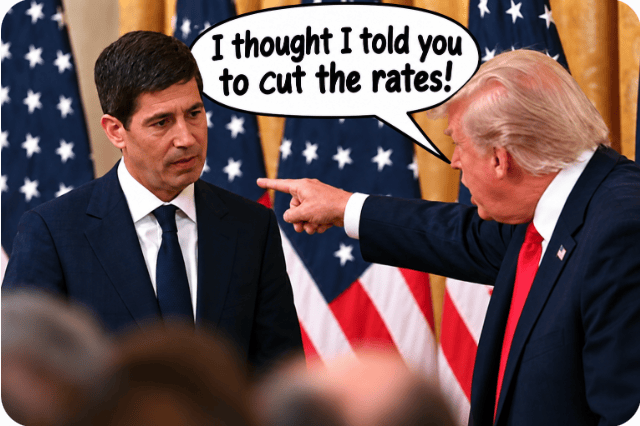
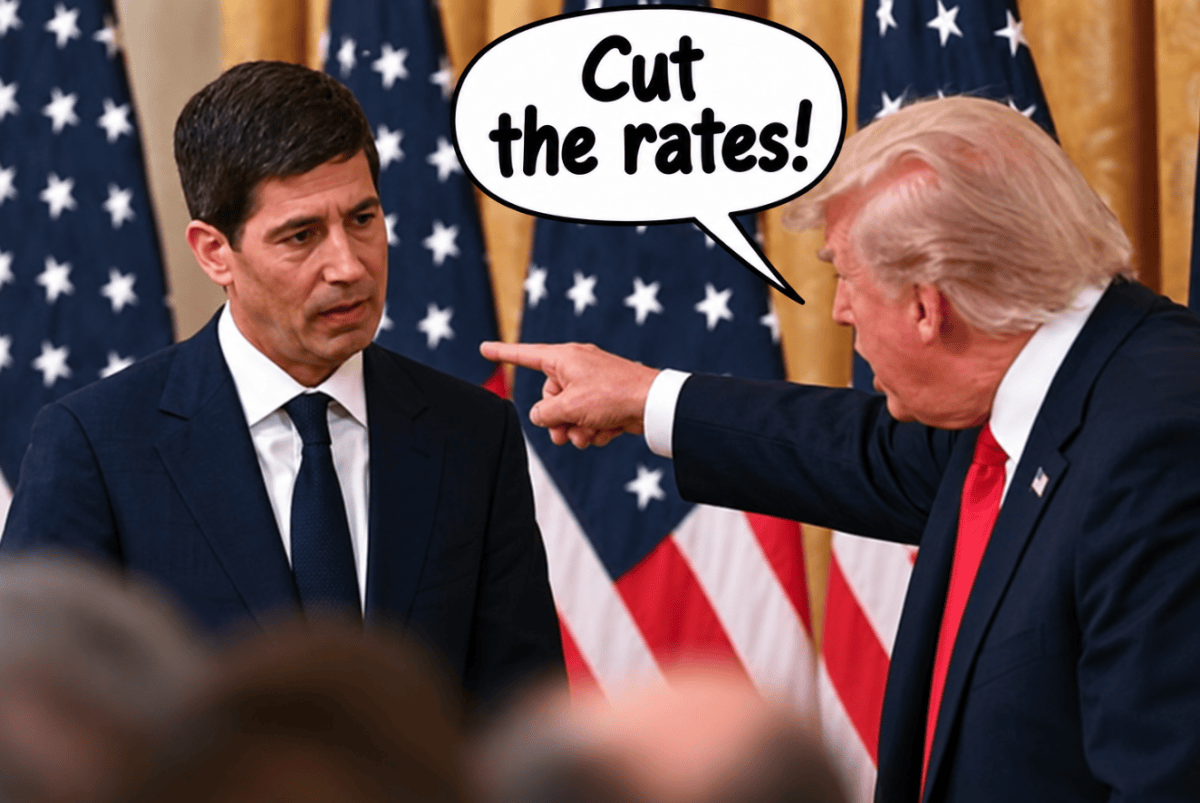
After the meeting of the committee in July 2025 when rates were unchanged the president posted “Jerome ‘Too Late’ Powell has done it again!!! He is TOO LATE, and actually, TOO ANGRY, TOO STUPID, & TOO POLITICAL, to have the job of Fed Chair.” It is in this institutional context that the unanimous vote to hold rates must be interpreted. The decision was not, in all likelihood, a reflection of the committee’s collective assessment of what policy the economic data warranted. Rather, it reflected the practical constraints under which the FOMC operates—constraints that are structural, not incidental.

I would have liked to have been a fly on the wall during the committee’s deliberations. The published minutes will offer only a sanitized summary, but I am confident that a significant portion of the discussion centered on what the models were actually prescribing—and the uncomfortable gap between those prescriptions and the committee’s intended action. Eleven of the twelve Fed models called for a rate increase. When I reviewed those results before the meeting, my immediate reaction was: “They would never dare.” The market reached the same conclusion, and so, evidently, did the Fed itself.

Taylor Rule Prescriptions and Model Evidence

The models underlying the FOMC’s internal deliberations, those of the market and those of academics are largely variants of the Taylor Rule, originally formulated by Stanford economist John Taylor in 1993. The rule provides a systematic basis for setting the federal funds rate as a function of two primary inputs: the deviation of inflation from its target level, and the deviation of real output (or unemployment) from its long-run potential. Formally, the rule prescribes a higher policy rate when inflation exceeds its target or when output runs above potential, and a lower rate under the converse conditions.

Given that inflation has persistently exceeded the Fed’s 2 percent target, virtually all Taylor Rule variants produce recommended rates above the current target range., some significantly so. A simplified heuristic—the “naïve” Taylor Rule—approximates the appropriate rate as current inflation plus two percentage points. At an inflation rate of 4 percent, this implies a federal funds rate of approximately 6 percent.

The naïve model that I use in my undergraduate class is:

However, Taylor’s original formulation is available from the Atlanta Fed’s data portal and is the one used in my Phd class:

https://www.atlantafed.org/research-and-data/data/taylor-rule

Of all the models surveyed, only one placed the appropriate federal funds rate within the current target range; the rest called for an increase, with one estimate reaching as high as 5.91 percent. Among the variants employed by the Fed, the Holston-Laubach-Williams (HLW) model—published by the Federal Reserve Bank of New York, whose president, John Williams, is a co-author—is perhaps the most widely cited. In its standard form, the HLW model prescribes a federal funds rate of 5.71 percent; the composite of all other variants yields 5.91 percent. When smoothing parameters and price-volatility adjustments are applied, these estimates decline to 3.69 percent (HLW) and 3.79 percent (composite)—with the adjusted HLW estimate falling just within the current target range of 3.50–3.75 percent. 

Detailed model outputs are available at:

https://fedagenda.substack.com/p/monetary-rules-report-b79

Implications and Outlook

The policy implications are significant. Should inflation fail to moderate in the coming months, the next FOMC meeting is unlikely to produce a unanimous decision. The structural divide between the Board of Governors—more exposed to political pressure by virtue of their being Washington-based —and the reserve bank presidents, who are institutionally more insulated, is likely to manifest more openly in the vote. 

For a comprehensive treatment of the current divergence between model prescriptions and Fed policy, see Matthew Schaffer’s analysis, “Nearly All Monetary Rules Say the Fed Should Raise Rates”:

More broadly, this episode reinforces longstanding concerns about the practical limits of central bank independence. When the Fed’s own quantitative frameworks call for policy tightening and the institution nonetheless holds rates steady, it is difficult to sustain the claim that monetary policy is insulated from political considerations. The most striking historical precedent remains the period in which the Fed maintained near-zero rates as inflation rose first to 4 percent and subsequently to 9 percent—a sequence widely regarded as a consequential policy error. Whether the current committee will demonstrate greater fidelity to its own analytical frameworks remains to be seen. 

Competing big brothers? The wisdom of Ayn Rand (and Stevie Wonder)

Competing big brothers? The wisdom of Ayn Rand (and Stevie Wonder)

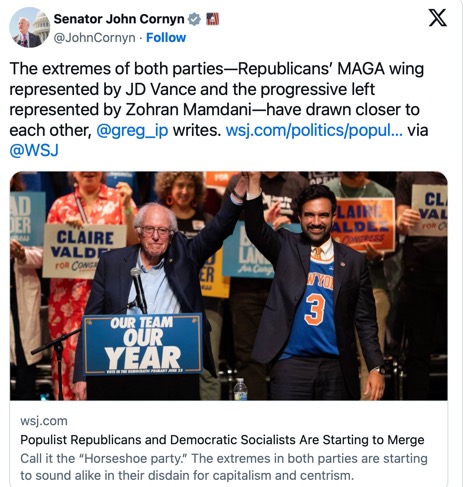
One of my closest friends to leans to the left mused “will we end up in a world controlled by competing big brothers?” What a question! Well, Trump’s populism on the right and the progressives’ populism on the left both end up with big government control. Trump wants to buy it while Bernie wants to expropriate it. This almost sounds like a version of Ayn Rand’s distinction between socialism and communism (see below) except Trump is socialism – lite.

Trump wants government involvement in industries that he deems vital to the national interest. Those companies are intimidated to sell and Trump or his cronies end on the boards overseeing executive decisions. Trump has gone where no president has gone before taking a personal hand in the Food and Drug Administration’s drug approvals, the Federal Trade Commission’s merger reviews and the Federal Communications Commission’s authority over broadcast licenses. Bernie must be envious. No conservative would even consider doing these things. The left keeps calling Trump and those on the right “Nazis.” That shows their ignorance because the Nazis were on the left – socialists (National Socialist German Workers’ Party). Doesn’t that sound Marxist? Of course it does because the Nazis, Marxists, fascists and socialists are all peas in much the same big brother pod.

Ayn Rand said it best:

There is no difference between communism and socialism, except in the means of achieving the same ultimate end: communism proposes to enslave men by force, socialism – by vote. It is merely the difference between murder and suicide.

The difference between socialism and fascism is superficial and purely formal, but it is significant psychologically: it brings the authoritarian nature of a planned economy crudely into the open. The main characteristic of socialism (and of communism) is public ownership of the means of production, and therefore, the abolition of private property. The right to property is the right of use and disposal. Under fascism, men retain the semblance or pretence of private property, but the government holds total power over its use and disposal.

Needless to say, under either system (socialism or fascism) the inequalities of income and standard of living are greater than anything possible under a free economy – and a man’s position is determined,not by his productive ability and achievement, but by political pull and force. Under both systems, sacrifice is invoked as a magic, omnipotent solution to any crisis – and “the public good” is the altar on which victims are immolated.

The social system based on and consonant with the altruist morality-with the code of self-sacrifice- is socialism, in all or any of its variants: fascism, Nazism, communism. All of them treat man as a sacrificial animal to be immolated for the benefit of the group, the tribe, the society, the state.

All “public interest’ legislation (and any distribution of money taken by force from some men for the unearned benefit of others) comes down ultimately to the grant of an undefined undefinable, non-objective, arbitrary power to some government officials. The worst aspect of it is not that such a power can be used dishonestly, but that it cannot be used honestly. The wisest man in the world, with the purest integrity, cannot find a criterion for the just, equitable, rational application of an unjust, inequitable, irrational principle.

It’s not that I don’t suffer, it’s that I know the unimportance of suffering. I know that pain is to be fought and thrown aside, not to be accepted as part of one’s soul and as a permanent scar across one’s view of existence.

There is only one institution that can arrogate to itself the power legally to trade by means of rubber checks: the government. And it is the only institution that can mortgage your future without your knowledge or consent: government securities (and paper money) are promissory notes on future tax receipts, i.e., on your future production.

Integrity is the recognition of the fact that you cannot fake your consciousness, just as honesty is the recognition of the fact that you cannot fake existence.

There is nothing wrong in helping other people, if and when they are worthy of the help and you can afford to help them.

I am opposed to all forms of control. I am for an absolute, laissez-faire, free, unregulated economy.

Capitalism is the only system in history where wealth was not acquired by looting, but by production, not by force, but by trade, the only system that stood for man’s right to his own mind, to his work, to his life, to his happiness, to himself.

Finally, remember Stevie Wonder’s “Big Brother”?

Big Brother

Stevie Wonder

Your name is Big Brother 
You say that you’re watching me on the telly 
Seeing me go nowhere 
Your name is Big Brother 
You say that you’re tired of me protesting 
Children dying every day 
My name is nobody 
But I can’t wait to see your face inside my door

Your name is Big Brother 
You say that you got me all in your notebook 
Writing it down every day 
Your name is I’ll-see-ya 
I’ll change if you vote me in as the pres 
The President of your soul

I live in the ghetto 
You just come to visit me ’round election time

I live in the ghetto 
Someday I will move on my feet to the other side 
My name is Secluded, we live in a house the size of a matchbox 
Roaches live with us wall to wall

You’ve killed all our leaders 
I don’t even have to do nothin’ to you 
You’ll cause your own country to fall

A Real Ceasefire? Or Just Another Cease farce?

A Real Ceasefire? Or Just Another Cease farce?

So we have a “ceasefire” with Iran. Previous “ceasefires” were more like cease farces with occasional attacks on our Gulf allies, the US firing on a ship and killing three Indian sailors, a few Iranian missiles lobbed at Israel with Israeli continuing operations in southern Lebanon against Hezbollah. Trump reportedly had a heated argument with Netanyahu telling him to stand down but in more colorful language. We don’t know what Netanyahu said back, but Israel’s Defense Minister Israel Katz told Trump to pound sand— the Israelis will stay in Lebanon “without any time limit” and will clear the Lebanese population from the areas it holds. So much for that.

Now comes a bilateral agreement between the US and Iran that leaves Israel out entirely. Of course the Iranians were never going to sit at the same table with the Israelis making the United States serve as Israel’s de facto proxy.  For the agreement to hold, Israel would presumably have to accept its terms. Yet that raises an equally difficult question: would Israel be expected to withdraw from southern Lebanon, leaving Hezbollah’s military infrastructure intact and the security of northern Israel compromised threatening the lives of thousands of Israelis?

We don’t know the full terms. What we do know is that Iran will reopen the Strait of Hormuz and we will lift our blockade. Trump, never one to miss a moment, went full NASCAR on us: “Ships of the World, start your engines. Let the oil flow!” There are reports that the US will also release some of Iran’s frozen assets — which is interesting, given how loudly Trump criticized Obama for doing the exact same thing in his “peace” agreement. And let’s be clear about what this actually is: a 60-day truce, during which the two sides will try to hammer out a final deal. Where have we heard that before?

Iran has broken every agreement it’s ever made. You’d have to be an optimist to think this one will be any different. That said, there is one small reason not to be completely pessimistic. Iran’s military has been seriously degraded – even though they do seem to have an unlimited supply of missiles and drones. Breaking the agreement would likely cause Trump to go full UFC and really try to bomb them into oblivion – a prospect the Iranian leadership would be unwise to dismiss.

Whether Israel convinced Trump to enter the United States into the conflict remains a matter of debate. What is less debatable is whether Trump’s stated objectives have been achieved. Is Israel safer now that Iran’s military has been severely diminished? What about the nuclear threat and Iran’s capability of delivering warheads to Europe? Trump said that he was going to war with Iran to accomplish three goals: the destruction of Iran’s ability to wage war; stopping its nuclear weapons program; regime change and the liberation of its people. So when the final deal is signed – if it is signed at all – will any of these goals be accomplished? 

On the military side, Iran has been weakened militarily, which is good news for its Gulf neighbors. On nukes, Iran has always insisted its program was purely civilian and not military. Almost nobody believed them. Whether the program gets fully dismantled and whether Iran will accept real inspections, are still open questions. And regime change? Forget it. Regime change is not part of the agreement. In fact, when the ceasefire was announced, many Iranians took to the streets in protest — not against the government, but against the deal. Crowds chanted “death to the compromiser” – Foreign Minister Abbas Araghchi – who was called on to resign. A member of the Iranian parliament Mahmoud Nabavian called the agreement a “total loss.” Back here at home, I’d bet Tucker Carlson, Lindsey Graham and other war hawks are equally unhappy, pushing for the war to keep going until the Iranian government actually falls.

So does Trump get anything out of this? The Iranians have played seven US presidents and Trump has been no exception. The TACO label — “Trump Always Chickens Out” — has been following him around for a reason. His latest reversal came when he threatened to bomb and occupy Kharg Island to shut down Iran’s oil supply entirely, then backed off at the last minute claiming that more fruitful discussions were underway. A friend of mine said that threats are the only thing the Iranian regime understands, which is why Trump does what he does. Maybe. But couldn’t he make those threats quietly, instead of publicly, looking like he’s constantly backing down making him seen like a wuss?

It looks like Trump wanted one thing above everything else, to get the Strait of Hormuz open. And he got it. I suggested early on that if Iran just offered to rename it the Strait of Trump, this whole thing would have been over much sooner. But the broader problem hasn’t gone away. Iran will find a way to eventually get a nuclear weapon. I wonder why they haven’t just bought one or two from North Korea? And if Trump can’t get Israel to stop fighting Hezbollah in Lebanon, how does the deal survive? Iran seems to consider Hezbollah a core strategic asset and will defend it — and its foothold in southern Lebanon — no matter what.

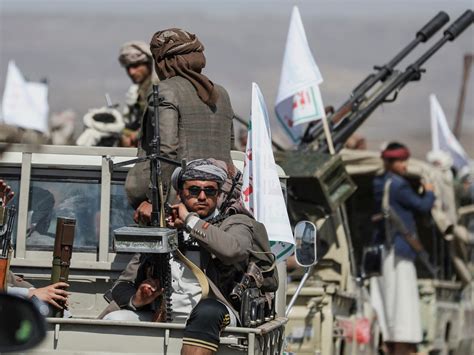
At a minimum, here’s what Trump should have demanded: no highly enriched uranium, with real inspections to back it up; limits on how much Iran can rebuild its military; a guaranteed open Strait of Hormuz; and an end to Iran’s support for its proxies — Hamas, Hezbollah, and the Houthis. After World War II, both Germany and Japan were forced to cap their military capabilities. The same standard should apply to Iran. And it should be made crystal clear: violate any term of the final agreement, and the bombing starts again — this time for real and no TACO.