Here is a big “no” to college football’s 24-team playoff
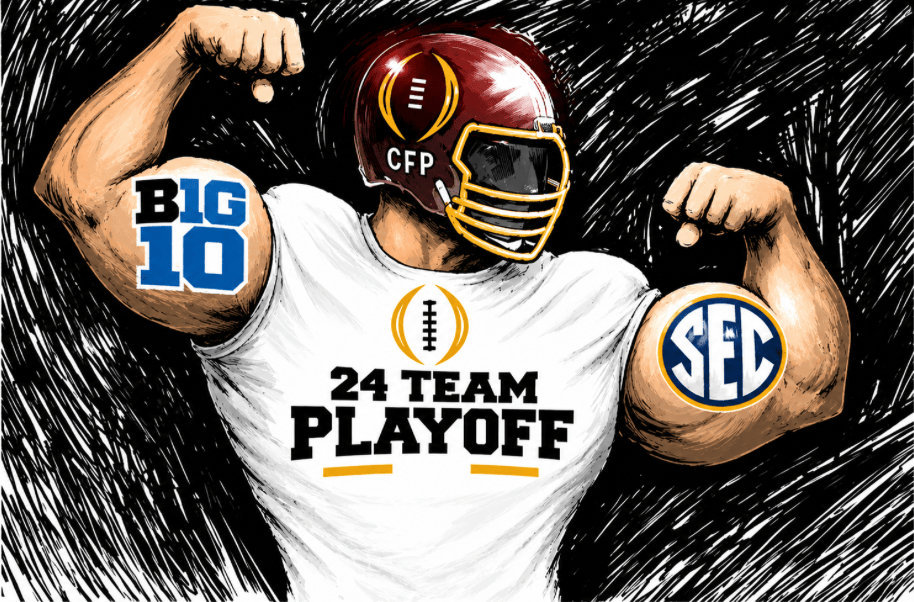
College football is expanding its playoff from 12 teams (we hardly knew you) to 24 for the 2027 season. Gee, I am old enough to remember when from 1998 to 2013 it was just the top two teams in the polls and we all yelled at the computer rankings. Then it went to four, and then to 12 in 2024. Now get ready for 24. When will it stop? Will it become like the basketball tournament, now with 76 teams? Twenty-four is designed simply to get more Big “10” and SEC teams into the playoffs, which may or may not also save some coaches’ jobs. Take Iowa, for example, which seems to be stuck with 7-5 and 8-4 records, neither of which would get it a sniff at a 12-team playoff. But lo and behold, its 8-4 record last year would have made the playoffs despite going 0-4 against AP Top 25 opponents. An invitation now being nothing more than a participation trophy. So we will get a bunch of mediocre teams from the Power Four conferences and maybe one lonely Group of Six team (I am pulling for Temple), and while we are at it, how about a little DEI with an HBCU team?
Now, no one (except the one lone rabid Iowa fan) would expect Kirk Ferentz’s team to compete for the championship. But the playoffs aren’t job security either, since Ferentz has been in the job since 1999 without winning a national championship and with only two Big “10” championships (2002 and 2004). He would have been fired long ago at most other Big “10” schools (James Franklin) and at the SEC schools (Mark Richt). Some have said that making the playoffs will mean job security for most coaches (other than Ferentz). But a coach who is consistently No. 24 won’t be long tenured (other than Ferentz who may outlast us all).
One of the byproducts of the new system is that there will be no more conference championship games. I guess if two or more teams are tied at the top, it is likely that all of them will go to the playoffs and be ranked by their final AP ranking like kids lining up by height for the class picture. (I was the second boy in line at my graduation. First was a midget.) I might be by myself here, but I liked the conference championships. Georgia may not have won the national championship last year, but it did win the SEC and bragging rights, even if it got upset in the playoffs by a Kiffin-less Ole Miss with a quarterback who played out of his mind. Likewise, Ohio State’s loss to Indiana (Indiana?) showed that the Hoosiers were no fluke and, in the end, a worthy national champion (Indiana?). Let that sink in.
But seriously, even in a 12-team playoff, there are probably three or four teams with about as much chance of being crowned champion as I have of being awarded the Nobel prize. So the first round of the 24-team playoff is a simple money grab paid for by ESPN’s multibillion-dollar contract. The first-round games will be on campus, with No. 17 at No. 16, No. 18 at No. 15, No. 19 at No. 14, and so on down to No. 24 at No. 9. Wow! I’m already clearing my calendar for that No. 17 at No. 16. Must-see TV.
With 24 teams in the playoffs, what happens to the Famous Idaho Potato Bowl, the Poulan Weed Eater Bowl or the Duke’s Mayo Bowl, where the winning coach gets doused in mayonnaise rather than Gatorade? Those bowls were devalued long ago anyway. There are so many of them that teams with losing records get invites, like a party where the host ran out of friends and started asking the neighbors.
Look, college football left me when conferences like the SEC went away from divisions. I came to the University of Tennessee in part because it was in the same division as my Georgia Bulldogs, and the two played every year in football and twice in basketball. I really didn’t have much interest in seeing the league expand to take in half of the Big 12. I would rather have seen it poach half of the ACC instead (Florida State, Miami, Georgia Tech — which used to be in the conference — UNC, Clemson, Virginia Tech and UVA). But those markets, except Miami and Atlanta probably aren’t big enough for the mighty SEC.
I guess the schools need the money to pay for NIL. One game I watched had a player who had been at five of the 18 schools in the Big “10.” I guess there wasn’t enough eligibility left for him to get to nine. Look, I will watch only Georgia, Ohio State and Tennessee. I have no interest in seeing USC play Rutgers — or any team play Rutgers including Ohio State.
Lastly, although some will argue that this will be a watered-down chase to a national championship, surprisingly I am not one of them. Whoever wins will be one of the same teams that would have won in a 12-team playoff. Recall that Ohio State won the first 12-team playoff in 2024 with two losses (to Oregon and Michigan — and yes, the second one still stings). The Buckeyes were the eighth seed (my Georgia Bulldogs were No. 2), but they made the expanded playoff and beat Tennessee, Oregon in a rematch, Texas and then Notre Dame in the championship game. No one would argue that that was a fluke.
One note: my neighbors went to Columbus for the Tennessee–Ohio State game. It was frigid, and Tennessee played like it had left its offense back in Knoxville. However, I was ashamed of my fellow Ohio State fans, who were ugly, cursing at and threatening my neighbors. I don’t recall anything like that when I was there from 1966 to 1970 — back then, the rudest thing you heard was the band playing “Hang On Sloopy” for the 40th time — and I apologized to my neighbors, who had to endure such abuse.
Now let’s see if James Madison wins the first 24-team playoff. Stranger things have happened. Indiana, for instance.