Reciprocal tariffs, Now I get it – I think
I have called Trump’s tariffs “stupid” and they are – maybe. I still don’t understand the across the board tariffs on Canada and Mexico which punish US car companies and reward the Japanese and the Koreans. If Biden did this I would speculate that Hunter probably had a hand in it. But Trump? Of course Trump has threatened a 100 percent on Chinese EVs but only put an additional 10 percent on Chinese goods. Why only 10 percent?
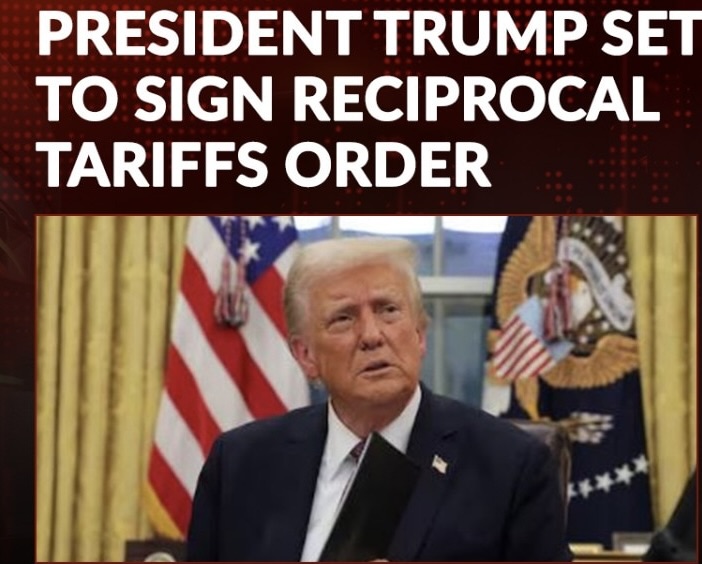
Trump’s trade representative Peter Navarro loves tariffs and is pushing for “reciprocal” tariffs. Although there is a bill in the House to give Trump the authority to impose these tariffs, Trump is likely to rush ahead and do it by executive order. What is a reciprocal tariff? They are tariffs on every country that trades with the United States that match any tariff levied on American goods exported to those countries. The White House released this statement:
“The United States has one of the most open economies and has among the lowest average weighted tariff rates in the world. The United States imposes fewer barriers to imports than other major world economies, including those with similar political and economic systems. For many years, the United States has been treated unfairly by trading partners, both friend and foe. This lack of reciprocity is one source of our country’s large and persistent annual trade deficit in goods — closed markets abroad reduce United States exports and open markets at home result in significant imports.”
Trump loves to say that the rest of the world is “cheating” us. He likely got the term from Navarro. The plan equalizes duties with virtually all U.S. trading partners If a country charges a tariff on the US it will receive the same treatment on its exports to America. Actually the US now only trails Brazil in the average tariff applied to all goods. Brazil is 8.5 percent and the US in now 7.5 percent. Does this mean that the US will lower rather than raise tariffs? The tariffs will be applied country by country. India imposes higher tariffs on American goods than America imposes on Indian goods. So look for import tariffs on Indian goods to go up until they are equalized with American tariffs on Indian goods.
You may recall that I had a conversation with Reagan’s most influential economic advisor who said that he had spoken to Trump about the tariffs. He insisted that the author of the Art of the Deal was using tariffs as a bargaining tool. He pointed out that at a G-7 meeting, Trump offered to lower all US tariffs to zero if the other countries reciprocated. None did. Now Trump is forcing their hands and using reciprocal tariffs as a negotiating tool. It is revealing that this threat was floated to coincide with the visit of Indian prime minister Modi. India imposes among the highest tariffs on selected American goods. Faced with reciprocal tariffs Modi is expected to agree to cut import tariffs on at least 30 products including cell phones, a 100 percent tariff on Harley Davison motorcycles and a 25 percent tariff on US automobiles. Top US exports to India in 2023 included crude oil and petroleum products ($14bn), LNG, coal, medical devices, scientific instruments, scrap metals, turbojets, computers and almonds. Trump wants them to buy more US arms and agricultural products to reduce the trade deficit currently at $45.7 billion. Chump change? But as Everett Dirksen famously said “A billion here, a billion there and soon it becomes real money.”
Trump is obsessed with the trade deficit which is $918 billion. However Trump is only concentrating on the trade deficit in goods and ignoring the trade surplus in services. In 2023, the US exported a trillion dollars in services and imported $750 billion with a trade surplus of $250 billion. Of course Trump even with reciprocal tariffs will not be able to eliminate the trade deficit with every partner. For example Viet Nam has very low tariffs of 1.1 percent. It has a trade deficit of $110 billion. Can this deficit be eliminated? It is doubtful given Viet Nam’s per capital income and small population. However, the country’s currency the dong has fallen to very low levels against the dollar making US goods more expensive and Viet Nam imports cheaper. Look out for Navarro to accuse the Vietnamese of currency manipulation. Will Melania ask Trump not to target Slovenia with its $5 billion trade deficit?
So I think I get it. Reciprocal tariffs are being used to equalize the tariffs between the United States and every country in the world. It is a bargaining tool if it impacts the foreign countries more than it does the United States. What is overlooked is that the US has a trade surplus with at least 25 countries. Afghanistan, Columbia, Lebanon, Morocco, Costa Rica, Peru, Paraguay, the Netherlands, Jamaica, Egypt, Qatar, the UK and Panama are some of the countries. Hong Kong is number one. Then do we lower our tariffs on these countries even if they have higher tariffs on American goods? No. If they impose a tariff on American goods then Trump will impose a tariff on theirs. Trade surplus be damned.
 haroldblackphd.com