More tariffs and rational markets?
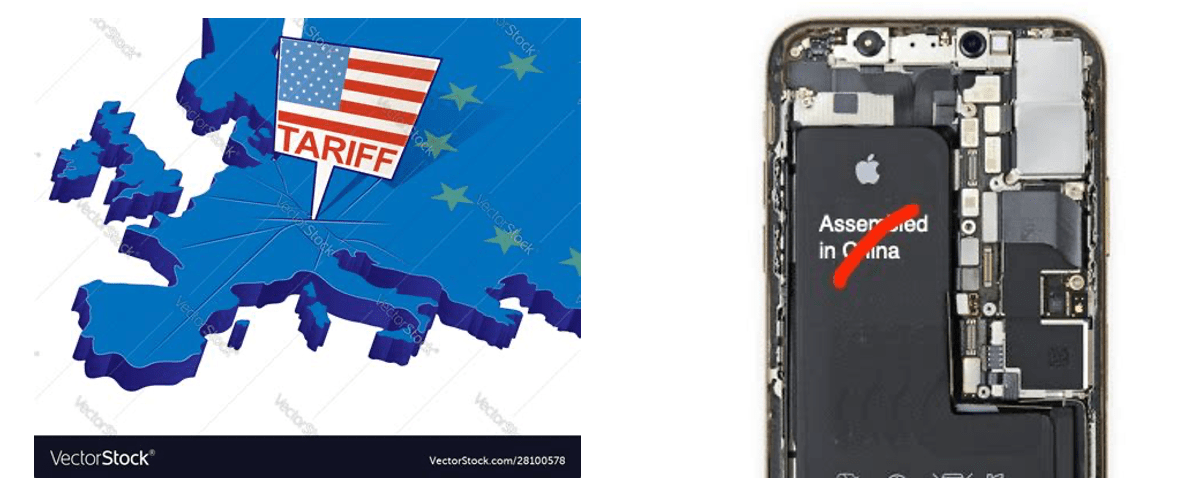
Ho hum. Trump threatened the EU with a new 50% tariff and Apple’s Tim Cook with a 25% tariff on iphones. Trump wants iphone production to be moved to the US while Cook has talked about moving it from China to India. Trump said that the new tariff would apply to all smartphones. It seems to me that if he wanted Apple to move its iphones to the US then he would only impose the new tariff on iphones. Wouldn’t that put more pressure on Cook who said that a US manufactured iphone would cost $3,500? This is disturbing to me and is against basic conservative principles. Has a president ever before threatened one company and one particular product before? Is this even constitutional?
Trump obviously wants the EU to do his bidding and is not open to negotiating. He has said “I’m not looking for a deal – we’ve set the deal.” Ironically, one of the main sticking points is that the EU wants tariffs cut to zero while Trump insists on preserving his 10 percent universal tariff. Trump also wants the EU to raise tariffs on China, which the EU refused to do. The EU’s trade “negotiator” responded “The EU’s fully engaged, committed to securing a deal that works for both. EU-US trade is unmatched & must be guided by mutual respect, not threats. We stand ready to defend our interests.” Lots of luck with that. There are 27 countries in the EU and Trump has different tariffs on each one of them. So how are they going to divide up who buys what and how much from the US? Lastly, at its core trade is between private parties and not governments. Trump rails about trade deficits but in the absence of demand from citizens how are those deficits to be addressed? Maybe he wants governments rather than their citizens to buy more US manufactured goods? Boeing jets anyone?
Pardon me if I find all of this tiresome. Apple is not going to move its iphone production to the US. It will cost over $30 billion over three years just to shift 10 percent of its production to the US. Apple will wait out Trump. It would be foolish to do otherwise and Tim Cook is no fool. The EU is not going to bend to meet all of Trump’s demands either. It is going to somehow have to manage its 27 members. It is not going to back down on its ban of GMO produce and hormone infused poultry and beef. It is not giving up its value added taxes either. A less strident Trump would settle on lowering tariff barriers rather than trying to impose demands on sovereign countries. But the real reveal is that Trump does not want free trade. Trump does not want fair trade. Trump really wants no trade – or at least sharply restricted imports.
Rational Markets?
To all finance professors, I have some good news and some bad news. All this tariff chaos is great fodder. It is an exciting time to be in the classroom relating what is being taught to what is happening in the “real” world. It fills the news and if the students are remotely interested in learning – and a few of them are – it presents the opportunity to talk about Adam Smith and mercantilism and Trump and his tariffs. However the bad news is the stock market. Finance teaches that markets are rational. It is hard to ascribe rationality to all of the gyrations in the market. Trump is the exogenous force roiling markets. The markets may be rational but the president is clearly not. If Trump imposes new tariffs, the market goes down. Then when he changes his mind and pauses the exact same tariffs, the markets rebound. Clearly there are times when the markets seem rational but this is one of the times when it seems that they are not.
So what is a professor to profess? I tell students that there are various investment strategies at play and at times one may dominate the others. Consider a Warren Buffett strategy in which one purchases a firm’s stock based on its underlying value. This will result in a mostly buy and hold strategy. Another method is one of a day trader who will try to buy low and sell high as stock prices move during the day. This is pure speculation. Then there is the circumstance where markets are rational but some investors are not. These may be the individual investors who are playing the market and seemingly buy at the wrong time and sell at the wrong time creating market volatility. Thus, one could argue that the market is rational but at times investors may not be. As such it is interesting to parse what is happening with the gyrations in stock markets and in the market for bitcoin.
 haroldblackphd.com