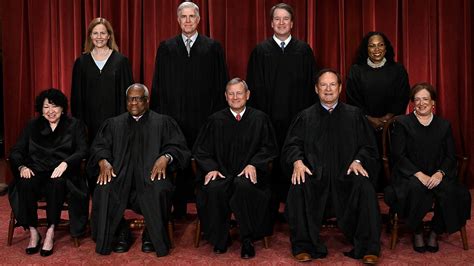
Supreme Court rules against Trump on deploying the National Guard
The Supreme Court has ruled by a 6-3 vote that the president cannot deploy national guard troops in Chicago to protect immigration officers and their facilities from protestors. The ruling rests on the interpretation of the law 10 US Code §12406. That law says the president can call the national guard into federal service if
(1) the United States, or any of the Commonwealths or possessions, is invaded or is in danger of invasion by a foreign nation;
(2) there is a rebellion or danger of a rebellion against the authority of the Government of the United States; or
(3) the President is unable with the regular forces to execute the laws of the United States.
The litigation in the case has revolved around the third point and the words “unable” and “regular forces.” What is mean by “regular forces.” Does this mean those who are enlisted in the armed forces rather than the weekend warriors in the national guard? Trump’s lawyers argued that regular forces did apply to the national guard while the opposing attorneys argued otherwise. The six supreme court justices said “We conclude that the term ‘regular forces’ in §12406(3) likely refers to the regular forces of the United States military. This
interpretation means that to call the Guard into active federal service under §12406(3), the President must be ‘unable’ with the regular military ‘to execute the laws of the United States.’” Of course the use of the armed forces domestically is restricted. The Posse Comitatus Act prohibits the use of the regular armed forces “to execute the laws” except in situations where it is “expressly authorized” by the Constitution or an act of Congress. Alito, Thomas ad Gorsuch dissented with Alito and Gorsuch penning their objections. Alito said that the president’s “inherent constitutional authority to protect federal officers and property” should be “sufficient to justify the use of National Guard members in the relevant area for precisely that purpose.”
In the lower courts there were arguments as to how much violence and disruption in the protests would be enough to warrant military intervention. That appeared to be the issue with Alito. However, one wonders if an Antifa like protest that occurred in Seattle was transpiring where facilities were torched and ICE officers injured would there be sufficient cause to invoke Section §12406(3). Also, since I don’t know the law, I wonder if the FBI or the Marshal’s Service or other federal law enforcement officers could be deployed to protect ICE and its facilities?
Finally, in those states where the governor concurred with deployment like Tennessee and Louisiana, the governors call out the guard rather than the president. I presume that if ICE facilities were endangered and the governor called out the guard, then that would be legal. But what of states like Washington, Illinois and California where the governors are hostile to ICE and hate Trump? How is ICE sufficiently protected in those states? Perhaps the attorneys who read this blog can provide an answer. Finally, I presume that if the president went to the Congress for the authority to use the national guard and it were granted (fat chance it would get 60 votes in the senate), then the guard could be legally deployed without the consent of the governors.
 haroldblackphd.com
Sanctuary cities are rebelling against the federal immigration laws, which would correlate with your No. 2 reason for calling out the National Guard.
LikeLike
While I agree I doubt if the courts would. However if there was a series of violent attacks maybe they would. Glad you are commenting again. Hope you have a great New Year.
LikeLike
Just a few thoughts.
How many readers objected when military were called out to be present as schools during integration?..
….this present case in Chicago : did the National Guard go to South Side Chicago, where the real danger is – or stay where the deep dish pizza is?
Where were the Regular military on January 6 th?
Are National Guard focused on intercepting Capris- or do they also aim their guns at Teslas?
Is there any objections to the traitors – whom the military felt assured these people would never shoot at their own countrymen- known as the Founding Fathers?
This decision is really in line with how the SCOTUS operates : not everybody gets everything they want. Otherwise that would mean a corrupt court and nation.
LikeLike
Excellent point. But not the readers objecting. When the guard was called out by the president during the integration of the public schools in Little Rock and the universities at Alabama, Mississippi and Georgia what would this court have ruled?
LikeLiked by 1 person
I will second your request. Maybe a reader who knows law would combine law and history.
LikeLike
I will add that I recall the states you mentioned, as being Dems; and the Presidents were Dems.
What if a Democrat President called troops on what is now Republicans states? .,
What would the courts do, if the states were Ruby Red? Let’s hope the same ruling.
LikeLike
Kennedy was president in 1962 (UGA and Ole Miss). Johnson was president in 1963 (Alabama). But Eisenhower was president in 1957 (Little Rock).
LikeLiked by 1 person
Yes, and I did get a messg fm someone not in the discussion telling me that. Which just makes the discussion even deeper- and indicates nothing special about Trump.
LikeLike
Agree with the comment above that #2 would seem to provide the necessary clearance to utilize the National Guard, Army, FBI, ATF or school crossing guards if needed. If a president’s main role is to defend against all threats, foreign and domestic, then it seems there is confusion over what constitutes a threat?
LikeLike
I have the feeling that this will be decided on a case by case basis.
LikeLike