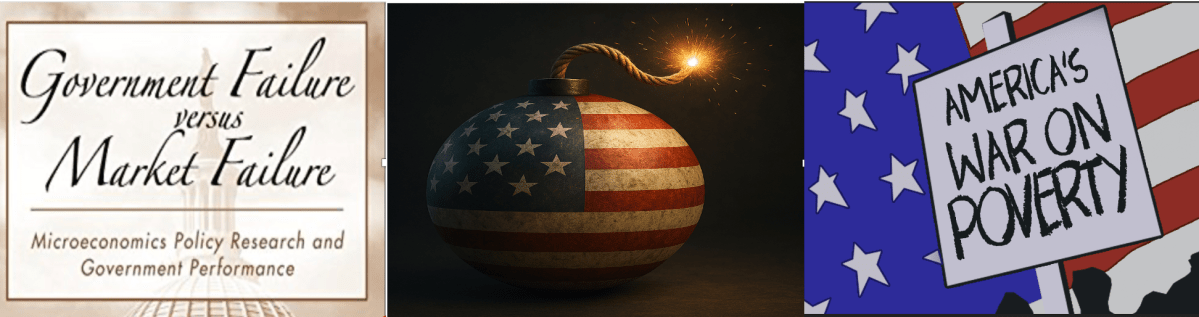
Munger on government failure. Powell on the debt. Are the poor really poor?
Munger on market failure and government failure
One of my favorite scholars is Duke’s Michael Munger, a leading thinker in the area of Public Choice. I have published several papers in that area but am no expert there. Munger was gracious enough to be the keynote speaker in the conference honoring my research – the “Dr. Harold A Black Academic Conference” sponsored by the business schools of the University of Tennessee, Middle Tennessee State University and the University of Tennessee at Chattanooga held on September 8-10, 2022 at UTC.
I have written before that the left hates everything big – big pharma, big business, big oil, big tech – except big government. However, big government is more likely to experience “failure” than the market. Yet the left ignores that reality. BTW, when economists talk about market “failure” it is in the context where the market cannot price the product efficiently. One instance would be neighborhood streets. Should they be paid for by only those in the neighborhood who would erect a toll booth at the entrance for visitors? Or should they be paid for out of the general tax fund – by people who would never use them? What about government failure? As one text frames the issue “Imagine a world where government intervention always fixes problems perfectly—where every regulation hits its target, every policy achieves its goal, and every bureaucrat works solely for the public good.” That word does not exist because government can fail too. In a recent publication Munger explores government failure and writes:
“I work and write in the field known as public choice. Public Choice began as an antidote to the naïve application of the “market failure” paradigm in which deviations from perfectly competitive markets always led directly to inefficiencies that markets themselves could never solve. This view was unchallenged in the 1950s and 1960s, and it worked to identify (mostly legitimate) problems with private, decentralized commercial processes. Markets are not perfect, so state action is required.
What was missing was any any theory of government failure. Under what circumstances—if ever—would state action likely be counterproductive? Government policy results from the digestion of imperfect inputs: the rational ignorance of voters, the concentrated interests of organized groups, and the principal-agent failures of unaccountable bureaucracies. Why would we expect imperfect government control and direction to be better than imperfect markets? This concern extended worries about market power to concentrations of power more generally.”
His essay can be found at
Highly recommended.
Jerome Powell admits that the debt is not sustainable
Its about time. Jerome Powell admits that the debt is not sustainable. In a lecture at Harvard, Powell doesn’t actually say that the $39 trillion debt is unsustainable but is on a path that is unsustainable. Powell, like everyone else, has no idea when it will become unsustainable but knows that one day it will be. Powell said “What’s clear is that our debt is growing much faster; the federal government debt is growing substantially faster than our economy. And that ratio is going up. And in the long run, that’s kind of the definition of unsustainable.”
With the interest on the debt growing to over $1 trillion, times a’wasting. Consider that in 2020 the interest payments were “only” $345 billion. But the explosion of federal spending under Biden and now Trump is rapidly turning the debt burden into a serious problem. Powell reminds us that fiscal policy is not the Fed’s job. However, the Fed has been a co-dependent to the Congress and engaged in monetizing the debt (purchasing Treasurys directly from the government) which aids and abets the increase in the debt when markets are reluctant to acquire more of the Treasury securities. Can the Fed just say no?
Powell points to the notion advanced by Ronald Reagan that the debt burden can be addressed not simply by paying down the existing debt but by growing the economy faster than the growth in the debt. But that has not happened for a number of years. This is nothing new. Even Janet Yellen warned that the
ever growing debt could reduce the Fed’s ability to address unemployment and inflation but restraint does not seem to be in Congress’s vocabulary. So although Powell does not know when we will arrive at that tipping point, he did say “It will not end well if we don’t do something fairly soon.”
The War on Poverty slowed down the reduction in poverty
Speaking of government failure, what was the purpose of the “war on poverty?” Liberals will say it was to help assist those in poverty. Conservatives will say it was to sap the incentives for the poor to extricate themselves from poverty and make them dependent wards of the state. Turns out that both are correct. Johnson’s war on poverty was supposed to aid the poor. It did but not surprisingly it also provided disincentives for the poor to leave poverty. Research has shown that from 1939 to 1963, poverty fell by 29 percentage points from 48.5 percent to 19.5 percent. After the introduction of the war on poverty, despite sending $20 trillion, from 1963 to 2025 poverty fell by only 15.7 percent.
Here poverty is measured in market income which includes income in kind (cash and noncash payments). Currently the most common measure of poverty overstates it and Sen. John Kennedy (R-LA) has proposed to change that. Currently, the poverty statistics exclude transfer payments and state that poverty is at 11 percent. But after including transfer payments and health insurance subsidies that number falls to 1.6 percent!
Of course the poverty industry will howl if the new, more accurate definition were adopted. But as Robert Rector has pointed out for years, that the poor are actually not very poor. They would be middle income in most of Europe and higher income in the rest of the world. Ninety-five percent of American households below the poverty line have electricity, indoor plumbing, a refrigerator, a stove, and a color television. More than 80 percent have an air conditioner, two-thirds own a washing machine and dryer. Everyone seems to have a cell phone. You want to see poverty? Then go to India, China, most of Africa and South America.
An excellent paper on this subject is Tyler Turman’s, “Measuring poverty correctly reveals a hard truth about the welfare state.”
Highly recommended.
 haroldblackphd.com