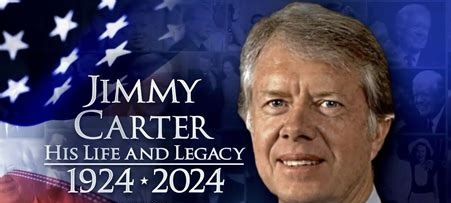
Jimmy Carter: An Appreciation
A right wing daily had the headline “20th Century’s Worst President Dead at 100”. Worst president? Not even close. I guess the author has forgotten about Woodrow Wilson (my number 1), Herbert Hoover, Warren Harding, Calvin Coolidge and possibly George W. Bush. Of course I am not terribly fond of Franklin Roosevelt or Lyndon Johnson either. I do like Harry Truman, Dwight Eisenhower and Ronald Reagan. George H. W. Bush ruined the Reagan legacy. I will never forgive Ronald Reagan for not having Jack Kemp as his vice president. Bill Clinton did some good things but was a sexual predator. Barack Obama was too obsessed with apologizing and grabbing power to be an effective president. But back to Jimmy Carter.
Carter was president during interesting times. He inherited a lousy economy, one with double digit inflation and double digit unemployment. The economic woes were a direct consequence of the OPEC induced oil crisis which precipitated the fall of the Shah of Iran and led to the Ayatollahs. He was late in addressing the economic crisis. His first mistake was to appoint G. William Miller as head of the Fed. Miller knew nothing about monetary economics. A friend of mine who was a senior economist at the Fed said that if anyone was hung over he could quickly sober up by going into Miller’s office. One publication said that Miller commented that when he arrived at the Fed and was confronted with the various theories of money and their relationship to the economy that he studied the theories and after a couple of weeks had them down pat. Carter, thankfully, replaced him with the chairman of the New York Fed, Paul Volcker. Volcker told Carter that to get out of the economic situation – called stagflation – that he would have to induce a recession. The Fed raised the Fed Funds rate to 17.5% (it is now 4.25%). The economy went into a recession but came out of it rather quickly – but too late to save Carter’s presidency.
Carter’s main foreign policy focus was on the Middle East. Perhaps his greatest achievement, and a controversial one, was the Camp David Accords. This agreement between Egyptian president Anwar Sadat and Israeli prime minister Menachem Begin was the first to establish peace between the two adversaries. It earned all three the Novel Peace prize. Although criticized by people in both countries, it did remove a major barrier to peace between the two nations. Carter, however, was no fan of Israel and favored a Palestinian state. He never wavered in that belief although roundly criticized by Israeli supporters.
The aforementioned fall of the Shah led to the Iranian hostage crisis which left Carter paralyzed in his actions. He literally did nothing. One reporter asked Bess Truman what would Harry have done and she relied that she didn’t know but she knew that he would have done something. The hostages were freed after Carter lost his reelection bid to Ronald Reagan. But Carter did do something but it failed. There was a rescue effort by the US military that ended in a helicopter crash costing eight lives. This further damaged Carter politically.
Carter also gave the Panama Canal to Panama. Although built by America in 1914 and administered by it through the years, Carter saw fit to give it to Panama to lessen criticisms about American imperialism in the hemisphere. Trump now of course wants it back. Carter was also faced the Mariel Boatlift in 1980 where Castro released 125,000 criminals and psychiatric patients and sent them by boat to the US.
Then there was the Russian invasion of Afghanistan. Carter then levied trade embargoes and heavy sanctions on the Russians. He then canceled the participation of the US team in the Moscow1980 Olympics. The Russians played tit for tat and canceled their participation in the 1984 Los Angeles Olympics. Eventually Carter and Soviet leader Brezhnev signed the SALT II treaty setting limits on nuclear weapons.
For us craft beer lovers, Carter was in essence the father of craft beer. Though a teetotaler, Carter signed into law the legalization of home brewing. Prohibited since Prohibition, Carter perhaps influenced by Georgia moonshiners like my great grandfather Milous Towles, in 1978 signed a law stating that any adult would be permitted to “produce wine and beer for personal and family use and not for sale without incurring the wine or beer excise taxes or any penalties” for up to 200 gallons brewed. Home brewers like Samuel Adam’s Jim Koch credits Carter with sparking the microbrewing industry. He is hailed as a hero by that industry..
Carter is also credited with saving NASA’s space station program. Carter was no fan of NASA and said that the space station was a mere contrivance to keep NASA alive. Yet Carter, for reasons that are not clear, rescued the shuttle by giving NASA the resources needed to see the project through to its inaugural launch in 1981and provided $200 million in additional funds in 1979 and an extra $300 million the following fiscal year.
One of Carter’s shortcomings was his frosty relations with the congress. His closest aides were from Georgia like my classmate Hamilton Jordan, and although his vice president was Walter Mondale, Carter maintained himself as an outsider. He also had frosty relations with the snooty White House press corps which looked down its collective noses at the Georgian with the Annapolis, rather than Ivy league, degree. They were especially rude to Rosalynn who graduated not from Yale but from Georgia Southwestern College in my Dad’s hometown of Americus. Once at a White House function, a writer on the society page of the Washington Post scoffed at only sweet tea being served. Rosalynn’s remark was that this was her house and in her house there is only sweet tea. The cartoonist at the Washington Post was no fan either running a cartoon depicting Carter and Hamilton Jordan walking into a room that showed all the polls with the caption “Let’s see what our policies are today!”
Carter was also the first diversity and inclusion president. Note that the “E” is missing. The Georgian was a staunch civil rights advocate. Unlike Lyndon Johnson, Carter meant it. I was told that he instructed the recruiters in White House personnel that he wanted a qualified black on every appointed regulatory board in Washington. Note the use of the word “qualified.” That led to my being contacted by the White House to come to Washington to interview for an appointment to the first National Credit Union Administration Board. I was then on the faculty of the University of North Carolina, Chapel Hill. On the call, the recruiter said that I had been recommended by the then chairman of the now defunct Federal Savings and Loan Insurance Agency who happened to have been my next door neighbor when I had been at the Comptroller of the Currency. Given that the law stated that the board had to be bipartisan and two of the three seats were already slotted for democrats, he said that I was perfect: a black scholar whose research and experience was in financial institutions and who was not a democrat.
Although Carter is thought of as a liberal, he was in fact one of the most market oriented presidents. He was no liberal. He was a champion of deregulation. Unlike most democrats Carter led efforts to deregulate the airlines, trucking, railroads, energy, communications and financial institutions. Phil Gramm – my old economics tutor at Georgia – writes in the Wall Street Journal, “The Airlines Deregulation Act of 1978, the Motor Carrier Act of 1980 and the Staggers Rail Act of 1980 unleashed competition and spawned the invention and innovation that gave America the world’s most efficient transportation and distribution system. The cost of flying a mile declined by half and air travel became a mainstay of American life. The logistical cost of moving goods shrank as a share of gross domestic product by 50%.” “The Carter administration began oil-price deregulation using its regulatory powers and set in place the gradual deregulation of natural-gas prices with the 1978 Natural Gas Policy Act.”
Carter also signed the most sweeping banking deregulatory act in history, the Depository Institutions Deregulation and Monetary Control Act of 1980. That act enabled institutions other than banks to issue interest bearing checking accounts, deregulated interest rate ceilings on credit union loans and allowed certificates of deposits. The act called for a gradual phase out of the interest rate restrictions over a six year period. I helped write the act and have a thank you note from Carter along with a pen used to sign the act. I was also appointed to the Deregulatory Committee charged with the interest rate phase out. Paul Volcker was the chairman of the committee. At the first meeting I suggested that we phase out the constraints immediately because the system did not need six years to adjust. My motion died for lack of a second. However, at NCUA we were able to raise the interest rate ceiling immediately rather than over six years.
What Carter did was to make Reagan’s first term easier than it otherwise would have been. Deregulation made businesses more flexible. Although there was a crisis in the savings and loan industry, that crisis occurred because the institutions could not adapt their balance sheets quickly enough to avoid bankruptcy. As a result, their federal insurance agency, the aforementioned Federal Savings and Loan Insurance Agency was merged into the FDIC. I was appointed as one of four public interest members of the committee that oversaw the merger.
Much has been written about Carter after his defeat. He went back home to Plains and became active in Habitat for Humanity, for which he received well deserved praise. Unlike some other ex-presidents, he did not seek to enrich himself. Yet all was not praise. Carter meddled in foreign affairs and was criticized as being antisemitic for his views on Israel. Again, his presidency was one of interesting times. He probably faced more adversity than any peacetime president since Herbert Hoover. He was the most pro deregulation president in history. Ok To call him the worst president of the 20th century just shows blind prejudice and is clearly false.
Rest in peace Mr. President.
 haroldblackphd.com
We’ll agree to disagree. I lived thru his administration and was totally disappointed. His performance with economics, energy, foreign policy, Olympic boycott, and welcoming home Vietnam deserters (scott free) left a bad taste. Capped by his malaise speech which was the most depressing speech I think I’ve ever heard. Nope I believed he was the worst until Obama. And then Biden blew past all.
Happy New Year, BTW.
LikeLike
Thanks as always. I wanted to give him credit where deserved. Times were different and interesting. I thought the criticisms had drowned out the positive. Happy New Year to you too.
LikeLike
Very perceptive, much more detail than is available in the major media.
LikeLike