Crypto 101
Do you understand cryptocurrencies? I don’t but as a professor teaching a class on financial markets, I feel obligated to make intelligent clucking sounding noises to the students even on subjects that I know little about. Here is my lecture on cryptocurrencies.
I cannot understand why anyone would want to buy and hold cryptos. When they first came on the scene I thought they were just a vehicle for money laundering. Of course, I was right but apparently they are useful for something else – but what? Some have touted crypto as the new gold and would act as a store of value and would protect against inflated government money. But crypto has proven to be no store of money. Its price is volatile and recently has been moving in the opposite direction as gold.
But what is crypto? It is a digital or virtual currency secured by cryptography, which supposedly makes it nearly impossible to counterfeit or double-spend. Most cryptocurrencies exist on decentralized networks using blockchain technology—a distributed ledger enforced by a disparate network of computers.
Cryptos at first were not issued by governments making them free from government control, interference or manipulation. However, governments soon started attempting to regulate cryptos, to adopt them and even to issue them.
There is now a digital yuan – the digital renminbi. Will there soon be a digital dollar? Some countries like Argentina, Brazil and Vietnam have high holdings of cryptocurrencies among their populations. Over a third of the citizens in those countries use crypto in day to day transactions. Countries that do are mostly ones with high economic instability. Argentina instituted a new cryptocurrency touted by its president which later crashed resulting in millions of dollars in losses and charges that the president somehow profited from the crash. The Trump Administration has created a strategic Bitcoin Reserve that will treat bitcoin as a reserve asset and a Digital Asset Stockpile, consisting of digital assets other than bitcoin owned by the Department of Treasury that was forfeited in criminal or civil asset forfeiture proceedings. Why? Again, I haven’t a clue. By the way, the market is clueless as well. However, the government will not buy crypto and will only hold (hoard?) what it only seizes.
What are the advantages of cryptocurrencies? You can’t hide them from the government. Governments monitor blockchains which are cryptos’ public ledgers. Crypto exchanges are regulated by the SEC. You have to pay taxes on them because the federal government treats them as property for tax purposes. The IRS considers them either as capital gains or ordinary income depending on how long you hold the cryptocurrency. Cryptocurrencies are price volatile, have high energy consumption for mining activities and are used in criminal activities. They also have been hacked and stolen – most notably by the North Koreans.
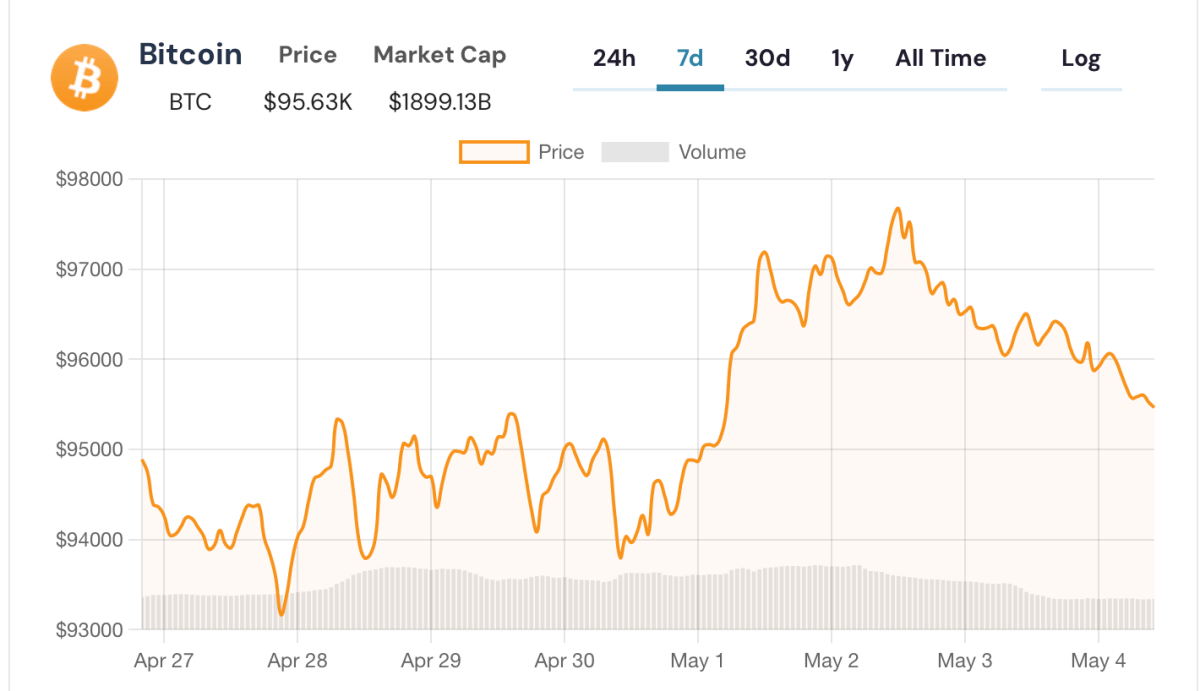
In finance we associate volatility with risk. The more volatile is the price of an asset, the more risk associated with it. Bitcoin, the most popular crypto, has had over 15 major corrections (extreme movements in price) over the past 15 years but each time recovered with an even higher price with a beginning to end gain of over 40,000 percent! Remember when it was $105,000 per coin before falling to $84,000 and then surging to $94,000? Perhaps the volatility has to do with the nascent nature of crypto. It only has been around 15 years or so. All new markets tend to be volatile as new products enter and new participants enter. Maybe when the market matures, that the price volatility will lessen. Finance calls this type of risk “idiosyncratic” or “unsystematic” which is risk unique to the asset and not to the market (which is called systematic risk).
Central to the appeal and functionality of Bitcoin and other cryptocurrencies is blockchain technology. As its name indicates, a blockchain is essentially a set of connected blocks of information on an online ledger. Each block contains a set of transactions that have been independently verified by each validator on a network. Every new block generated must be verified before being confirmed.
What about “mining?” First off, crypto mining is not environmentally friendly. Bitcoin mining exposes millions to harmful air pollution each year. There is significant greenhouse gas emissions from Bitcoin mining, which requires vast amounts of electricity. The noise levels of the cryptocurrency mines has reached 72 decibels — well above the 55 dB limit beyond which the World Health Organization (WHO) deems to be dangerous for human health. China banned cryptomining in 2021 causing the amount of mining operations to explode worldwide. In the United States crypto mining consumed an estimated 36 billion kilowatt-hours (kWh) of electricity, as much as all of the electricity consumed in Maine, New Hampshire, Vermont, and Rhode Island put together.
Using powerful computers, crypto miners solve complex mathematical problems that are required to validate transactions on the blockchain. Blockchain networks serve as a public ledger for all transactions, promoting transparency. One expert says “This competitive process rewards successful participants with newly generated tokens while maintaining the integrity of the decentralized system. Essentially, mining combines network security with financial incentives in a technological ecosystem designed to operate without central authority.” The upfront capital needed for mining equipment, access to cheap electricity, and reliable internet infrastructure can be prohibitive and the mining ecosystem is increasingly dominated by industrial-scale operations established in regions with lower electricity costs. But what of the costs? Mining for cryptocurrency may no longer worth it. According to a recent study, the cost of electricity and computational power needed to mine for Bitcoin now often exceeds the actual value of the coin.
That is interesting. Some have said that one of the positive features of Bitcoin was that its supply is limited unlike that of government fiat currencies. For Bitcoin it is 21 million coins. However, this only limits Bitcoin because other coins can easily be created and most do not have limits on supply. New coins are added to the Bitcoin supply approximately every 10 minutes, which is the average amount of time that it takes to create a new block on the Bitcoin blockchain. By design, the number of bitcoins minted per block is reduced by 50% after every 210,000 blocks, or about once every four years. Whew! If the supply of bitcoin ever reached 21 million then no more can be generated meaning that bitcoin miners could only earn income from transaction fees.
Although bitcoin is the most famous cryptocurrency there are many others. At https://coinmarketcap.com/coins/ you can find the top 100 cryptocurrencies. However, missing from that list are the memecoins which point to the absurdity of cryptocurrencies. A meme coin is a cryptocurrency arising from a joke or some humorous characteristic. The first memecoin was s–tcoin (I kid you not) which has a market cap of $116,000 https://coinmarketcap.com/currencies/shitcoin/
There is the Doge coin (sound familiar?) and the ever popular Fartcoin (again I kid you not), Some memecoins have high market capitalizations. Ask yourself, why would anyone buy a Fartcoin? Dogecoin was released after being created as a joke. But then Elon Musk tweeted that Tesla-branded merchandise could be purchased with Dogecoin. Is this where the name “Department of Government Efficiency originated? Both the president and the first lady have their own memecoins. The meme coin $Trump has a market value of $2.5 billion. First lady Melania Trump also has a meme coin with a market value of $224 million. Recently, the president tweeted “Whichever 220 users hold the most Trump tokens between now and May 12 will get an exclusive invitation to a dinner attended by the President”. The result was that the president netted $900,000 in trading fees over a two day period. Georgia senator Ossoff says that this is grounds for impeachment. But for this president, what isn’t?
 haroldblackphd.com
I have yet to understand the intrinsic value of crypto. Its an imaginary value that costs an enormous amount of electrical energy to “mine”. I see no value unlike precious metals which have value in manufacturing industries through a myriad of products. So I refuse to invest in it.
LikeLike
Thank you for this essay. This is the global world’s currencies. We get to have the same unbacked currency as Communism… And I get to point to all the phony patriots who talk about the flag, but clearly reject bills and coins that represent our history, ideals and God. Don’t go to Cruz IceCream and expect to pay money- you just get in the way of their busy lines. They like cards, and soon they will prefer Global currency. Maybe they will scan your forehead?
LikeLike