The monthly jobs report or how to lie with statistics
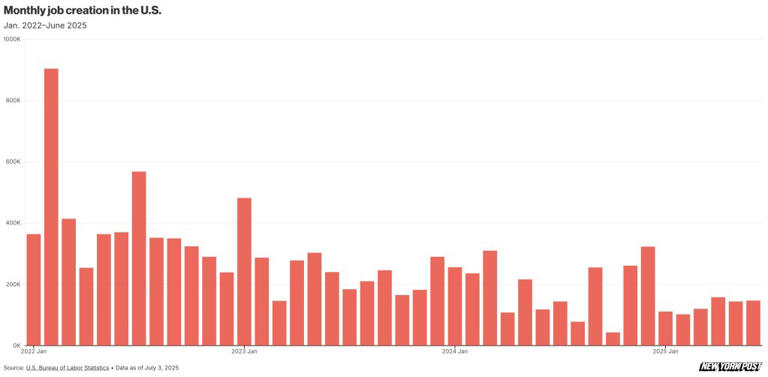
There are few things in life as certain as death, taxes and an inflated monthly jobs report. The report for June says that 147,000 jobs were added to the economy. Hooray? But the report from the Department of Labor is always wrong. After the initial report is issued, the Department starts revising it. That is because the report estimates job growth from a survey of selected employers. Consider that thus far from January through April, the Labor Department has revised down the monthly employment gains by an average of 55,000 jobs. March’s report was an additional 228,000 jobs then revised to 185,000 and then to 120,000. Historically, actual job growth is less than half of what is initially reported.
Look for the 147,000 jobs number to be significantly revised downward. Also look at the numbers within the numbers. While the Labor Department was reporting job gains of 147,000 other surveys said that for the first time in years overall private sector employment fell and that 47,000 jobs were lost at employers with fewer than 50 employees. Eighty percent of the job growth was in state and local governments. I have long contended that public sector employment should be excluded from the job figures. I believe that June’s numbers substantiate that claim.
Thus, it looks as if the job market is weakening and may be shrinking if not stagnant making the Labor Department’s report an example of how to lie with statistics. Also consider that the revised data show that job growth last year was about 168,000 a month. Thus far it is 124,000 a month which will be revised downward. Do you think that tariffs and immigration are having an impact on the numbers? This is one of the reasons that Trump is screaming at the Fed to lower the fed funds rates – along with thinking that lowering the rate will lower government borrowing costs.
One might think that the troubling job numbers would cause Trump to back off his raising of tariffs. But no. Instead he has announced that the administration will start sending out letters informing countries of their tariff rates effective August 1. Trump said “They’ll range in value from maybe 60% or 70% tariffs to 10% and 20% tariffs. We’ve done the final form, and it’s basically going to explain what the countries are going to be paying in tariffs.” Note that the president persists on saying that the countries are going to be paying the tariffs when in fact it will be the importers. Why does the president keep telling this lie and curiously why hasn;t the media called him on it?
Is he serious about a 60% or a 70% tariff? Yes. Bet on it. What will be interesting is to see if like before, our allies are taxed higher than our enemies. Look for the tariff on Canada to be higher than that on Russia. Trump once said that his tariffs were reciprocal. I guess it is how you define “reciprocal” because the negotiated agreement with Viet Nam calls for a tariff of 20 percent on goods imported from Viet Nam and a transhipping tariff of 40 percent on goods manufactured in other countries (namely China) but shipped to the US via Viet Nam. There will be a tariff of zero on US goods imported into Viet Nam. Again Trump says that Viet Nam will pay the tariffs. So let me get this straight, we put a 20 percent tariff on them and they put a zero tariff on us. Yep that sounds reciprocal to me. The technical term for an agreement like this is called a “shakedown.”
So going forward expect job losses to continue as the tariffs kick in. Also expect immigration to have a negative effect on jobs as well. But keep in mind that the job growth numbers do not reflect all that is happening in the job market. Again government jobs should be taken out and secondly the monthly figure should be a net – that is job growth minus job loss. Consider that job losses thus far are around 59,000 a month. Also, the labor force participation rate is falling as increasing numbers are dropping out of the labor force. This means that the unemployment rate is not rising because workers who drop out of the labor force are not counted as being unemployed. That definition is those who are out of work and are looking for a job.
Consequently, the jobs added numbers being reported do not tell the whole story. Taking into account the inflated numbers from the Labor Department, the number of government jobs, the monthly job loss and the declining labor force participation rate, one can only conclude that the labor market is stagnant at best. For example, in the third quarter of 2024 total job losses equaled total jobs gained but the media only reported the jobs gained. One would also need to know whether the new jobs are high paying and if new hires are underemployed, meaning that they are working at a lesser job than for which they are qualified.
One more thing to consider, it looks like net immigration may be negative with more noncitizens leaving the country than coming into it. What impact with this have on the job market and on certain industries currently dependent upon a migrant labor force? Somehow, I don’t think a lowering of the Fed funds rate will be enough to counteract the negative impact on the economy. But Trump says we must be patient. He muses that although there will be an initial slowdown, then things will come roaring back as the tariffs will force an increase in industrial growth and production. Jobs will surge back. The economy will boom and all will be apple pie and roses. Actually for the country’s sake, I hope he is right. But if he is, then everything I know and believe about economics is wrong. We shall see.
 haroldblackphd.com
America’s economic exceptionalism: the term I hear a lot, referring to a reputation that is now controlled by political legacy..
No tax on tips- people tell me they will tip less; immigrants- every roof, yard or laid cable is done by people that look like they came fm South of the Panamanian border; not human looking. Retirees- everybody! Because for some of these Trump- Blessed factory workers, work doesn’t pay. Govt checks are the only reliable check..
Job creation is hiring— and firing, and replacing with tech, and sending overseas, and shutdowns. Are all these factors part of job stats?
LikeLike