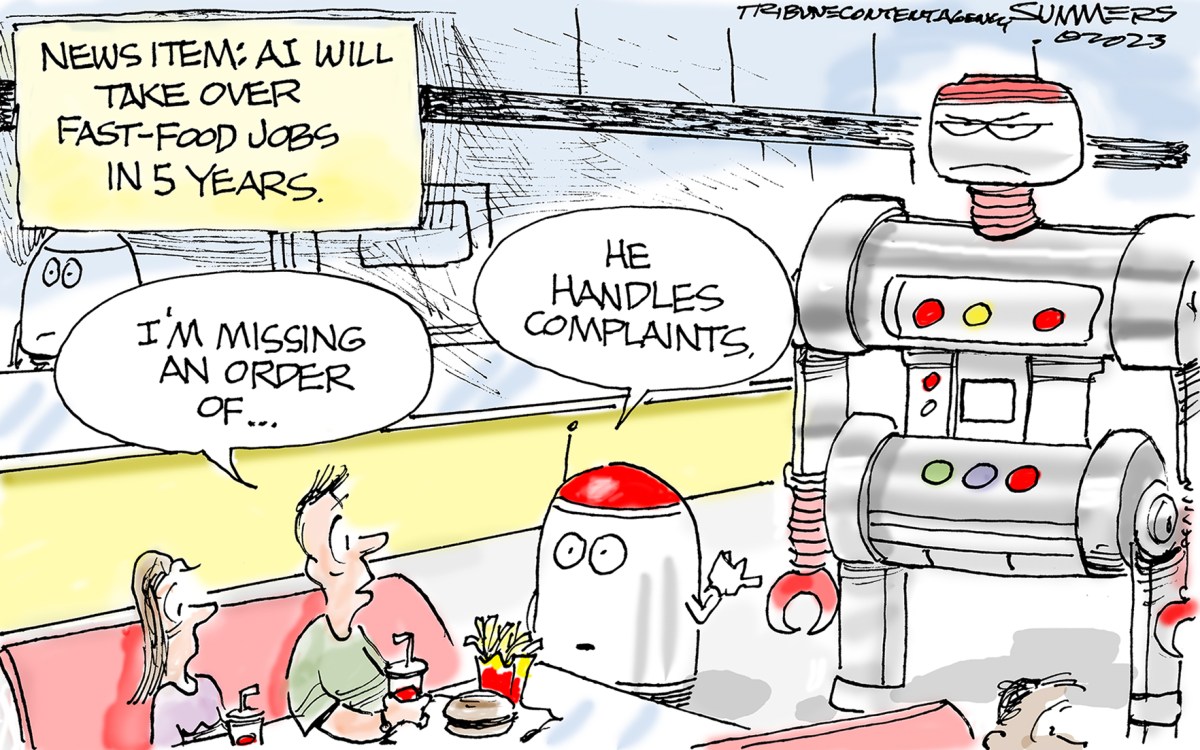
Who is afraid of AI?
I am not AI proficient. But some of my readers are and I salute them. Elon Musk has apparently banned me from using Grok. Chat GPT and I don’t quite communicate right now. There is the AI that appears sometimes when I google and it is okay. A friend of mind sent me a podcast where a group of AI engineers were talking. They were predicting a massive displacement of workers and the need for a guaranteed annual income for all those thrown out of work. I told my friend that “those who do not know history are doomed to repeat it as well as those who do know history but are still doomed to repeat it.”
The AI engineers either do not know history or think that somehow this time will be different. Every major innovation has caused disruption and displacement followed by higher standards of living and new jobs that few dreamed of. The agricultural revolution threw people off the land and into the cities. There was awful poverty. The industrial revolution did the same. Recall poor Ned Ludd who lost his job as a weaver when the auto looms displaced him. Ludd responded by trying to burn down the textile factory and was hanged for his troubles. But the term Luddite lives on for those who resist change. What about Henry Ford? The automobile displaced the horse industry throwing out of work most of those associated with it. Some said that our national security was threatened as we were losing the cavalry. What were we going to do with so few horses? Transportation and the movement of goods were predicted to be impacted resulting in fewer jobs and a lower GDP. When I was in graduate school, my then wife got bored and took a job as a telephone operator. Do they still exist today (telephone operators not ex-wives)? My grandfather never quite got used to a rotary telephone, being so used to picking up the receiver and saying “Hey Hazel.” My Dad’s father drove a coal truck and one of his brother’s was a milkman. Dad once was a postal clerk for railway mail, sorting letters as the train traveled from town to town. All those jobs are gone and yet unemployment is low. A great depression from technological job loss we do not have.
At the university there were vast numbers of women in the typing pools, typing the manuscripts of faculty and administrators. Where are they now? The desktop computer displaced thousands of middle managers. Are they on the unemployment lines? What happened to the people who used to come by your house to hook you up to utilities? Where are all the Walmart cashiers? Yes there has been job loss. American manufacturing’s job loss is blamed on the Chinese but it was actually caused by technology. We simply did not need that many workers making stuff. Just like once we had 60 percent of the workers in agriculture, now it is only 2 percent. No one says that the Chinese “stole” those jobs. We all know it was technology.
The best – and likely the most complete – article on technological displacement is by Frank Glassner’s “Your Vanishing Career: A Houdini History of Jobs.” https://blog.veritasecc.com/your-vanishing-career-a-houdidni-history-of-jobs?utm_campaign=78730990-Blogs&utm_medium=email&_hsenc=p2ANqtz-8kUFDYm1P_ODOPoRmCMaipX6ZRN5zPe3AHi6dmw8jTl4pTeLhXS1mA0-LQbswpTISp9hBKVfrTgvEzMESiVpqU9JrNWnikGVKR8kOufDaG9J9mycw&_hsmi=12854812&utm_content=12854812&utm_source=hs_email
I told my friend that the AI engineers with their doom and gloom were a repeat of when I was at Georgia of a group of social scientists from “elite” universities who called themselves the Ad Hoc Committee on the Triple Revolution. They sent an open memorandum to President Lyndon Johnson in 1964 concerning the increasing use of automation, the nuclear arms race, and human rights. Of the three they were mainly concerned with what they called the “cybernation revolution” of increasing automation. This is from Wikipedia: The committee claimed that machines would usher in “a system of almost unlimited productive capacity” while continually reducing the number of manual laborers needed, and increasing the skill needed to work, thereby producing increasing levels of unemployment. It proposed that the government should ease this transformation through large-scale public works, low cost housing, public transit, electrical power development, income, union representation for the unemployed, and government restraint on technology deployment. Our AI engineers likely would endorse all of the above as would Bernie Sanders and AOC.
Yet they all forget history. Each major leap in innovation has fostered new jobs, less drudgery and more prosperity. We are an innovative ingenious people and that won’t stop with AI. As a matter of fact I am optimistic of my grandchildren’s future. I firmly believe that AI will create wonders that will make their lives better and more productive. When I was working on my dissertation I had a carel in the library stacked with books and journals. I typed the draft of the dissertation on a selectric typewriter having to change the balls when I wanted to type scientific symbols. I punched my own IBM cards and lived in the computer center with its mainframe but also cots and cafeteria. I would submit a job and with a few hours hoping to get hundreds of pages of printouts only to realize that I had made an error somewhere because the output was only a scant couple of pages. Research was slow and tedious. Yet by the time I retired all had changed. I was much more productive with my desktop (I didn’t even know where the computing center was), all the on-line databases and google scholar. I didn’t even need to go to the library anymore. Are there still graduate student carrels?
But just think of all the hundreds of workers who once toiled at the university that are no longer employed there. Shouldn’t we have provided all the things suggested by the Ad Hoc Committee since they would not only be unemployed but would be unemployable? And what about that guaranteed annual income? What about income redistribution? By the way, if everyone is unemployed where does the income that is to be distributed come from?
The Wall Steet Journal had an article on the new Hyundai plant in south Georgia. It is really spooky seeing all the robots welding, assembling cars and doing what were once dangerous tasks performed by humans. The plant does employ 1,450 people who do the work that the robots can’t. I wonder if one day robots will do those jobs too.
There is one current academic paper on whether AI will displace a significant number of workers. The paper itself uses AI to crunch ‘anonymized data on millions of employees at tens of thousands of firms, including detailed information on workers’ ages and jobs, making this one of clearest indicators yet of AI’s disruptive impact.” The finding? That “AI can help people in their work, rather than replace them, employment among young people is improving.” Big whoop! They crunched millions of numbers to come up with that?
So be not of despair – unless you were one of the ones hoping for a free ride on guaranteed income while playing video games and looking at Tik Tok.
 haroldblackphd.com
If you did punch calls, I will have to change my obituary- for I won’t be the last person to operate punch- down blocks. I did this at RH Stearns , a department store that served free meals to employees, who would have lunch right next to executives. Now that’s history—was it all bad?..
I’ve been saving this thought, by a professor/ now author. He said he wished for the days before AI…..Because it was FUN to figure out who had bought a paper online, or who had plagiarized…..Because AI can write a paper, with a thousand ways to hide the fact that the student did nothing. Can’t catch anybody- the role of professor is down- graded. By progressive corporations.
LikeLike
True. I could not require term papers because of AI. No more take home exams. Rebirth of the blue books.
LikeLiked by 1 person