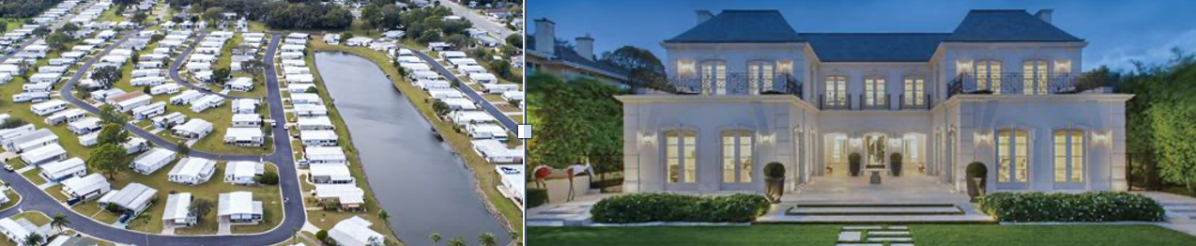
Is “affordable” housing affordable?
The U.S. Department of Housing and Urban Development defines affordable housing as housing where the occupant is paying 30% or less of the gross income on total housing, including utilities, insurance, maintenance and property taxes so that other basic expenses like food, healthcare, transportation and education can be covered. Low affordability is considered 60%. This definition on its surface holds regardless of the value of the home. That is, a million dollar home is “affordable” if its occupants are paying 30 percent or less of their gross income on total housing expenses.
I think one of the main problems in the discussion of “affordable housing” is the mixing of rentals with single family homes. The market is bifurcated with many renters preferring not to purchase a home as well as many unable to purchase a single family dwelling. For example, since illegals are more likely to rent than to purchase, their influx into an area should mainly affect only rental prices and not the “affordability” of single family homes.
“Affordable housing” is being used today to include both first time home buyers and lower income households who typically rent. Homes may be “unaffordable” because the existing housing stock does not match the income, tastes and preferences of the renters or home buyers. Consider that there are available homes and apartments but they are either too expensive and that less expensive stock is located in “less desirable” locations. The mismatch between where homes sit empty and where demand is growing helps explain why the market remains tight despite so many vacant properties.
For home buyers some homes that are desirable are out of reach because of financing costs. A $400,000 home with 20 percent down payment and a 3.5 percent interest rate, which was as recently as 2021, has a monthly payment (principal and interest) of around $1,440. At a rate today of around 6.5 percent, that same home would be $2,020 per month, or around 40 percent higher. Third, this does not include insurance, maintenance and property taxes which in some instances is a contributor to delinquency and foreclosure.
There are currently around 16 million vacant homes so some would argue that there is not a shortage of homes. However, about a third of these homes are seasonal or recreational properties in destinations like Florida and Arizona. The question though is where there is a lack of “affordable” housing, given demand then why isn’t that housing being built?
Given the stock of existing housing what makes housing unaffordable? There are financing costs, the ability to pay insurance, property taxes and maintenance, and a mismatch between the location of the home and the desirability to live there. The question, therefore arises as to why cannot the stock be increased where households want to reside? There impediments such as regulations, building costs, the cost of labor and limitations on land use.
I have seen advocates talk of “more people in need of a home than there are homes available” which is a totally meaningless statement. Land use and restrictions or limits on property density could prevent the construction of an apartment building, the construction of single-family houses or the construction of modular homes, “tiny” houses or even trailer parks. Other restrictions on apartment construction such as a minimum number of parking spaces per unit or the number of elevators can add thousands of dollars per unit to the total cost of the project. Overall about 24% of the cost of a single-family home is due to regulations at all three levels of local, state and federal government.
Also consider the case of New York City where the number of rent-stabilized apartment vacancies are over 61,000. Rent-stabilized apartments represent nearly half of all rental housing in the city and are among the most
“affordable” places to live in New York where the average rent is over $4,000. Landlords say that the current price restrictions on stabilized housing robs them of the capital needed to make necessary repairs in older housing stock, hence the vacancies. There is currently a lawsuit against the city by landlords on this issue. Mamdani says that he wants to build 200,000 “affordable” housing units for households earning less than $70,000 a year at the cost of $100 billion. That is $500,000 per unit. Typically, those units would rent for $5,000 per month. Mamdani has not said what would be the rent on these units. However, the rents would be rent-controlled and frozen. That should eliminate private developers. But thirty percent of $70,000 would set the rent at $1,750 for the lucky ones who would get such a unit. That rules out private developers. How would the city bear the loss? And where would the units be located? Details. Details.
The Trump administration is supposedly looking into ways to make housing more affordable. I can guarantee that whatever they come up with will either not help or will make the matters worse. Unfortunately, they, like the socialists love to freeze prices, but the only way to make things more affordable lie in the factors determining housing prices via supply and housing demand. What policies are there to reduce house prices, rental prices and financing costs?
Since reducing the cost of financing a mortgage would make homes more affordable then isn’t the Fed to blame as the president says? No. Mortgage rates are more tied to the 10 year Treasury that the Fed funds rate. The primary cause of the higher rates is the government itself by continuing to borrow in financial markets to finance its ever growing debt. In economics we call this crowding out” where when the government enters the financial market to borrow to fund spending, interest rates rise due to the government demand. That increase in interest rates makes private investment more expensive and reduces the investments in the private sector. So a decrease in the rate of government spending would have the result of reducing mortgage rates and making home financing more affordable. So Mr President, don’t blame Jerome Powell, blame yourself and Scott Bessent.
 haroldblackphd.com
You delivered! Even yesterday in your response to me, I didn’t see this coming..
But there’s always more..
Socrates – the Subscriber – talked about quality of life & and the illegal invasion; limits on building are quality of life; codes on buildings EMBRACE quality of life, their absence lead to the Chicago neighborhood that had a 30 story apt building dropped into a lot surrounded by single- family homes. Or give a blond eye to subdivisions before roads. Or a Walmart parking lot allowed right up to your patio..
To me the idea that Govt knows better how to use YOUR property always results in corporate greed..
We are returning to olden days of Inheritance : my cousin inherited his mother’s home- who got it fm her father in law; my uncle inherited a condo fm his sister; a Scott Cnty family inherited a mountain..
If inheritance didn’t offer homes to our relatives, we would be a family of homeless..
So HUD: what do you think of Ben Carson’s time?
LikeLike
Developers, local governments, neighborhood associations, environmentalists, building codes, section 8 housing, housing projects of all stripes, advocates, kooks, eminent domain, preservation groups. It’s almost too much. Who wins? Who loses?
LikeLike
We will find out, since the president is a developer, and making global deals that will involve land deals and Constitutional land stealing..
Those units at the ballpark, the planned condos at Norris, BlackBerry Farms- all places where the rich won’t run into me, maybe not you either. Legal segregation…
Rich may have ( preserve ) large land holdings; some want expensive NY condos with culture in walking distance. It’s OK to be ‘You’ll Never Be Us’ upper crust..
.. but development is a temp job, needing govt to set the pace for more land. If you won’t sell, govt will take it.
LikeLike
In Kelo, etc, Clarence Thomas opposed the pro development SCOTUS ruling. And clearly states the govt/ development intentions. I hope he does so again, against Trump…
..”Protecting the politically weak: Thomas noted that private-to-private eminent domain disproportionately harms politically weak individuals and minority communities. He stated that these groups are often targeted for “economic development” projects that are intended to benefit politically powerful corporations..”
LikeLike