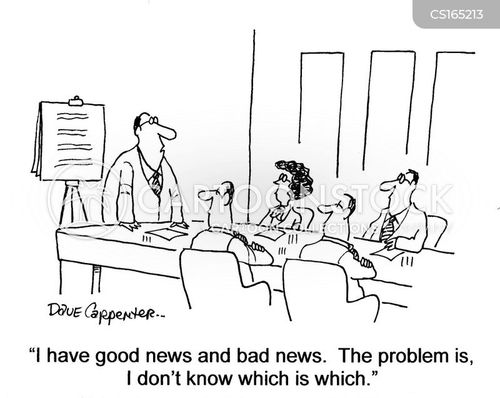
Good news or bad news?
I have some good news and some bad news. The good news is the inflation rate is 2.6%. The bad news is the inflation rate is 2.6 percent and that number does not include food or energy costs.
How quickly they forget. December’s CPI came in at 2.6%. The conservative media trumpeted that it was a win for the president. Here is one typical headline “Positive Inflation Report Delivers Economic Win for Trump.” Huh? I guess everyone has conveniently forgotten that 2.6% is still above the Fed’s target of 2 percent. Also once again after Trump got rid of all the resident number crunchers at the Department of Labor and the Bureau of Labor Statistics, we have gotten nothing but numbers that favor the president. Is that a coincidence?
Apparently, I am the only one who thinks that this is a bit suspicious. Nonetheless, the president declared that inflation was defeated and again badgered the Fed to lower the Fed funds rate even further. He said that Joe Biden (naturally) “gave us a colossal stagflation catastrophe but my administration’s rapidly and very decisively ended that.” He also said “We have very low inflation. That would give ‘too late Powell’ the chance to give us a nice beautiful big rate cut.” “If I had the help of the Fed, it would be easier, but that jerk will be gone soon.” His Truth Social tweet was “Great (LOW!) Inflation numbers for the USA. That means that Jerome ‘Too Late’ Powell should cut interest rates, MEANINGFULLY!!! If he doesn’t he will just continue to be, ‘TOO LATE!'”
Good grief. Speaking of grief, the media is finally realizing that when Powell’s term as chairman ends, he can stick around for two more years when his term as a governor ends. Although odds are that he will leave, the prospect of giving Trump another Fed nominee and the possible threat to Fed independence might compel him to stay. I repeat that if I were Powell I would stay just to stick it to the president. Can you imagine Trump’s indignation and frustration? But Powell is likely pretty fed up (pun alert!) and will leave and go back to making serious dollars on Wall Street. Take this job and shove it!
Who let the dogs out?
I have some good news and some bad news. The good news is that there was an election in the southern African country of Malawi and a peaceful trasition of power. The bad news is that although the ex-president left he took the office’s guard dogs with him enbroiling the nation in controversy.
The nation is divided over who gets custody of the presidential guard dogs. Guard dogs? Yes guard dogs. When the past president lost re-election he took his dogs – a Dutch shepherd and three Belgian Malinois – with him saying they were part of his personal security team. The newly elected president begged to differ and insisted that the dogs were civil servants employed by the president’s office. He demanded the return of the dogs. The ex-president refused. The new president Peter Mutharika sent 80 policemen to the ex-president’s home to get the dogs. The ex-president Lazarus Chakwera refused. Meanwhile the former president’s allies in Parliament rushed to his home to prevent the dogs’ removal. President Mutharika then would not move into the presidential palace saying his full security team wasn’t in place. The country is divided with each party supporting one or the other president. The matter is in the courts.
Speaking of presidential dogs, remember when Obama got a dog because someone told him that presidents should have one? Ted Kennedy gave him a Portuguese Water dog named “Bo” that Obama kept around until his term ended and promptly gave the dog to his press secretary. Then there was Biden’s German Shepherd Commander who was supposed have bitten Secret Service personnel at least 24 times. At least two had to get medical treatment for severe bites. Trump doesn’t have a dog and may be the first president who doesn’t even have a pet.
A new spate of minimum wage laws
I have some good news and some bad news. The good news is that we are raising your minimum wage to $16 and hour. The bad news is that you are fired.
The politicians again showed that they know exactly how much workers should be paid when they spawned a multitude of new minimum wage laws across the fruited plain with 19 states raising the minimum wage. Although it has always been a favorite of the democrats to increase dependency by increasing unemployment, this time they were joined by several republican led states. Thirty states now have minimums above the Federal minimum of $7.25 an hour. The highest is Washington state at $17.13. Hawaii’s is now $16 and Nebraska and Missouri’s are $15. Raising the minimum is always popular with 90 percent of democrats and nearly half of republicans supporting the measure. Localities in some states can raise the minimum even more. Seattle’s is $21.30 and Los Angeles set a minimum for hotel and airport workers at$30 beginning in 2028.
Since the buzzword is “affordability” raising the minimum is even more popular than before. What the increase in the minimum does is to reward those workers who can keep their jobs. Others will be terminated and there will be fewer new hirings. Not surprisingly, turnover rates also fall as workers know when they have a good thing. One of the not noticed effects is on those who are unemployed and on those who are just entering the workforce. These people will need to have job skills that merit the new wage and many don’t. That is why teenage unemployment rates are always the highest and will likely rise in the face of the increases in the minimum wage. When a subminimum is suggested for teenagers it is generally rejected. What people do not understand is that the real minimum wage is $0. Raising the minimum only increases welfare dependency as unemployment rises and labor force participation falls.
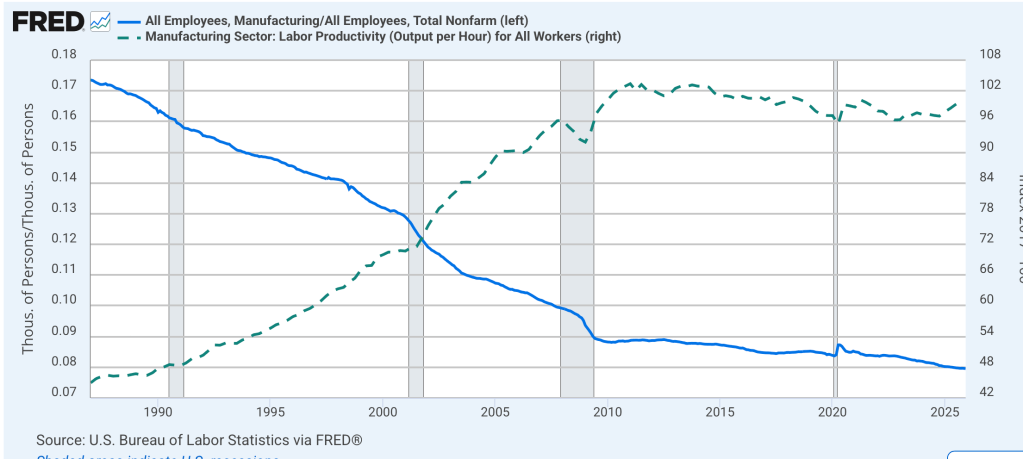
The chart below shows that over time the number of workers in manufacturing is decreasing while worker productivity is increasing. This of course mirrors what happened in agriculture. Now the increasing minimum wage prompts employers to substitute labor saving methods for labor itself. We saw that in California when the minimum wage for fast food workers was raised to $20. Workers are being displaced and menu prices have increased. There has been an increase in automation and self-service technology. Restaurants have self-order kiosks, kitchen automation software and other labor-saving technologies. Restaurants are reducing employee hours, having fewer workers per shift to control labor costs, others are letting go of staff. Some franchisees are not opening new restaurants while others are actually closing not being able to operate profitably with the increased labor costs. For example, Rubio’s Coastal Grill shut down 48 of its locations in California. Fast-food restaurants are raising menu prices for customers between 8% and 10% and many are still losing money.
BTW, all this is well known but raising the minimum remains popular among politicians and among the public. I used to ask my class how many favored raising the minimum wage and nearly every one would raise their hands – and these were business majors. I told them that once they stopped being employees and became employers they would change their minds. I then would show them graphically by plotting the demand for labor and its supply to show the increased unemployment. I would ask “Why have a minimum wage?” Often the answer would be “It prevents employers from paying a zero wage.” I then would tell that student that they need to transfer to sociology (or education). Then there are those who say that the minimum wage is to lift workers out of poverty and give them a “living wage.” I usually answer that means that those workers must currently be dead if they are not earning a living wage. Also why not really lift them out of poverty by mandating a minimum wage of $1,000 an hour? I was then told “Well they are not worth $1,000 an hour.” To which I reply “Many are not worth $15 an hour either.”
One striking consequence of minimum wages creating unemployment among the lowest skilled and least educated workers was found in an important paper by Bayer, Charles and Derenoncourt. It finds that the income inequality gap between black men and white men in 1950 is basically the same as today’s. However, among the college educated, the income gap has narrowed almost to the point of statistical insignificance. Some may point to the roles of affirmative action and DEI which researchers have previously found benefitted only well educated blacks and had little if any impact on the economic status of poorer educated blacks. That is a topic for another day. Nonetheless, increases in the minimum wage lead to an increase in dependency by closing the door to gainful employment for the less educated.
 haroldblackphd.com
I just don’t know how you can cover all these topics!..
African ICE going to the dogs! If dogs are considered essential workers, maybe we need to re- think illegals..
Your former publisher did his crybaby routine when Dollar Tree went fm $1 to $1.25, how his wife was destroyed..
***By Biden Inflation..***
Well, I went into a Dollat Tree yesterday- saw prices $1.75; saw a roll of stickers indicating prices to be $1.50; and shelves of $3 products. Your old publisher won’t write about that. Trump, u know..
Seriously. Where is the core of inflation? You mention hourly rates & rising fast food. I spoke with a realtor that PROMISED WeThePeople will never have a real home – but will be forced to share roofs with strangers in duplexes…
Realtors want inflation- to make $$ to shop at Dollar Tree..
What is ground zero in creating the decision, to make prices rise, that affects all other prices/ income/ jobs/ homes?..
I paid $144,000 for my home; now it’s supposed to be worth $400,000.
Since this house is well-used, why wouldn’t the market say this house is LESS than original price? Like a car?
LikeLike
A used house is worth more than a used car? One is an appreciating asset while the other is a depreciating asset. I bet part of the value of the home is in the increasing value of the land. Empirically, a way to test this would be to compare the value of a mobile home where the owner does not own the land to one where the lot is owned by the owner of the home – and I am not saying that you live in a mobile home!
LikeLiked by 1 person
Well, I have lived in trailers 🎼 For sale or rent 🎼..
We are having to do some renovations, because we feel the conscious effort to give people their money’s worth.
Should we sell…
which means we would have to incur debt on a house no better than ours.
But we’ve found a flipper , just in case we exit sooner than expected.
LikeLike