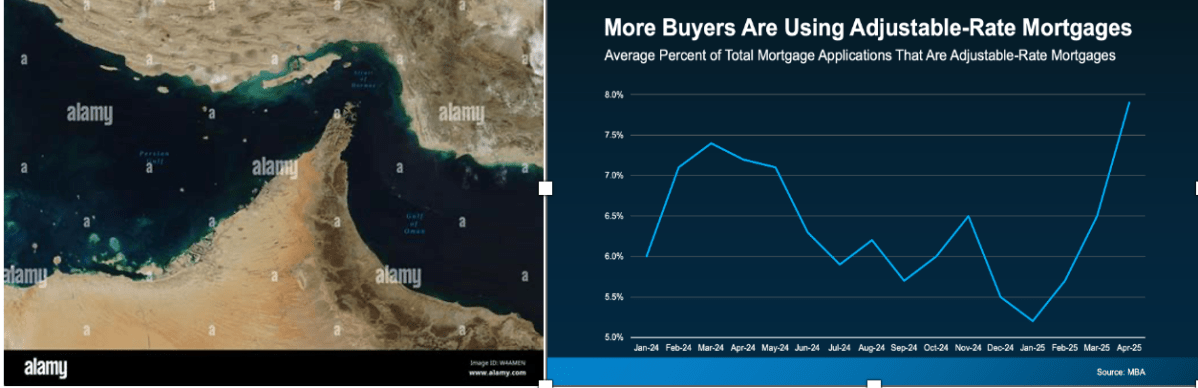
Arms for Iran. ARMs for mortgages too.
Do we have an exit strategy?
Was it a surprise that the Iranians shut down the Straits of Hormuz? Shouldn’t there have been a strategy implemented on Day One to keep the straits open? Maybe the surprise was that after decapitating the Iranian leadership that the country didn’t fold like a house of cards. However, the Iranians were obviously prepared for war and are willing to wage it. Maybe Trump was convinced that a bombing campaign would quickly subdue the country. Let us assume that he simply didn’t know history. Never has a bombing campaign succeeded to win a war without boots on the ground except perhaps the nukes over Nagasaki and Hiroshima. But prior to that we murdered Japanese civilians by firebombing their cities. Given that their homes were primarily made of wood, the toll was horrific. We killed over 100,000 civilians and left over a million homeless. Curtis LeMay who commanded the US forces stated that if we had lost the war he would have been prosecuted as a war criminal. Yet the Japanese never surrendered until we nuked them and yet there is evidence that what motivated their surrender was the invasion by the Russians in Manchuria.
Although the president never spelled out his objectives, I am sure that nuking the Iranians was off the table. Maybe he thought it was going to be like the earlier raid in June where he would bomb a few sites and declare victory. But not in this instance. The Iranians are pursuing an interesting strategy in not attacking Israel in force but rather the US installations around the Gulf and strategically attacking our installations – but not civilians. Trump wanted the Iranian citizens to “take back their country.” But probably miscalculated.
It would have been nice to have articulated an exit strategy but lacking that at least a strategy to keep the straits open. The longer the straits are closed then the more pressure on the US to reach an agreement with the Iranian new supreme leader Mojtaba Khamenei who is even more hardline than his late father. How can the US open the straits? It does not have the ships to escort every ship through the straits. Even if it did it would run the danger of the US ships being hit by missiles and drones. It cannot take out every missile that can hit shipping in the straits. It can’t even prevent the mining of the straits by the Iranians. Although the US navy has attacked Iranian ships and even a submarine, most of the mines are laid by frogmen operating out of small fishing vessels. BTW, The Iranians are shipping their own oil on their tankers through the straits. Why aren’t those tankers stopped by our navy? Again, unless the Iranians run out of missiles and drones (and we bomb all their production facilities) at some point Trump is going to have to declare victory. The problem is that the Iranians are going to insist that to reopen the straits that major concessions are made to them – stop the embargos and lift the sanctions. They will probably insist on restarting their nuclear program but that is a nonstarter. Life got a lot more interesting. Shutting down the Straits of Hormuz is a global economic killer. The Iranians know it. We know it too. Surely Trump knows it. The question is that this looks more and more like a miscalculation and an absence of a viable strategy of keeping the straits open.
Trump’s Karoline (Lying) Leavitt said “The Pentagon has been planning for Iran’s desperate and reckless closure of the Strait of Hormuz for decades, and it has been part of the Trump administration’s planning well before Operation Epic Fury was ever launched. The U.S. operation to wipe out Iran’s military capability “is quite literally intended to deprive them of their ability to close the Strait.” Oops! Now Trump is sending more troops to the Gulf including 2,500 marines along with the USS Tripoli amphibious battle group. Please don’t tell me he is going to put boots on the ground. I wish he would just say that the US will always seek to degrade Iran’s capability to build a nuclear weapon, declare victory and leave. Instead it looks as though he is going to dig us deeper and deeper into a hole that will be increasingly difficult to extricate ourselves. I hope not.
At least Joe Biden is no longer president. Trump, to his credit, has stopped the green nonsense and moved to make the US energy independent. He has ended the stupid embargo on the sale of LNG, issued more drilling permits, opened up previously closed land for drilling. Alaska’s governor is touting pipelines to Japan and South Korea, two countries currently dependent on oil coming through the Straits of Hormuz. Saudi Arabia is now routing oil through its pipelines to the Red Sea. All this will mitigate to some extent the closure of the Straits on energy prices. The major concern with then be “what about fertilizer?”
The return of the adjustable rate mortgage
Mortgage rates have fallen below 6 percent but the rates on adjustable rate mortgages have fallen even faster causing an upsurge in the use of those rates by homeowners. The benefit of an ARM is that if rates fall even more, then the mortgages can be refinanced into a fixed rate mortgage. However, if rates go up then when the mortgage rates adjust, they can cause some financial stress. Theoretically, when the homeowner qualifies for an adjustable rate mortgage then they are supposed to be able to qualify even at the highest projected rate. That is what a prudent lender would do. The problem is that most mortgages are sold either to Fannie Mae or to private investors removing the default risk from the originator after a certain period of time.
One of the threats from the war in Iran is that inflation will go higher – the new data show that food prices went up 3.1 percent last month. Higher inflation means even higher mortgage rates so buyers are tempted to lock in a 7 year adjustable in hopes that the rates seven years from now will be lower. Then they would refinance into a lower fixed rate loan.
BTW, I know this sounds like a self-promotion but I instituted the first adjustable rate loans while on the board of the National Credit Union Administration. We were faced with inflationary recession and rising interest rates. Credit union loans were all fixed rate so if loans on the books were at low rates while deposit liabilities were having to be paid higher rates, credit unions were in danger of becoming insolvent. So I proposed that we revise the language in our lending regs which read that loans had to be repaid in mostly equal installments to simply remove the words “mostly equal” thereby creating what we called a variable interest rate loan. A week later the savings and loan regulator adopted similar language calling it an adjustable rate loan. So if you get an ARM and rates go up instead of down, it’s my fault.
 haroldblackphd.com
Glad that you had a say in financing. And despite your permission, not blaming you for anything..
Curtis LeMay signed my dad’s discharge papers. At least that was the story – until I hunted for his autograph and found a rubber stamp. Maybe he at least looked at the papers..( I didn’t mention G Wallace)..
War is hell- as you said yourself once. The atomic bombs killed an estimated 40,000 unborn babies; homeless Japs- also radioactive-sick…
Damage with the air quality and water quality. Also in Iran. And the Strait. And in America on 9/11….
children, animals, nature- all die for the legacy of madmen.
So I wouldn’t be too quick to dismiss the environmental protections, esp if the GOVERNMENT promises anything, like energy independence..
Deaths of US and Iranian soldiers are the pawns of government. Ask a soldier if they want to die for either leaders..
Don’t forget the propaganda and news censorship- which Trump is attempting now, just like Wilson and Roosevelt…
It’s all about PRESIDENTIAL legacy..
Vanity Fair 2016 covered Trump’s selling of the Miss Universe Organization he owned, to be a Pres candidate, after many controversies:
.. “ On the other hand, as Trump once told Esquire, it doesn’t really matter what anyone writes about him “as long as you’ve got a young and beautiful piece of ass.”
He just is that way.…”
LikeLike
Maybe LeMay used an autopen. But I am always amazed that somehow the Japanese could become our allies much like why would Israel ever be an ally of Germany?
LikeLiked by 1 person
I’d settle for an auto pen- knowing it had signed more important papers than Dad’s ..
I love going thru piles of old books to find for-real signatures.
Won’t name all I’ve found but you might appreciate Howard Baker..
and Peter Drucker.
LikeLike