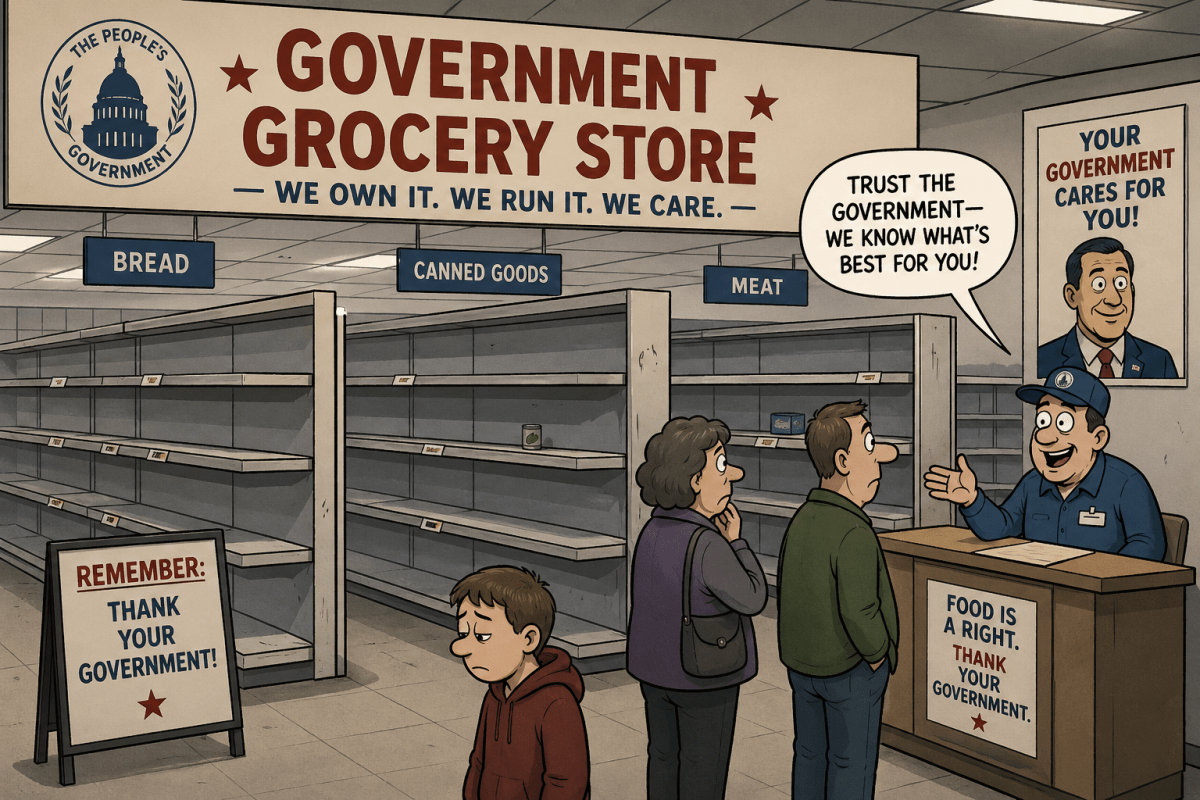
New York’s city-owned grocery stores
So what is it with the left and grocery stores. In New York, the mayor held a press conference announcing the first of the city-owned grocery stores. At an initial projected cost of $30 million the city would own the land, cover major overhead costs and bring in a private operator to sell staple foods at discounted prices. The mayor said that this would mean lower prices on basics like bread and eggs. This will be the first of five city-owned grocery stores. Mamdani said that 65,000 New Yorkers live within a 10-minute walk of the proposed site. However, the site is not on a food desert (that’s not a chocolate cake) because there is a supermarket in the area along with several convenience stores (called bodegas in New York city), an Aldi and even a Whole Foods. There is also a fresh produce store a three minute walk from the site. So one wonders why this site for Mamdani’s store?
BTW, here is what Wikipedia says is a “food desert.” A food desert is an area that has limited access to fresh food. A food desert typically lacks the presence of a grocer and instead supplements it with convenience stores or fast food. It is interesting that Mamdani is not during the usual leftish whine about the poor pay more. Rather he and his cohorts are saying that the new grocery store will bring more nutritious food to the underserved. That implies that poor nutrition is somehow correlated with living in a food desert. Here is a statement from a paper at the American Journal of Clinical Nutrition:
“Food insecurity and the lack of access to affordable, nutritious food are associated with poor dietary quality and an increased risk of diet-related diseases, including cardiovascular disease, diabetes, and certain types of cancer. Those of lower socioeconomic status and racial and ethnic minority groups experience higher rates of food insecurity, are more likely to live in under-resourced food environments, and continue to bear the greatest burden of diet-related chronic diseases in the United States.” https://ajcn.nutrition.org/article/S0002-9165%2823%2966352-X/fulltext
So presumably, bringing nutritional food into underserved areas would foster better health. Right? Well not so fast my friends. Research shows this is not necessarily the case. Adding fresh produce markets does not mean that people will stop going to McDonalds (although higher prices might). Here is a study from the National Bureau of Economic Research entitled “Food deserts and the causes of nutritional inequality.” https://www.nber.org/system/files/working_papers/w24094/w24094.pdf
The study finds that food deserts have no meaningful effect on eating habits. Exposing low-income households to the same products and prices as those in high-income households reduces nutritional inequality by only 9 percent while the remaining 91percent of the nutrition gap is driven by difference in what shoppers prefer to buy. One of authors said “One of the conclusions in our study is that opening a supermarket in a food desert has very little impact on the nutritional composition of households’ shopping baskets.”
But even if this is known to those on the left, they would ignore it because it is counter to their false narrative. One wonders why $30 million? Couldn’t Walmart put one of its neighborhood markets on the site for less money and just have the city subsidize any losses? Wouldn’t that be cheaper? Alas, Walmart does not have a single grocery store in any of the five boroughs of New York city. I guess socialists don’t care for low prices after all. Well how about Aldi instead. Aren’t they known for their fresh produce? Also, why not remove property taxes, minimum wages, zoning regulations and any others for grocery stores in designated food deserts? I bet that would motivate some grocers to locate there.
Government-owned grocery stores don’t have a great track record. Socialists always shrug off failure saying “it will be different this time.” They simply don’t trust the market. Kansas City tried city-run markets and it was a failure. The store KC Sun Fresh, lost nearly $900,000 over the last year and is closing its doors after more that $18 million is subsidies. Currently large portions of the store’s shelves were bare or only partially stocked — including meat, produce and dry goods. One customer said “There’s no meat. There’s no vegetables. There’s no nothing. Are you going to take care of the community that’s surrounded around you? If not, sell the store to someone that can be more responsible.” Ironically, there’s a grocery store right down the street that is doing well. Mamdani should take heed but he says that his city-run grocery stores will “operate without a profit motive,” there will be no “price gouging” as he alleges private stores do. The stores would not have to pay property taxes, would buy and sell at wholesale prices and charge lower prices than other stores in the city. His five proposed stores are budgeted at $70 million with $30 million to the first store.
To be fair, my hometown of Atlanta has a city-owned grocery store – the Azelea Fresh Market – that is doing well. The city paid $8 million to open the store and is in an area with no grocery stores – a food desert! The mayor said that the city had failed to entice the major grocery stores to come into the market and said “well screw it, we’ll do it ourselves.” And so they did. The store is publicly funded but privately operated by a major grocery store chain. The goal is for the store to become profitable without any government subsidy within three years. The store is such a success that it is already aiding the construction of a second planned store 6 miles away, expected to open next year. That site will be a challenge since a grocery store had gone out of business there. Unlike in New York, profit is not a dirty word in Atlanta which wants its stores to be profitable. Atlanta officials think that with for-profit supermarket management they can avoid the failures of some other government grocery experiments. Any profit lost from cheaper staples is partly made up upstairs, where there is a sandwich and sushi counter. Wine and beer sold at typical prices.
There seems to be a simple reason why government-owned and operated stores fail – profit. Atlanta recognizes this but New York does not dooming those stores to either fail or to be cash drains on the city. We know that government-owned grocery stores in communist countries like Russia don’t operate as efficiently as profit-driven stores in the US. I guess Mamdani thinks his will be better.
But actually there is a large – huge – government-owned grocery store chain in the US. It’s the military commissary system funded at $1.5 billion a year. The government-backed stores do have lower prices. They pay no rent and are heavily subsidized. It leverages scale, limits markup but also is lacking in the variety of commercial stores. The losses are never realized being in the overall military budget The telltale sign is if military personnel feel the need to go off the base the purchase items that might – or might not – be sold on base. I have pointed out in the past how military medical services are not as extensive as those provided in the private sector – this is especially true for drugs. Many have argued that the commissaries need to be transformed to be more like successful commercial grocery stores. For decades, the Defense Commissary Agency (DeCA) has struggled to meet the intent of providing good, discounted groceries to service members, their families and veterans. This does not seem like a model for success. If the Federal government’s socialist stores are a market failure, will New York’s Mamdani and other socialist mayors take heed?
 haroldblackphd.com
LOL. (Atlanta) Government owned grocery funded by taxpayers? Got any data on how much money this nets Atlanta after all start-up, labor, product, maintenance, and insurance costs are subtracted? Cause if is bringing home profit why wouldn’t cities open up chains of them? I suspect its much like Knoxville’s own KAT system. Which has never provided income and is just another loss leader for the city.
By the way what do you think of Knoxville’s emphasis on parks, greenways and sidewalks at the expense of thousands who use the poorly maintained roads everyday? We were always raised to take care of the basics first, then if you have money left over you can consider entertainment. Not this town and not these leaders.
LikeLiked by 1 person
I don’t have the Atlanta statistics. I harken back to Jack Kemp and his enterprise zones where all the impediments to enry are removed (lower or no property taxes, building code restrictions, minimum wages, etc) to induce firms to enter certain areas. Then the government subsidizes losses if this is deemed an “important” public service. At least it should be less costly than a city owned and operated facility. Roads and essentials first! It is interesting that parks and greenways are generally not for low income and are a subsidy for upper income residents. Isn’t that curious in a leftist run city?
LikeLike
How considerate of the city Mothers
LikeLike
This is an important essay, covering a lot of ground, including governing the governed..
Thanks for the memories of commissaries.
Mom would make the kids go with Dad to the store to get us out of the house. The commissary didn’t allow kids- so we joined the other kids at the front door , all of us without parental supervision. My mom liked cheap military prices- all the cigarettes she could smoke. Govt in action!
Old poor neighborhoods down Chapman hwy. have gas stations for grocery shopping.
High costs, lots of RingDings..
Dollar Tree on Magnolia had shoppers on Public assist. Don’t go there at the first of the month- people buying 3 carts worth of stuff: soft drinks, cookies, canned food.
BTW : that capitalist store is closed …
Point is : people will or must buy whatever they can , or damn well want..
What can help Mamdani? His charismatic personality! NYers like him, at least as many as like Trump. And parallel to Trumpsters— Mamdani will have followers who will take citizen responsibility by becoming activist , or nationalist or terrorist. Same with Trumpsters.
LikeLike
I had to look up “ring dings.” All of the lefts’ arguments for government-owned stores are fradulent. The real reason is control – and we all know it.
LikeLike
I can go along with that. Because all politicians want to leave a mark and not be forgotten. It’s just the approach that matters.
Trump’s signature on money , and picture on passports is as pathetic as Mamdani- just less market-driven.
LikeLike
Doesn’t this bring back memories? My wife and I recall the soviet Russian grocery stores, which still existed in Moscow in 1994-1999. They were called Gastronoms (Гастрономы). If produce was available, three queues were required. Line up to select the items. Line up to pay for the items. Line up to receive the items. Of course, western-style stores were also around, full of produce at higher prices.
LikeLike
I thought the western stores were only open to members of the Party. I remember people going to Moscow with several pairs of Levis to sell at prices that were “whatever the market would bear.” Have times changed?
LikeLike