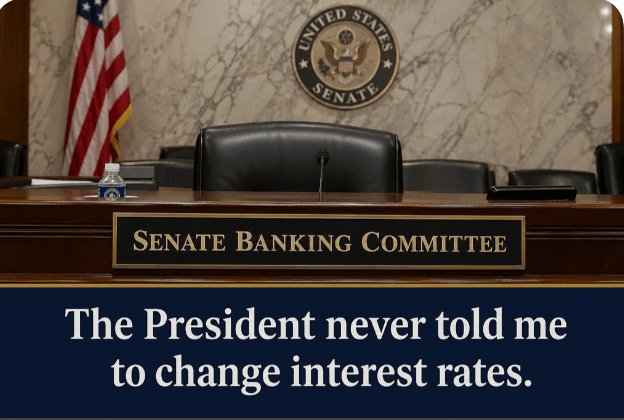
A change is a-coming at the Fed – or is it?
Trump’s Department of “Justice” dropped the bogus investigation of Fed chairman Jerome Power leading Sen. Thom Tillis (R-NC) to drop the hold on the confirmation of Kevin Warsh to a governor’s seat and to being the next Fed chairman. Warsh’s nomination went out of committee by a 13-11 vote will all the republicans voting for and all the democrats voting against. One of our favorite senators, Elizabeth Warren said “A vote today by this committee to advance Mr. Warsh will bring the president one step closer to completing his illegal attempt to seize control of the Fed and to artificially juice the economy.” Of course, this is what she would want the Fed to do if there were a democrat president, so it is curious why she would oppose this. Well it is political and she hates Trump. I presume the senate vote will only find Fetterman voting with the republicans for confirmation.
The governor’s seat is the vacancy left by Stephen Miran who went back to his old job as Trump’s chair of the Council of Economic Advisors. What is noteworthy is that Powell has said that he will stay on as a governor, thus denying Trump another vacancy to fill at the Board. I bet Trump is furious having indicated that if Powell didn’t resign, then he would fire him. But we have gone down that road before (somewhat). The president has been trying to fire Fed governor Lisa Cook since August 2025 when Bill Pulte, head of the Federal Housing Finance Agency accused her of mortgage fraud.
The president who had successfully fired other appointed officials at independent agencies, leapt at the opportunity to fire Cook. He already had appointed two Fed governors and relished the opportunity to add another in order to perhaps direct the Board to do his will. Note however that his two appointees (not counting Powell), Waller and Bowman consistently had been voting with Powell on the conduct of monetary policy. But Cook is still on the Board and her case is before the Supreme Court. It is doubtful that the president will prevail. Previously, the court had explicitly noted that the Fed was a unique agency and indicated that its governors could not be fired without cause. Although the president’s attorneys will argue that the allegation of mortgage fraud – if proven – would be grounds for dismissal, their case is weakened by evidence that the president himself did the same thing on two mortgage applications in Florida.
I am convinced that Powell is only staying in order to deny Trump an additional appointment to the Board. If Trump had not conducted a ceaseless barrage of insults against Powell, he most likely would have resigned. Powell was ironically nominated by Trump and has been at the Board since 2018. He probably would like to go back to the private sector and earn some serious money. However, he is staying. His term ends January 21, 2028. It will be interesting to see if he stays that long because Trump will still be able to nominate another governor since the president’s term ends on January 20, 2029.
At his confirmation hearing, nominee Warsh promised “regime change” at the Fed. Now normally “regime change” would imply a change in the leadership structure of an organization or government. It will be interesting to see what this means at the Fed where Warsh can only rearrange the deck chairs. He can alter the composition of the Fed’s committees and substitute one governor for another. He can perhaps get the president to nominate other governors as vice chair (currently Philip Jefferson) or vice chair for supervision (currently Michelle Bowman). He can replace staff members. He can bring in new economists using other monetary policy models to predict changes in economic activity. I will suspect that he will do all of this. But fundamentally, Warsh probably meant that the Fed will stick to its knitting. It will no longer allow its reserve banks to host symposia on inequality and equity. It will focus on reducing the Fed’s balance sheet and discontinue the practice of forward guidance generally intoned at the Open Market committee press conference which some say creates inflexibility in Fed’s actions.
Warsh is no rookie at the Fed. He was a governor from 2006 to 2011. He opposed the buildup in the Fed’s balance sheet then but as a single governor with one vote on the Open Market Committee could not stop it. However, Warsh, despite his public remarks about disagreements after leaving the Fed, never cast a single dissenting vote on the Open Market Committee. Now this may be because as a rule, despite disagreements during the discussions about policy at the Fed, the votes announced to the public were usually unanimous, showing a united front. It has only been recently that dissenting votes were on the record.
So I don’t expect much of a change at the Fed, despite what you may read in the press. Warsh knows the Fed and will tweak it here and there – as do all new Fed chairs. The reserve banks will keep focusing on regional economics – with the possible exception of the New York Fed. The Board will busy itself with bank regulation and monetary policy. I actually regret that Warsh is not a trained monetary economist – Waller is the only governor with that training – because I would like to see the Fed Board’s models scrutinized. There is a Fed model, and it may well be unchanged through different regimes. One of my dissertation readers left Ohio State and went to the Fed. He ended up being chief economist on the Open Market Committee. Although he was a student of Milton Friedman at Chicago and a staunch monetarist, at the Fed he morphed into what we called in the profession “a Fed economist.” No longer were monetary aggregates to be the focus of monetary policy but instead the Fed’s interest rate models were the ones emphasized. Oh well, when in Rome.
And don’t believe the reports about the Fed members being at odds with each other. Yes there were more dissents reported but I believe it was all for show with the two other Trump nominated board members hoping that the president would nominate them for chair. Note that once Warsh was named, the other two went back to voting with the others. It will only be a matter of time when Trump grows exasperated with Warsh. If Trump badgers him to lower rates, Warsh knows that he has only one vote and the other governors and reserve bank presidents may not agree. What will he do? I know of only one occasion where the Open Market Committee did not vote with the chairman and the market tanked saying the Fed was leaderless and out of control. That is why the Fed puts on (usually) a united front despite differing opinions. I think this will continue because Warsh does not want a Fed in disarray and the market in chaos.
 haroldblackphd.com
The last time a Fed chair remained on the board after losing their chairmanship was 1948. I’m sure that that was not unnoticed by yourself? Yes, there are politics involved and Powell is determined to be the splinter in Trump’s bannister.
LikeLike
That was Marriner Eccles for whom the Fed headquarters building is named. Eccles seemed to be on the board for life staying on well past his term as chair. He was an advocate of Keynes in asserting that the depression was a victim of inadequate government spending. You might be right about Powell’s intent but I believe he is staying on for a while just to gig Trump. I don’t think he will be an impediment to Warsh. Also I expect that he will leave before year end.
LikeLike