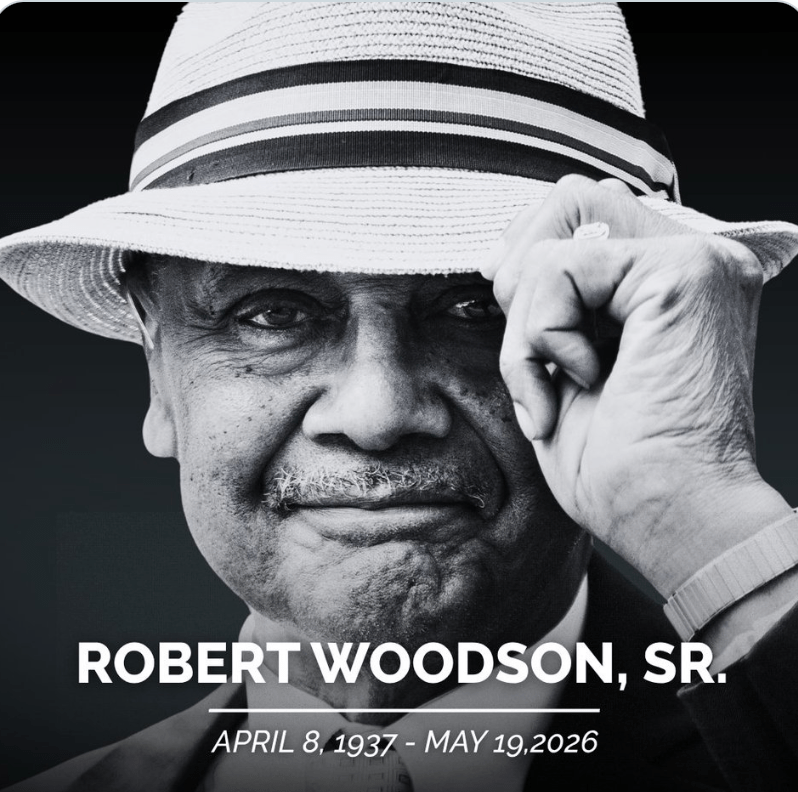
Bob Woodson, April 8, 1937 – May 19, 2026
My dear friend Bob Woodson just died. He was 89. Bob who? Most of you have never heard of him even though Bob was a towering forceful leader. He chose not to exploit his fame. You might say that Bob was the most famous person that no one had heard of. Yet presidents knew him as did the conservative media. He was often on Fox News as a counterweight to more famous folk like Al Sharpton and Jesse Jackson. Although he has been recognized with a MacArthur ‘Genius’ Fellowship, a Presidential Citizens Medal and other awards, Bob never sought publicity. Instead he sought results. He was a contributing editor to The Hill, The Washington Examiner and The Wall Street Journal. He was published in influential newspapers and journals such as Forbes, National Review, the Washington Post, the Harvard Journal of Law & Public Policy and the Vanderbilt Law Review.
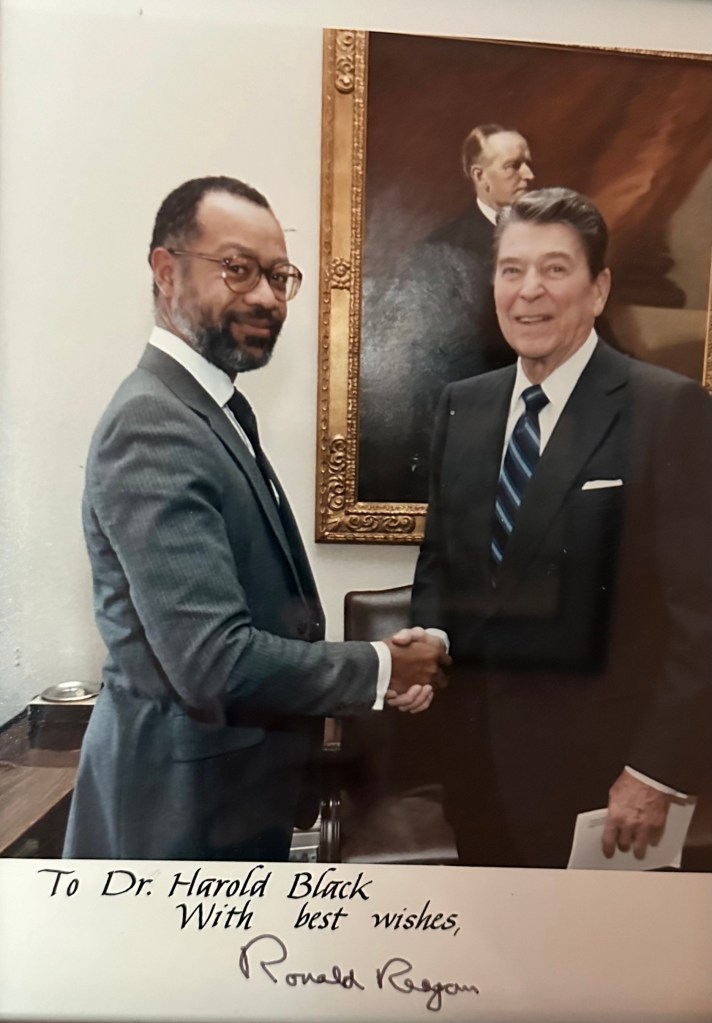
Bob was a counselor to House Speaker Paul Ryan (R-Wisc.) and helped Ryan develop his Better Way agenda. Woodson was influential in helping the George W. Bush administration develop its Office of Faith-Based and Community Initiatives. And before that, Bob served as an advisor to Jack Kemp when he was HUD Secretary. He was instrumental in Kemp’s famous Enterprise Zone initiative. Bob and his board met annually with President Reagan who wanted Bob to search as an undersecretary at HUD – hence my picture with the president. President Trump also wanted Bob to be HUD secretary in his first administration. But Bob demurred believing that he served best outside the confines of the political theatre.
Here is a photo of one of those meetings with President Reagan.
Bob was a different civil rights icon, loved and admired by those who were touched by him. Why wasn’t he better known? This statement says it all when he wrote in reference to the Southern Poverty Law center: entitled “Wake up America. Excellence is our inheritance.” He wrote: “Let me be clear. The cause of civil rights remains one of the noblest defenses of human dignity in American history. But the movement has, more often than we admit, been commodified. What began as a mission rooted in sacrifice has, in some quarters, hardened into an industry rooted in exploitation. When the suffering of a people becomes a fundraising hook, the incentive shifts from solving problems to sustaining grievances. Our communities are being exploited from multiple directions. By outsiders who turn our pain into their profits. By self-proclaimed leaders who monetize resentment instead of producing results. And by the enemy within, who perpetuates violence and corruption, we’re too eager to ignore because it wears a black face. We must stop being the “product” for these groups and start being the “judges” of their integrity. We have never suffered from a lack of excellence. https://www.washingtonexaminer.com/in_focus/4552542/bob-woodson-wake-up-black-america-excellence-is-our-inheritance/.
Bob used to say that when white folk were at their worse, black folk were at their best. Ponder this statistic: during the Depression, when racism was enshrined in law and black unemployment was 40%, the black community had the highest marriage rate of any group in America.” Bob was fond of telling audiences that if you didn’t want to be poor then you should do this in this order: graduate from high school, get a job, get married, have children – in that order. Then you won’t be poor.
Bob founderdthe National Center for Neighborhood Enterprise in 1981 and asked me to serve on its board of directors. I did so for a number of years until other obligations had me leave his board but continue to contribute whenever he asked. I recall when as a board member I went with him to a meeting in a black church in Alabama where a local group had just received a grant from the
Center – later to be renamed the Woodson Center. Bob spoke to the group and said that the first thing was no to cast blame on anyone else for whatever ails them, to take it upon themselves to address their issues and to solve them. Bob reminded me of my Dad when he said that black folk were victims only if they allowed themselves to be so. Bob was an inspiration.
Bob’s approach was one of self-help. He described the function of the Woodson Center as to rejuvenate indigenous civil society in impoverished neighborhoods. The group’s signature approach is to look for people in a community whom others “turn to in times of crisis” and “try to resource them so that they can scale up,” thereby strengthening “informal networks” responding to problems of crime, addiction and family breakdown. The Woodson Center’s mission is to empower community-based leaders to promote solutions that reduce crime and violence, restore families, revitalize underserved communities, and assist in the creation of economic enterprise.
One of Bob’s best initiatives was the Violence-Free Zone (VFZ), a school-based model that employs a mix of mentoring services, youth development programs and young adult “advisors” who work full-time in area schools. A Baylor University evaluation of the initiative found significant improvement in academic performance and lower rates of behavioral incidents and suspensions. At one Richmond high school, arrests of students dropped 38 percent and there was a 73 percent drop in motor vehicle thefts that Bob said police had attributed to VFZ helping keep kids in school. In Dallas, Bob said one high school recorded 133 gang incidents before bringing in VFZ and zero the following year.
One of his latest projects was Voices of Black Mothers United where he sought to help those mothers who had suffered the loss of a child by murder. The organization links those bereaved mothers with law enforcement in their communities to promote positive policing. https://woodsoncenter.org/how-we-help/voices-of-black-mothers-united/
Bob was mortified by the 1619 Project and started his 1776 Unites that published its own set of essays counter to those in the 1619 Project. Bob wrote that “1776 Unites is an assembly of independent voices who uphold our country’s authentic founding virtues and values and challenge those who assert America is forever defined by its past failures, such as slavery.”
He asked me to write one of those essays and I did so gladly. Appropriately it was entitled “The Cult of Victimhood.” https://1776unites.org/the-cult-of-victimhood/. 1776 Unites also has classroom instruction that counters that of the 1619 Project. Schools can integrate the curriculum into their classroom instruction. https://1776unites.org/#theMarbleheadMen
Later Bob edited two books: “Red, White, and Black: Rescuing American History from Revisionists and Race Hustlers. Rescuing American History from Revisionists and Race Hustlers” and “A Pathway to American Renewal: Red, White, and Black Volume II.” Again I have an essay in each volume. “The Cult of Victimhood” in the first and “Bring Back the Rosenwald Schools” in the second.
Bob was a Korean War veteran and his father served with the famed Harlem Hellfighters in World War I. Bob’s father died when he was only 9 but credits growing up in a strong community with strong values. I guess it really does take a village.
With Bob’s passing the Woodson Center will carry on his good works, doing great things in a quiet manner that gets things done. But Bob will be missed.
May he rest in peace.


I’m very sad to say that until now, I didn’t know Bob Woodson. What a gift he was to America, and your post was a wonderful tribute. I’m so sorry you lost such a great friend. I’m almost as sorry that we’ve all lost such a great voice, and greater working hands with dirt, grime and sweat under every fingernail.
When I read stories about the few like Bob, I feel a blend of inspiration and guilt. Inspiration that things can be better if we give it an intelligent and diligent chance, and guilt that I’m as naive as I am about how things were and are. My lens is my own experience; I wish I had read the essays long ago, or known of Bob’s exploits that involved people such as yourself (and great photo with the Gipper).
How does Bob’s voice stay alive in the marketplace? Who dares to carry that mantle? Who is the voice in this American wilderness?
LikeLiked by 1 person
Good questions all. You would think with all the accolades, all the awards, all the inputs to presidents and politicians, Bob would have been better known. But he wasn’t because he chose not to. He would advise and let others take the credit. All he wanted to do was to work hands on with people and let his good works shine through them and their overcoming their obstacles. Too bad there are so many grifters who just seek to enrich themselves rather than help others.
LikeLike
He took a Matthew 6 approach from Jesus’ guidance on how to pray…shut your door and pray with God, unlike the Pharisees who pray elaborately for fame and glory. They got their reward, but Bob was rewarded in private.
LikeLike
If we are to live forever , beyond the idea of eternal salvation, it is by accomplishing things the world will remember. Events coming to mind when our names are mentioned.
I think Mr. Woodson has met that goal..
In looking for a proper title, I see some recognizing his death, by calling him a civil rights leader- but I think he might like what others said: community leader..
He embodies a quote I’ve used before. the last sentence of a post -WWII book, which name I no longer recall:
The secret to America is that there’s not any problem we can’t solve , doing it in a positive way, confident that we can move forward- -as long as we do it together.
LikeLike
Thank you Larry for such a beautiful comment. It is a great observation about Bob was a community leader rather than a more narrow civil rights leader. He, indeed, met that goal of “accomplishing things the world will remember.”
LikeLiked by 1 person