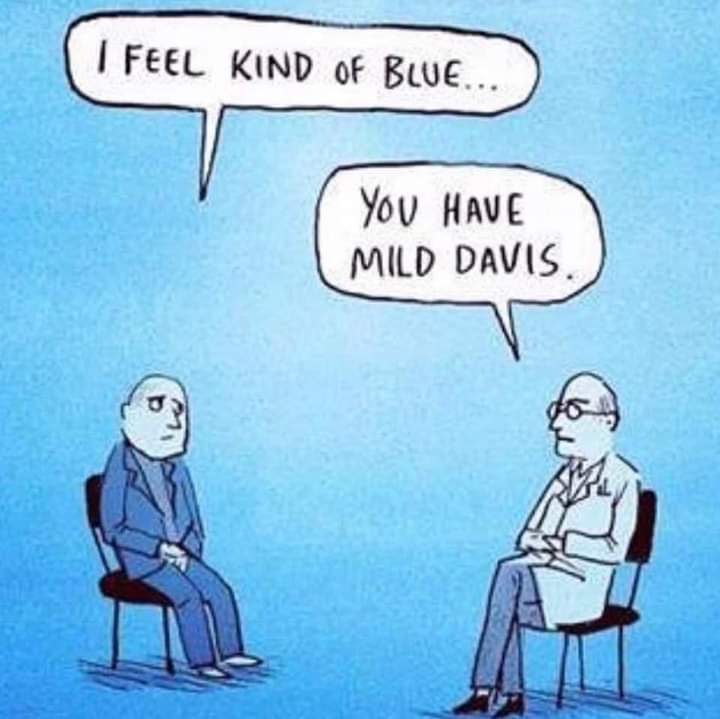
Miles Dewey Davis III
May 26, 1926 – September 28, 1991
The Giant Among Giants
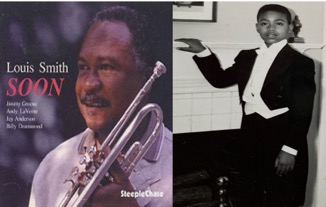
To call Miles Davis brilliant would be a gross understatement. He was a giant among giants in the bebop era, standing apart from an extraordinary generation of trumpet players that included Dizzy Gillespie, Freddy Hubbard, Blue Mitchell, Lee Morgan, Dizzy Reece, Eddie Henderson, Donald Byrd, Fats Navarro, and Kenny Dorham — not to mention my own high school band director, the great Louis Smith. All of those men were exceptional. Miles was transcendent.
My introduction to his world came through Steamin’, released in 1956 — an album I still return to today. It featured his first great quintet: Red Garland on piano, Paul Chambers on bass, Philly Joe Jones on drums, and the immortal John Coltrane on tenor saxophone. Garland, a former prize fighter who recorded prolifically on his own, nonetheless deferred entirely to Davis. Midway through a solo on “Something I Dreamed Last Night,” Miles called out “block chords, Red” — and Garland shifted instantly, without missing a beat. Coltrane, characteristically, did not bend so easily. When Miles once asked him why his solos ran so long, Coltrane replied simply, “It takes a while for it to come out of the horn.” Being a clarinet player, I take particular delight in knowing that even the immortal Coltrane squeaked on “Diane.”
A Sound Unlike Any Other
My father’s reaction when I first played that album stays with me. He was a big band man — Count Basie, Duke Ellington — and he had no patience for what he heard. “How can you listen to that noise?” he said. “They’re all playing different things at the same time!” His measure of worth was simple: if you couldn’t dance to it, it wasn’t worth your time. I can only imagine what he would have made of Thelonious Monk.
Miles was cut from different cloth entirely. The son of a dentist, he enrolled at Juilliard in 1944 only to abandon it for Charlie Parker’s quintet — a decision that said everything about where his ambitions lay. He stayed with Parker until 1948, then formed his own group. Album after album followed. He collaborated with arranger Gil Evans on landmark records, including Sketches of Spain. Then came Kind of Blue.
Kind of Blue may be the most beloved jazz album ever recorded. It featured Coltrane, Chambers, drummer Jimmy Cobb, Julian “Cannonball” Adderley, and two pianists: Wynton Kelly and Bill Evans. Evans had briefly replaced Red Garland, making the group one of the first racially integrated bands in jazz. Kelly replaced Evans as the permanent pianist, yet both appear on the album. Davis told Kelly to study Evans — not to imitate him, but to better understand how to play alongside Miles. The session itself was famously spontaneous. Davis sketched out the songs beforehand and most were captured in a single take.
The Second Great Quintet
A second great quintet followed, featuring Kelly, Chambers, Cobb, and the formidable Sonny Rollins. When Rollins departed, he was replaced first by George Coleman, then by Wayne Shorter — who would become the band’s principal composer. The final lineup, with Herbie Hancock on piano, seventeen-year-old Tony Williams on drums, Ron Carter on bass, and Shorter on saxophone, was something else entirely. Williams, with characteristic bluntness, reportedly pushed Coleman out, feeling his playing had grown repetitive. With Shorter’s arrival, everything shifted.
This band still played many of the same songs as earlier Miles groups, yet made them sound entirely new. The texture, phrasing, and rhythmic sensibility had been transformed. Listen to Four and More or My Funny Valentine, then put on E.S.P. or Nefertiti — Davis’s last fully acoustic album — and the evolution is unmistakable. I once heard a live recording of “Joshua” played at a breathtaking tempo from inside my SUV, and the quintet was simply at the top of its powers. Hancock and Williams were electric — the drumming frenetic, blistering, and utterly alive. It was stunning.
Going Electric
When Miles went electric with In a Silent Way and Bitches Brew, he shed most of his traditional jazz audience without hesitation. The expanded ensemble — adding pianists Chick Corea and Joe Zawinul, bassist Dave Holland, and others — had been shaped by Davis’s obsessive listening to Sly and the Family Stone and Jimi Hendrix. He even recorded with Prince. This era culminated in Agharta, where Davis also took up the organ.
Agharta is one of only two Davis albums I struggle with — Decoy is the other. But Miles never seemed to register the alienation of traditionalists, or if he did, he didn’t care. In truth, he had been alienating purists even in his acoustic years. His stage presence was famously cold: back to the audience, rarely a word spoken, prone to walking off mid-set while his bandmates continued playing, and just as likely to barrel back onstage and cut short a colleague’s solo. And yet — I have a recording of Davis accompanying the magnificent Shirley Horn on “You Won’t Forget Me,” and in that setting he is the model sideman: restrained, attentive, adding precisely the right touch at the right moment to support her poignant voice.
Legacy and the Road That Led Here
Davis was brilliant through it all — through heroin addiction, a hip replacement, and a five-year absence from music between 1975 and 1980, during which he later wrote that “sex and drugs took the place music had occupied in my life.” When he returned, Decoy is the only album of real substance before his death in 1991. Like many of his contemporaries, he lived surrounded by temptation. My band director, Louis Smith, was the trumpet player in the celebrated Horace Silver Quintet — his dazzling work is on display in Silver’s Live at Newport ’58. Mr. Smith told us that his wife had issued an ultimatum: leave the band or lose the marriage. His first “real job” landed him at Atlanta’s Booker T. Washington High School in 1958, and I was one of only three eighth graders in the varsity band that year. I was twelve years old. Sitting in the band room, my feet did not reach the floor.
It was Mr. Smith who put Steamin’ in my hands and made me a Miles Davis fan for life — through all the transformations, all the controversies, all the years. We have had other great players. But there has been only one Miles Davis.
Happy Birthday and rest in peace.


What a great unpacking of a musical masterpiece!
You’ve now inspired my back porch cigar-smoking musical immersions with a genre I’ve only dabbled in previously. I’m going to create a playlist of all that you’ve listed here as the starting point.
When I was in college, a radio station in Charlotte (WBCY) had a Sunday evening show from 7-11pm called ”Jazz Flavors,” but it seemed to pickup on the era just after what you’ve described. It was much more focused on “smooth jazz,” featuring artists like Spyro Gyra, Path Metheny, Bob James, and my personal favorite Earl Klugh. That music was the backdrop to our Sunday night study time (not that it helped that much).
A great review – I heard a similar deep story on NPR this morning. Amazing life stories and talent.
LikeLike
I like some of “smooth jazz” – Boney James, Richard Elliott, Rick Braun – but too much of it sounds the same. We heard Earl Klugh in a jazz festival in Grand Cayman years ago. Also a favorite. But Miles is different. He molded great players into his style. Just look how many had styles completely different when they left his band (Hancock, Adderley, Zawinul, Corea, even Shorter and Coltrane). As my son texted “Miles was the best!’
LikeLike
When a young kid drove his bike into my mailbox, it took substantial help fm neighbors to resurrect it. But I would have no other way to learn that this young kid was a clarinet player. So I knew he was not reckless youth….maybe a future musician?..
….”At first glance, the two highest-selling jazz records of all time are opposites in their makeup. The first, Miles Davis’ Kind of Blue, is a celebrated masterpiece of innovation and radicalism—a moment in time when an eccentric genius decided to turn his back on standard chord progressions and redefine what the genre could sound like. The other, A Charlie Brown Christmas, was made mostly in one three-hour session in conjunction with a 1965 TV special paid by The Coca-Cola Company…”. VICE 2016..
I’ve heard these two albums are the greatest-selling jazz albums.
Miles Davis and many mentioned here, I know thru essays like yours. Not that familiar. But I will see your bet , and raise you a Papa John Creech.
LikeLike
Charlie Brown Christmas- really? I remember the Vince Guaraldi album but had no idea of its popularity. Poppa John Creech?
LikeLike
Take what you can get category: Charlie Brown soundtrack probably introduced many to jazz. .
Wiki says I spelled Creach wrong. I pull out that name just to show off..
…..”John Henry Creach (May 28, 1917 – February 22, 1994),[1] better known as Papa John Creach, was an American blues violinist who also played classical, jazz, R&B, pop and acid rock music.[2] Early in his career, he performed as a journeyman musician with Louis Armstrong, Fats Waller, Stuff Smith, Charlie Christian, Big Joe Turner, T-Bone Walker, Nat King Cole and Roy Milton.[2]….”
LikeLike