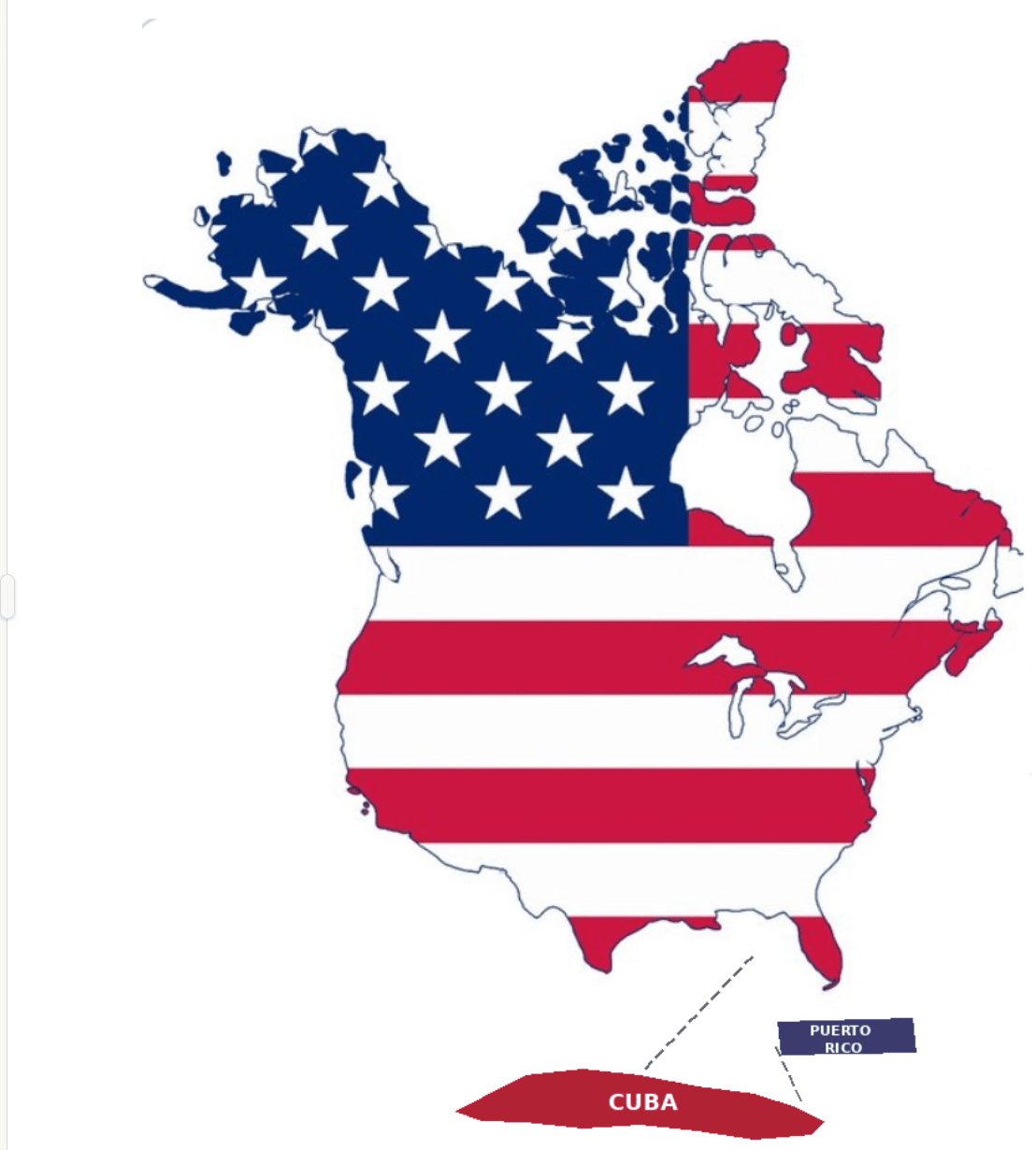
More States? Yes please!
Democrats have long championed adding Washington, D.C. and Puerto Rico as new states to increase their clout in Washington. That proposal has always met with resistance from the right – and rightly so. However, there is a way to add the new states if their residents want to join the Union. First, D.C. would need to incorporate the portion of Northern Virginia originally intended to be part of the nation’s capital. The democrats might resist that since it would weaken their hold on Virginia. Second, historical precedent calls for offsetting additions: when one side of the political ledger gains, the other must as well. The Missouri Compromise of 1820 offers the classic example — Missouri was admitted as a slave state, balanced by Maine entering as a free state. More recently, Hawaii and Alaska became states in 1959 with Hawaii in the democrat column and Alaska in the republican. Balance. Balance. Balance.
So what might balance the admission of D.C. and Puerto Rico? Two candidates stand out: Cuba and Alberta, Canada. Cuban-Americans lean heavily Republican and that political orientation may well extend to the island itself. Alberta, meanwhile, is Canada’s most conservative province and has long chafed under Ottawa’s thumb and the influence of the more liberal central provinces of Quebec and Ontario. Alberta is already exploring a referendum on secession — an effort unlikely to succeed, but one that reflects a strong separatist core. As an independent country, Alberta would likely be too small to stand alone. Aligning with its neighbor to the south, however, is a different matter.
The numbers are worth examining. Cuba, with 11 million residents, would have eight representatives and two senators. Alberta’s four million people would translate to five representatives and two senators. On the Democratic side, Puerto Rico’s three million residents would bring four representatives and two senators, while D.C.’s 700,000 people would yield two representatives and two senators. Assuming Alberta and Cuba lean Republican while D.C. and Puerto Rico lean Democratic, the math favors the GOP: up to 13 new Republican representatives and four new senators, versus six new Democratic representatives and four new senators. Republicans would likely find that arithmetic appealing — Democrats, considerably less so. Of course, something would have to be done with the fixed number of representatives now set at 435 by the Reapportionment Act of 1929. But let’s look at the two new potential candidates.
Cuba
Cuba has a long and complicated history with American expansionist ambitions. In the antebellum era, southern politicians eyed Cuba as fertile ground for expanding slavery into the Caribbean. President James Buchanan and the Democratic Party actively sought to annex the island as a slave state. Annexation was described as Buchanan’s “favored project” and, by 1859, his best hope for securing renomination in 1860. He dispatched an envoy to Spain to negotiate a purchase and democrats introduced legislation in Congress to that end. The effort collapsed with the rise of the republican Party as an anti-slavery party in the 1850s — republicans made clear they would block any new slave state, while looking westward for the addition of more free states.
Fast-forward to today and Cuba is back in the American political conversation. A buildup of U.S. forces in the Caribbean has fueled speculation about the administration’s intentions. President Trump has made a series of pointed remarks, cutting off Venezuelan oil to Cuba, threatening other nations with tariffs if they fail to follow suit, and making blunt statements about the island’s future. “I do believe I’ll have the honor of taking Cuba. Whether I free it, take it, I think I could do anything I want with it.” Cuba’s foreign minister responded by warning the country was preparing for “the possibility of military aggression.” Trump has added, “Other presidents have looked at this for 50, 60 years. It looks like I’ll be the one that does it.”
The legal pressure has followed. The U.S. indicted former Cuban president Raúl Castro for murder over the 1996 downing of two planes that killed American nationals — a move Cuba’s current president, Miguel Díaz-Canel, dismissed as “a political stunt designed to justify possible American aggression.”
Cuba itself is in crisis. Decades of communist mismanagement and American sanctions have pushed the island to the brink with widespread power outages, fuel shortages, food scarcity, and collapsing infrastructure. Against this backdrop, some politicians — many of Cuban heritage — have begun openly discussing a Puerto Rico-style territorial arrangement. Representative Nicole Malliotakis (R-NY) called it “a real option” that deserves more serious consideration. Representative Carlos Gimenez (R-FL), born in Cuba, agreed it is worth exploring. Senator Ted Cruz (R-TX) did not rule it out. Marco Rubio offered more measured language, saying he would prefer a diplomatic resolution — though Cuba’s foreign minister accused Rubio of “inciting military aggression” and falsely labeling Cuba a state sponsor of terrorism.
It is notable that every American politician quoted above is Republican. Proponents of statehood argue that bringing Cuba into the American orbit would unlock economic opportunity, strengthen regional security, alleviate humanitarian suffering, and curb migration pressures — all while adding a likely Republican-leaning state to the union.
Alberta
Alberta is moving toward a vote on secession from Canada. Premier Danielle Smith has announced a referendum for October 19, 2026, and has publicly committed to placing an independence question on the ballot if a petition effort succeeds. Unlike Cuba, Alberta comes to the table as an economic powerhouse. The province holds vast oil and gas reserves, is among the world’s top producers of wheat and canola and boasts thriving technology hubs in Calgary and Edmonton. Add to that significant deposits of coal and precious metals — including rare earth minerals — and the economic case becomes hard to ignore. Many Albertans already feel a closer cultural and economic kinship with the United States than with Ottawa.
Canada’s National Observer has gone so far as to argue that Premier Smith is “already turning Alberta into the 51st state,” suggesting it is her ultimate political goal. Smith’s government has been restructuring Alberta’s healthcare system along decidedly American lines, expanding the role of private insurance and the private sector. Her rhetoric, too, echoes that of American conservative politics. Sounding like Donald Trump, Smith has said “An unelected judge is not synonymous with democracy. Democracy is when elected officials who have to face the electorate every four years get to make decisions.” The article’s author concluded that Smith may be using these policy shifts as a cultural and legal runway toward eventual annexation.
President Trump has rattled sabers across the entire hemisphere — threatening to annex Greenland, repeatedly suggesting Canada become the 51st state, and publicly belittling Prime Minister Mark Carney. I have written before that it would really be dumb to annex all of Canada but why not just Alberta? It is resource-rich, politically aligned and eager for a new direction. It’s rich resource base, strong technology and political philosophy would make it attractive from a Republican standpoint. It is difficult to see the downside – unless you are a democrat.


This is why people read this blog! Always something new..
By its very nature this blog is about politics , and I would like to consider we are talking about real people & families..
But, let’s recall Obama did make inroads with Cuba until Trump stopped it..
I don’t know about Canada, but I do recall a visit to Quebec- where I spent the vacation in silence , afraid to speak because of the French-English language wars..
Wherever you’ve got people you’ve got problems. And capitalism will again fall to the power of politics- as ‘leaders’ play chess, WeThePeople living in the world they create..
There’s no mention of Texas leaving America- which I think would help America’s morale. Those advocating say you ‘foreigners’ – that’s us- would have six months to change citizenship or leave.
Can the U.S. get their military out that fast? Can the Republic of Texas get their own money and postal stamps and issue new licenses to lawyers that fast?..
I recall there were people going to Texas to bring secession. Then that weather freeze happened . Then the thaw. Damage to schools and homes. Then insurance claims to pay for recovery.
Hey- Texas-silence was the result: The Great Independent Sovereign Texas didn’t mind shared-risk insurance Socialism, or Big Government interference..
The borders of the World change. Or should I say human trafficking – that’s us- remains a constant.
LikeLike
Texas! Watch out for tomorrow’s.
LikeLiked by 1 person
Will do !
LikeLike
It’s always interesting to note when Democrats have their wild-eyed ideas about how to destroy the institutions in this country, only to realize on the backside that they have opened an unintended door to a future they didn’t consider.
I love the balance concept – an eye for an eye type of method. You want to add liberal senators and representatives, then what’s good for the goose….Alberta would be a great addition, and Cuba – while a mess right now – would become an island oasis for millions, with billions of dollars flowing behind…
The other item that’s being bandied about is less intriguing and more harmful. Democrats whine constantly about separation of powers when Trump oversteps his bounds, but have nothing to say beyond silly justifications for taking the Supreme Court to 13 AND determining which cases get a hearing. How can they possibly think it appropriate for one brand to dictate in such a way to another branch? So much for check and balances. It’s more like “our checks” and imbalances.
LikeLike
Politicians can be so dumb at times. Do they think that if they expand the court to 13 that it will stay liberal from here to eternity? But determining what cases go to SCOTUS is sobering but once again even if implemented would eventually come back to bite them.
LikeLike
I appreciate staying on topic with the essay. But nothing is said in consideration for family homes, small business, private property- that came into being in one country, but suddenly end up in another..
I did not like Obama’s reaching out to Cuba. But not because of party.
Business articles said U.S. would come into Cuba and wash present residents out to sea. But Trump did not gut Obama-plans for humanitarian purposes.
If anyone wants to go conservative , let’s extend the concept of Replacement Theory to anyone not American right now.
LikeLike
Larry, We cannot cover every thought. I wish that all comments would stay on topic rather than stray from them. Let’s discuss one thing at a time. I appreciate Pat doing this.
LikeLike
And I will look forward to a deeper dive. For every country is made up of individuals. And every capitalist system is made up of business- small to medium.
LikeLike
I wouldn’t want any more states that require welfare recipients be taken care of.
LikeLike
Cuba and Puerto Rico would be a welfare disaster.
LikeLike
Puerto Ricans are already citizens and some must already be on welfare. Cubans be welfare dependent? That’s an empirical question.
LikeLike