This week’s Open Market Committee Meeting: Will the Fed hold?
The latest inflation numbers are in and its not good. Consumer prices in May were up 4.2%, mainly due to gas prices. We have had this discussion before so what about “core” inflation that excludes energy and food? Well it was up 2.9 percent, above the Fed’s target of 2 percent. All this means is that at the next Fed Open Market Committee meeting this week (June 16-17), there is zero chance of a decrease in the Fed funds target rate. In fact, I fully expect the discussion to be whether there should be an increase in rates and virtually no sentiment for lowing rates since Miran is no longer there. Even if the current spike is deemed transitory, there is that worrisome 2.9 percent in the core rate that is troublesome. In the end, though, the committee will vote to hold. What will be interesting is to see whether the announced vote is unanimous.
What the Fed Futures Market Is Telling Us
The market is predicting with a 97.4% certainty that the committee will vote to hold. Now how does the market know? It is from the Fed funds futures rates for the next month. Investopedia says that “Fed funds futures are financial contracts traded on the Chicago Mercantile Exchange (CME) that track the fed funds rate which is the overnight lending rate between banks. Their prices reflect market expectations of future rate changes, allowing banks and traders to hedge or speculate on U.S. interest rates influenced by Federal Reserve policy.”
“CME’s 30-day fed funds futures are monthly contracts listed for 60 consecutive months and cash-settled on the last business day of every month. The CME also lists options on fed funds futures contracts expiring within two years.
The 30-day fed funds futures’ contract price is the arithmetic average of the daily effective federal funds rates during the contract month as reported by the Federal Reserve Bank of New York, subtracted from 100. So if the effective fed funds rate were to average 1.75% for a given month, the settlement price of the fed funds futures contract expiring that month would be 100 – 1.75 = 98.25.
The minimum contract size is expressed in U.S. dollars by multiplying the contract price by $4,167. In the example above, it would be 98.25 x $4,167 = $409,407.75.
Options on the fed funds futures contracts are American-style, meaning they can be exercised on any business day prior to expiration.”
Got that?
Going to CME’s website shows CME FedWatch probabilities represent the market’s expectations regarding the likelihood of changes to the federal funds target rate at upcoming Federal Open Market Committee (FOMC) meetings.
https://www.cmegroup.com/markets/interest-rates/cme-fedwatch-tool.html
So there you have it! The markets have spoken. Now will the Fed listen? Stay tuned.
Global Central Banks Are Already Moving
Other central banks, not faced with Donald Trump’s threats, are raising their rates. The Bank of Japan has raised its rates to a 30 year high, prompting a sell off of government bonds raising those rates to over 2 percent for the first time since 1999. The rate is only raised by 25 basis points to 0.75% but Japan has been running negative rates for some time now. Real rates in Japan (rates adjusted for inflation) are still negative. The European Central bank also raised its rates 25 basis points from 2 percent to 2.25 percent. Central banks in Australia, Norway and the Philippines have also raised rates in the face of increasing inflation.
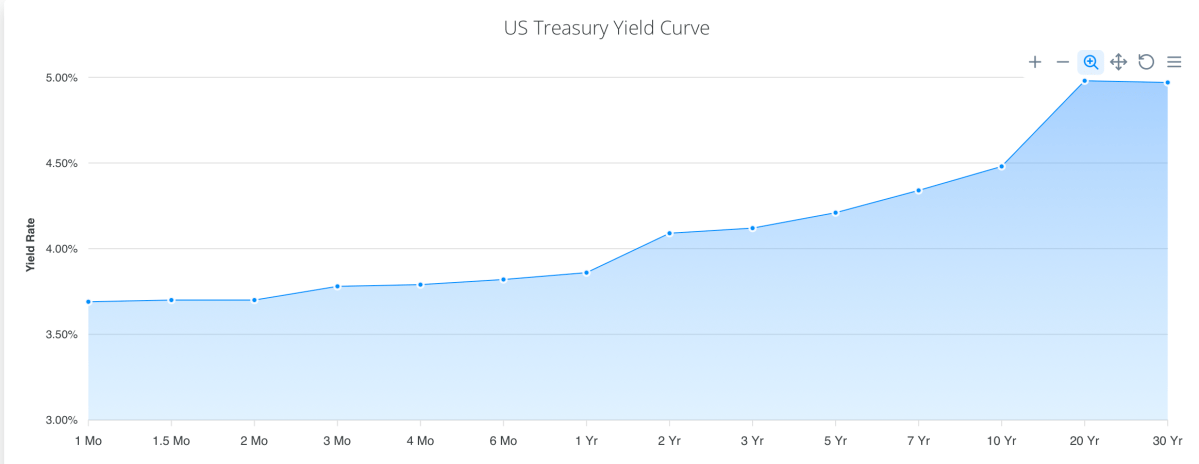
Meanwhile back in the USA, although the short term Fed funds futures market is predicting a hold, the longer term market is not as certain. The ten year Treasury is rising. The graph shows the Treasury yield curve for June 12, 2026. The sharp rise in long term Treasurys shows that the market is expecting the inflation to continue as long term Treasurys rise relative to short term Treasurys. One prominent economist is actually calling for an increase in rates at this month’s meeting.
Fat chance!
But when the Fed meets again July 28-29? Now that will be a closely watched meeting especially if inflation is not coming down. Indeed, CME’s FedWatch is now predicting that there is a 70 percent likelihood that the Fed will raise rates at its October meeting. All I can say to Kevin Warsh is BEWARE THE DONALD!!!

