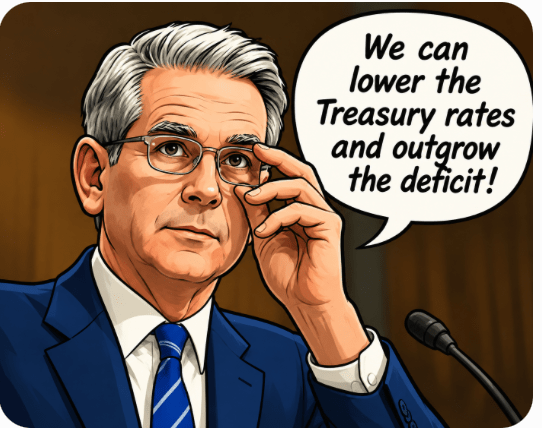
Bessent Should Know Better
Bessent tries to manipulate the Treasury bond market
Treasury Secretary Scott Bessent, who always gives off the impression that he is the smartest man in the room obviously relished the opportunity to embarrass Elizabeth Warren who criticized his propping up the Japanese yen. Warren wrote “that “American taxpayers would ultimately bear the cost if Japan were unable to repay the Department of the Treasury.” Bessent leapt at the opportunity to chide Warren on X saying: “In her latest sciolistic letter to me, @SenWarren made it clear that she knows even less about foreign exchange markets than she does about banking.” And “For a fuller explanation, I recommend Senator Warren take any entry level course in international finance for her and her staff, or l can personally give her a tutorial on Foreign Exchange for Dummies. Although I am not holding my breath, I hope her next letter will demonstrate that she has learned the difference between a currency purchase and a swap or a loan.” I wonder if Warren had to look up “sciolistic”?
Warren may be ignorant of international economics but those that do who are critical of Bessent’s forays into international currency intervention which are only short run patches for long term problems (but maybe Bessent is only worried about the short run). See “Bessent becomes the most interventionist Treasury chief in decades” https://fortune.com/2026/08/20/scott-bessent-treasury-interventionism/
Bessent presumably picked up his intervention playbook during his years working for George Soros, is now putting it to use in Washington. He first helped prop up the Argentine peso to support Javier Milei, buying the currency directly. Then he intervened using euros to bolster the Japanese yen. Now he’s turned to the Treasury bond market itself, doubling the Treasury’s buybacks of long-term bonds. (A quick primer: when Treasurys mature, bondholders roll a portion of the proceeds into new bonds, and the Treasury buys back the rest. Bessent announced the buyback pace would double.)
Why do this? The goal is to shorten the average maturity of the debt by financing more of it with shorter-term Treasurys, which carry lower yields than long-term bonds — in theory, lowering the government’s overall interest costs. How did the markets react? They dumped dollars for gold and cryptocurrency signaling that Bessent was making Treasurys and the dollar look like a less reliable safe haven. Instead of long-term rates falling, they rose. The dollar fell 0.7 percent while bitcoin jumped 22 percent. Oops.
Buybacks don’t touch the actual drivers of high Treasury rates: inflation and a ballooning federal debt. Another credit downgrade, echoing 2011, would not surprise me. Bessent himself once argued that the administration could bring down yields and lower borrowing costs for Americans the right way — by cutting the budget deficit (thereby shrinking the supply of Treasurys) and ramping up oil and gas production to bring down energy prices. He was right then. He’s wrong now. Having failed to address the underlying problems, he’s resorting to tactics meant to artificially move the market. He should know better: other Treasury secretaries have tried the same maneuver before and failed, and no one can permanently move a $31.5 trillion market.
It’s also worth remembering that his boss’s fiscal record hasn’t helped, and neither has his fixation on tariffs. When Trump declared “Liberation Day,” markets responded by selling off Treasurys, worried that foreign governments would retaliate by dumping their own holdings — and many did, shifting part of their reserves into gold instead. There’s also a factor Bessent has no control over at all: the explosive growth of AI-related corporate bonds. Economists call it “crowding out” — when government borrowing pushes up interest rates and squeezes out private investment. Here we’re seeing something like the reverse dynamic: private AI bonds are crowding out Treasurys, as investors substitute corporate debt for government debt, shrinking the pool of buyers willing to hold Treasurys and pushing their yields higher. Basically, the market is saying that AI bonds are a safer bet than Treasurys.
Despite Bessent’s intervention, 30-year Treasury yields sit at 5.3 percent and mortgage rates are above 7 percent. As one trader put it, Bessent is used to taking actions with short-run impact, while the problems he’s up against are structural and long-term. He may be trying to relive his Soros days, when he helped break the Bank of England and forced the pound to crash in 1992. But this isn’t 1992. As one market observer put it, governments that defend prices against fundamentals always lose — the only question is how much they spend before they concede.
Bessent can’t do math, either
Bessent says the United States can grow its way out of its federal debt. He should know better and probably does. But he is taking the easy way out of the Federal debt crisis by avoiding making difficult decisions. Speaking to “Squawk on the Street” co-host Sara Eisen on CNBC, he said there’s nothing magic about the $40 trillion figure and that the economy can outgrow it. Then, following the administration’s usual script, he pinned the blame for the deficit on his predecessors, saying the Trump team “inherited a mess” after the Biden administration ran the highest deficit-to-GDP ratio in history outside of a war or recession — conveniently overlooking that this administration has since added fuel to that fire with its “Big Beautiful Bill,” tariffs, and the Iran conflict.
Bessent seems to be channeling his inner Ronald Reagan, who argued the economy could outgrow the national debt through tax cuts and spending restraint that spurred growth. Reagan’s view was that the real problem wasn’t the deficit’s size but the government’s overall claim on the economy. But he still considered deficit reduction essential.
But can we really grow our way out of the debt? Not according to the math. In “America Can’t Outgrow $40 Trillion in Debt,” Peter Earle calculates that doing so would require real (inflation-adjusted) income growth of nearly 7.3 percent per year — and that’s assuming the debt itself doesn’t grow further and interest rates stay flat. Real income growth rarely approaches 7 percent, let alone sustains it annually. Even the Reagan expansion of 1983–1989 produced “only” 4.4 percent real GDP growth. Earle notes that the CBO (my former employer) currently projects real GDP growth of just 2 percent, below the long-run historical average.
So where would higher growth even come from? Population growth is slowing due to an aging population and tighter immigration policy. AI, perhaps? The CBO estimates that AI-driven productivity gains will add only about 0.1 percentage point to annual growth. Earle then assumes an exceptionally bullish alternative with AI adding 1.5 percentage points to annual productivity growth. Combined with roughly 0.4 percent labor-force growth and the economy’s existing productivity trend, the U.S. would then sustain real growth of 3.5 to 4 percent. That would be a genuine economic triumph — and still only about half of what the debt math requires.
The bottom line is that 7.3 percent annual GDP growth is essentially impossible. Even when Earle sets aside the biggest obstacles — spending restraint, entitlement reform, tax policy, and fiscal discipline generally — that number remains out of reach. So why did Secretary Bessent make the claim? Did he assume no one would fact-check it? Apparently Sara Eisen did not know enough to push back. But insisting we can simply outgrow this $40 trillion debt is flat wrong, and it suggests the secretary can’t do math.
 haroldblackphd.com
Funny – I wonder if Warren had to look up “sciolistic”?
Great point. In other words, central planning doesn’t work.
– As one market observer put it, governments that defend prices against fundamentals always lose – the only question is how much they spend before they concede.
LikeLike