The Federal Reserve Bank of Kansas City’s Annual Jackson Hole Symposium
The Fed just held its annual symposium at Jackson Hole, Wyoming — rather the event is actually hosted by the Kansas City Fed. This year’s theme was “Financial Innovation: Implications for Payments and Policy.” But you would never know it. The media, as always, fixated on the Chairman’s remarks, parsing every word as though reading entrails. But the Chairman’s actual role is only to deliver brief introductory remarks. The conference’s real substance is the invited research papers from academics and the discussions that follow.
https://www.kansascityfed.org/research/jackson-hole-economic-symposium/2026
You’d never guess that from the coverage. The conference has changed since the days when I was, for a time, important enough to be invited — and even, on one occasion, to present my own research. Back then it featured work by economists from the Fed Board in Washington and the regional reserve banks, with occasional papers by outsiders. It was held at the Jackson Lodge, near a trout stream where the kitchen would cook whatever you caught for breakfast (though grits, sadly, were missing from the menu).
The chairman’s remarks in those days — a welcoming address, nothing more — barely registered in the news. Not anymore. This year the media fixated entirely on what Warsh had to say and ignored everything else. For anyone interested his full remarks are here:
https://www.federalreserve.gov/newsevents/speech/warsh20260828a.htm
It was an address that moved markets – not the introductory chitchat about hiking trails – but his comments on the economy and his posture as chairman. There was absolutely nothing new in what he said. Yet the media treated it as major news. Even the markets reacted. After a brief rally, the Nasdaq Composite, S&P 500, and Dow Jones Industrial Average closed down 0.5%, 0.3%, and 0.1% respectively. What actually captivated the markets was this line: “While this summer’s PCE and CPI readings were better than expected, they do not tell me that underlying trends have meaningfully improved.” Traders read that as a signal the Fed is more likely than before to raise rates at next month’s Open Market Committee meeting. CME Group’s FedWatch tool now puts the odds of a hike at 62%, up from 36% just before the speech.
For the record, I doubt if the Fed raises rates in September, even though a group on the committee will push for it. If inflation doesn’t fall below 3% – which it won’t – I do think we’ll see a hike at either the October or December meeting. Warsh presents himself as an inflation hawk, but my guess is he’ll delay a rate increase as long as he can, hoping inflation recedes on its own in the months ahead. Still, I’m glad to see him steering the Fed back toward its core mandate of controlling inflation, rather than wandering into the political arena the way some of his predecessors did.
I’d guess that once Warsh wrapped up his brief remarks, the press rushed out of the room and the conference proceeded largely unbothered by reporters — with sessions on “Innovation in Tokenized Finance,” “International Experience with Payments Innovation,” and “Financial Innovation and the Future of Banking.”
And I’d guess, too, that later the attendees went out for a hike — or maybe a little trout fishing.
 haroldblackphd.com
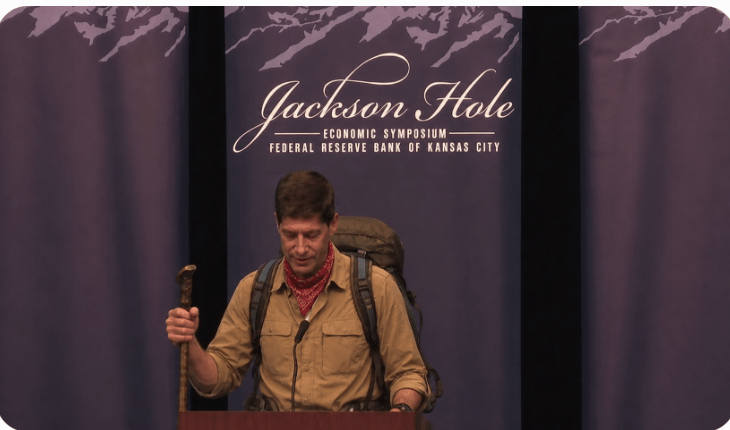
Did he really make appearances in hiking gear?
That’s OK if he did. I think the references to hiking and his other encounters – which came across well in his speech- are a great way to get the attention of ordinary folks, who will never be invited to the conference…
Bloomberg says they are watching the increase in wage pay. and the passing-on of labor costs.
Altho I think this blog has expressed a wish to divide labor fm actual Fed decisions, the Warsh link does talk labor:
….”When labor supply is barely growing, monthly job gains are naturally going to run low. There are always areas of concern in the labor market—for example, among recent graduates. In general, though, people who want to work, by and large, are holding or finding jobs. They may well be concerned about possible future labor disruptions, but as of now, I believe the labor markets are consistent with full employment…”
In the link, this caught my eye. What does this mean? Is this a statement the White House would be happy to with? :
….”And I believe when policymakers make quasi-commitments on interest rates through the cycle, we inhibit our own freedom to make the right calls when it’s time to decide….”
LikeLike
I had AI dress him as a hiker – since he mentioned it in the speech.
LikeLiked by 1 person
Amazing.
On similar lines, knowing you use Claude, did you see this?:
…”In mid-July, the University of Tennessee Research Foundation filed the first ever patent infringement lawsuit against Anthropic, an artificial intelligence company known for creating the popular language model Claude….”
Daily Beacon 8/26
LikeLike
Warsh is proving himself to be just the tonic the Fed needs to right its ship. He refuses to give forward guidance, thereby allowing the day traders and profit mongers to rattle the markets.
We live in a “headline” world. CNBC is a good example of the insatiable appetites of the financial news world. What historically was delivered by Barrons and the WSJ is now “BREAKING NEWS” every 5 minutes as a means to keep eyeballs glued to meaningless chatter among the “experts” of the moment. What you never see is a hitting percentage from these experts on their urgent predilections or predictions.
I like Warsh’s early actions. He’s finally putting congress on the hook to start cleaning up their messes without the Fed bailing them out. Look for major league caterwauling from politicians – and Trump. The honeymoon will be short, I predict. As Trump becomes more irrelevant, we’ll hopefully see Warsh continue to flex his analytical chops. He has a mandate. Let’s see if he’s serious in driving it, despite a Tariffer In Chief who doesn’t understand economics, or worse – understands and does it anyway. Clearly, Trump is willing to let the American consumer pay for the financial dalliances of people such as himself and Congress who see us as “house money.”
LikeLiked by 2 people
I feel the same about Warsh. I am somewhat encourage that Trump actually talks to him often as opposed to how he treated Powell. Let’s see how long that lasts and when will the shouting start.
LikeLike
Although I don’t approve of allies spying on each other, I’m sure it happens more than we know. Israel has never been found to have harmed the U.S. with spying. Jonathan Pollard is another issue altogether and he was a true spy, trying to make a buck. I surely don’t feel that AIPAC needs to register as a foreign agent. However, CAIR and its proxies should register as foreign agents. Although CAIR has not been proven to be directly harmful to the U.S. it’s proxies certainly have.
LikeLiked by 1 person
I am not an expert on harm but I do know several geopolitical experts that would disagree with you on that point. I think that both AIPAC and CAIR should be registered as a foreign agent. But that is the opinion of an admitted novice in this area. I am as always open to be educated and proven wrong.
LikeLike