The Fed Raises Its Target Rate
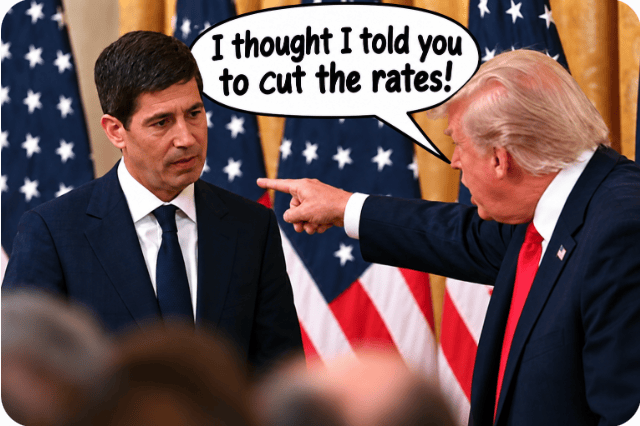
Kevin Warsh and the Fed’s Open Market Committee just defied the president, raising the federal funds target range by 25 basis points, from 3.50%–3.75% to 3.75%–4.00%. The vote was unanimous, and committee members signaled that another increase is likely before year-end. The move came despite the president’s repeated demands to lower rates to 1 percent or less and his threat to cut off trade with every country the U.S. runs a trade deficit with if the Fed raised rates.
Good grief.
Warsh, the new Fed chairman, has said he favors a more rules-based approach to monetary policy — a stance consistent with his admiration for Milton Friedman (unlike our economically illiterate vice president). Friedman’s rule grew out of the Quantity Theory of Money, which ties the growth rate of the money supply to the economy’s long-run growth rate. That target wasn’t meant to be fixed forever — it could shift in response to sudden drops in economic activity or bursts of inflation.
The best-known modern monetary rule comes from Stanford economist John Taylor, who posited that the federal funds rate should be set at a long-run neutral level and then adjusted as inflation deviates from the central bank’s target, or as real economic activity deviates from the economy’s full-employment potential. When inflation runs above target or output exceeds potential, the rule calls for raising the target rate; when inflation runs below target or output falls short, it calls for lowering it. In its original form, the Taylor rule currently implies a federal funds rate of 6.02%. Now that would blow off the president’s head!
There are, however, several variations on the original rule, the two most common being the “forward-looking” and “smoothed” versions. The forward-looking variant uses expected future inflation rather than backward-looking data. The smoothed variant weights in the current fed funds rate itself. Combine both adjustments and the rule-implied rate comes out to 3.79% — within and just above the bottom of, the new 3.75%–4.00% range. See the Monetary Rules Report for the full breakdown.
Warsh, who has criticized the Fed’s sometimes slapdash decision-making in the past, says he’s committed to discipline. Friedman once argued that discretionary monetary policy — the opposite of rules-based decision-making — was itself the most disruptive source of instability in financial markets. Warsh appears to be taking that warning seriously. But we’ll see, because he still has to contend with a president who wants lower rates always and forever, regardless of the economy’s condition. As the president put it: “We should be paying — the United States is so strong — we should be paying the lowest interest rate in the world, regardless of their formulas.” Now he’s pinning the rising cost of financing the growing national debt on the Fed and its handling of the fed funds target rate — the rate banks charge each other for overnight loans of excess reserves. Here is the president’s posting:
“Interest Rates in the United States should be 1%, or less, because we are the Best Credit in the World — BY FAR,” Trump wrote. “Our Country is BOOMING with new Investment! If we stopped Trading with every country that we have a Deficit with, which is most of them, we would make, at least, 1.5 Trillion Dollars a year. The word ‘Deficit’ is nothing more than a fancy word for LOSS. We are ‘carrying’ almost every country in the World, and that cannot go on any longer. LOWER THE INTEREST RATES FOR THE UNITED STATES OF AMERICA, AND FAST!”
The president seems to be confusing the Fed funds rate with individual borrowing rates based on the individuals’ credit history. Where is Scott Bessent when we need him to explain the basics of finance to this president? Trump also threatened to cut off trade with the countries with whom we run a deficit if the Fed didn’t cut rates. BTW, saying that if we stopped trading we would somehow “make at least $1.5 trillion a year” is so idiotic it doesn’t deserve a comment — except to say that if that were really the case, he should adopt Nike’s old slogan and “just do it”.
Again: good grief. This is getting embarrassing.
But a relevant question is actually raised by the president: what is the statistical relationship between a change in the Fed funds rate and a change in the country’s borrowing costs, as reflected in the 10-year Treasury. The president seems to think it’s one to one. Research from the Dallas Fed is relevant here. In “What drives mortgage rates and their response to monetary policy changes” by McCormick and Ramaswamy, May 7, 2026, they find: “Historically, over the past 20 years, the 10-year rate has tended to move by a third as much as the fed funds rate (measured using the beta between rolling quarterly changes over that period). Co-movement of 10-year rates with the fed funds rate has diminished in recent years. Over the past five years, it has only been about 15 percent and has even turned negative the past one to two years. For the estimation that follows, we use the long-run average beta of 32 percent as a baseline choice.” https://www.dallasfed.org/research/economics/2026/0507
So there is a positive relationship, albeit a rather weak one. Now, since Warsh and the FOMC raised the rate, will the president now insult Warsh? Bet on it! One Kalshi prediction market puts only a 44% chance on Trump publicly insulting Warsh before year-end. I’ve said before that I don’t really understand prediction markets, but I’d bet against that number — insulting Warsh seems practically guaranteed if the FOMC raises rates again by year-end.
Kalshi had more than $85 million wagered on the FOMC outcome, with only 12% betting that rates would hold steady and 86% betting on a hike. A narrower market focused specifically on the September FOMC decision saw over $42 million in volume, with slightly more than half of participants backing a 25-basis-point hike and just under 45% expecting no change. Again, I don’t claim to fully understand this stuff, but that later prediction market was apparently pricing in a real chance the Fed would hold rates steady and defer a hike to a later meeting — even though the CME was putting the odds of a hike at 90.7%.
One thing that’s gone largely unremarked: if the Fed hadn’t raised rates, markets — which had priced in a hike — likely would have sold off sharply. In that sense, market expectations alone may have forced the Fed’s hand, regardless of political pressure.
One more note: this Fed, true to form, moved in its usual 25-basis-point increment. Larger moves are rare because they risk sending a negative signal to markets and stirring up turmoil — exactly what the Fed tries to avoid. Circling back to an earlier point, Fed critics could argue that current inflation is transitory, driven by elevated prices tied to the conflicts in the Middle East and Ukraine, and that the right call was to hold rather than hike. I’m sure that argument came up at the FOMC meeting — and was apparently rejected unanimously.
 haroldblackphd.com
3 cheers for the FOMC and Warsh’s deafness!
if it is true – and my bet is that it is – that inflation levels are transitory based on energy prices, then the FOMC can start lowering rates in reaction. The school aged media in this country would be shocked to see the 20% mortgage rates of the 1980’s, and the Fed is well guided to keep a lid on inflation that’s eats at real wages and acts as a stealth assassin.
Warsh will need a steely edge for a few months. When Trump’s follies come to bear in a disastrous midterm election, he will be defanged as a two year lame duck. Warsh can then just quit taking Trump’s calls….
LikeLike