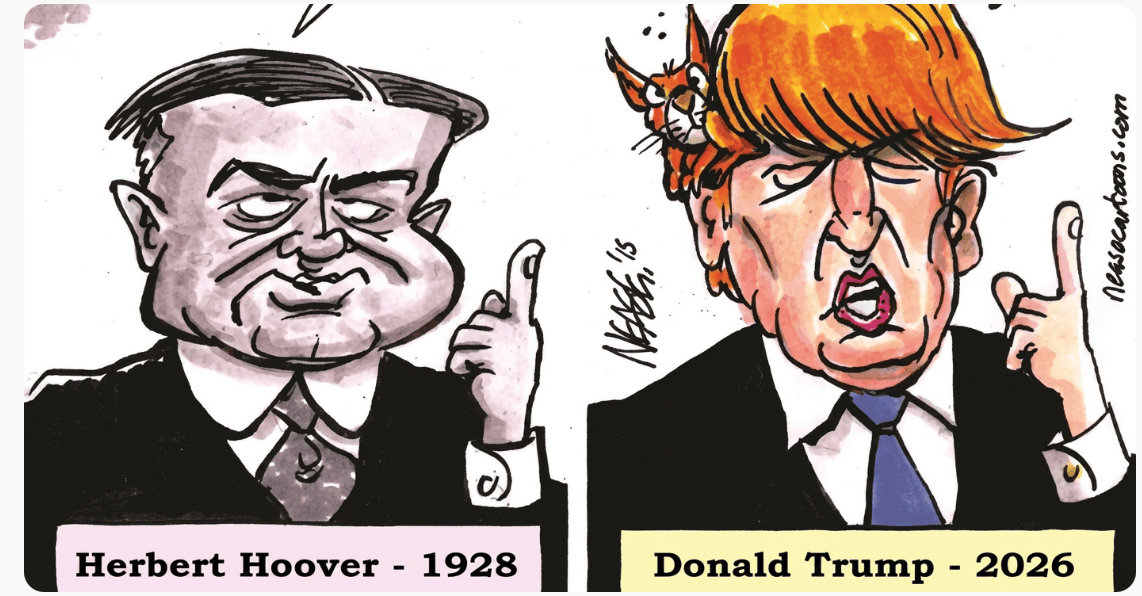
Is Donald Trump Herbert Hoover?
In 2024, Trump said that if there was a crash, he hoped it would be before he took office because he did not want to be another Herbert Hoover. He said, “The one president—I just don’t want to be Herbert Hoover.” Hoover is, of course, rightly or wrongly, blamed for the Great Depression simply because it began on his watch. Hoover had been in office less than a year when the market crashed, but nevertheless history puts the blame on him. Until now, Hoover wore the mantle as having the worst economic record of any president. Yet an aide to Franklin Roosevelt said that “practically the whole New Deal was extrapolated from programs that Hoover started,” arguing “his (Hoover’s) policies were substantially correct.”
What about Trump? Are his economic policies “substantially correct.” They are now focused on protectionism and not the economic wellbeing of the economy even though the president thinks that they are one and the same. Trump seems to think that protectionism will bring back jobs and increase prosperity. That is contrary to economic history and his only advocates are those on his payroll, hardcore MAGA, and Fox News. Just as many have said that Biden replaced Carter as the worst president in history, some are now wondering if Trump a worse economic president than Hoover. Although Trump gets high marks for closing the border and stopping the Green New Gift and DEI, he now gets negatives for overkill in all those areas. But his economics are threatening to make him the second worst economic president in history. I actually credit Lyndon Johnson as the worst economic president because of his inflationary recession.
Trump’s policies have not resulted in a severe recession like Johnson’s – yet. But he is obsessed with tariffs – which are border taxes – that reduce real consumer household income. His war on Iran has driven up energy prices and disrupted access to life-giving fertilizers and other products moving through the Strait of Hormuz. Despite what Trump says, tariffs are taxes, and the estimate is that during the first year, the tax-equivalent increase for American households was $1,745. This year that has increased 43% to a tax-equivalent $2,500, according to the Joint Economic Committee. Of course, the president keeps telling the lie that exporting countries pay his border taxes and that they are making us “rich as hell.”
Last year, Trump claimed that the US was earning “trillions of dollars” from his border taxes when, in fact, the government collected only $195 billion – which it is having to rebate to the importers. On July 28th in an interview on Fox – where his statements are never vetted – Trump again stated that the border taxes have made the US a “fortune.” Well, with an additional tax burden of $2,500, Americans are certainly not feeling rich. This was ahead of his third attempt to impose his illegal border taxes on the world. These taxes of 10% and 12.5% are also imposed under Section 122 of the Trade Act of 1974, which allows temporary border taxes for 150 days. These tariffs are replacing the ones that are expiring.
Trump saying that the border taxes are making us rich is akin to only looking at the revenue coming into the Treasury rather than looking at the source of that revenue. But there is bad news for the president. For the first time, border tax revenue was negative due to refunds ordered by court rulings. In June, $166 billion was reimbursed, and the U.S. government’s customs duties receipts showed a negative balance of $25.6 billion. This is despite the president threatening those who seek a refund, saying that he would “remember” those who asked for one. In essence, the president is saying that if businesses don’t seek a refund, they will be in his good graces and can expect positivetreatment from the White House.
By the way, why can’t the president see the contradiction here? If the foreign exporters were paying his border taxes, then the American importers would not have to seek a refund.
Anyway, taxes of the amount imposed by the border taxes reduce household real income and stifle economic growth. In fact, GDP grew at only 1.5% last quarter – well below Treasury Secretary Bessant prediction of 3 percent. Some of Trump’s supporters are asking him revive the flagging economy and to reconsider his new border taxes, drop them and return to Reagan’s example of supply-side economics. Fat chance.
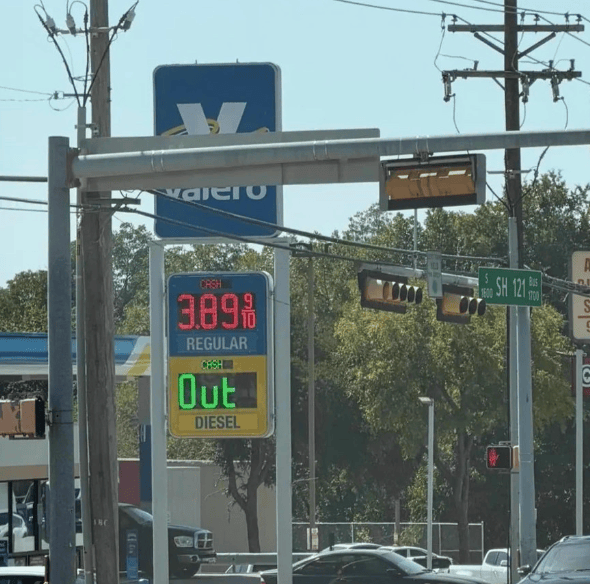
The border taxes, the increase in the cost of energy caused by Trump’s war on Iran, and the prospects for an inflationary recession increase. Currently, regular unleaded is over $4 nationally, with diesel over $6 a gallon. At that price, many small truckers will go out of business, and the price of virtually everything will rise. The Wall Street Journal reported that one long-haul trucker spent $1,800 on diesel during a week on the road. This was 40% higher than before Trump’s war on Iran. I sort of feel his pain, having spent $180 on a tank of diesel for my F-250. I was shocked when a close friend sent me a picture of a gas station in Texas that was out of diesel. This should never occur. Texas should be awash in diesel. “Out” happens in socialist countries not market economies. Is that what Trump is turning us into?
Small truck drivers — many of whom own their rigs and pay their own fuel bills — are hit hardest. Eventually, the higher diesel prices will show up in consumer goods, intermediate goods, and final goods. What will Warsh do as the CPI and PCE start to rise even more? Fed models estimate that every $1 increase in diesel prices typically translates to a 0.3% rise in core goods inflation within 90 days.
Diesel is also used to power machinery used by the fishing, farming, and construction industries, and those price effects will eventually show up in rising prices as well. The indirect effects of higher diesel prices are enormous, flowing through to essentially all goods, at a time when supply chains are already stressed by Trump’s border taxes.
One analyst stated the obvious: “Until we see a meaningful resumption of oil flows through the Strait of Hormuz, upward pressure on fuel prices is likely to persist.” But the war has damaged capacity in the Gulf, with Iranian drone attacks on oil and gas facilities across the Persian Gulf hobbling operations in oil-producing nations such as the United Arab Emirates, Kuwait, Bahrain, Saudi Arabia, and Qatar. Some experts say that even if the war ended today, it would take months before normal operations could resume.
Economic research indicates that sustained diesel prices above $5.25 a gallon historically correlate with recession probability increasing above 40%. This is because diesel fuel serves as the backbone of modern industrial activity, powering everything from heavy manufacturing equipment to long-haul freight transportation networks. Moreover, as one source puts it, “The global economy operates within an intricate web of energy dependencies that extend far beyond simple supply and demand calculations. Industrial economies rely on complex fuel distribution networks where disruptions in one geographic region can trigger cascading effects across multiple continents.” So Trump’s war has worldwide spillover effects – not just in the US. It affects our trading partners, which will increase the price of our imports even more – and recall that half of our imports are intermediate goods.
The border taxes have made Americans worse off – despite the propaganda coming from the White House. The immediate impact has been to raise consumer prices. Now, with the president’s ill-considered war on Iran, prices will rise even more. Energy price shocks have historically preceded major economic downturns, with diesel prices serving as particularly reliable recession predictors. This points to an inflationary recession caused by the president’s policies. Whether this will rival the inflationary recession of 1979-1982 remains to be seen. Inflation was as high as 15 percent, unemployment was 10 percent, the prime rate was 21 percent, and the 3-month T-bill rate was over 17 percent. I was at the heart of that episode, having been appointed to the National Credit Union Administration Board, serving on the committee chaired by Paul Volcker to address the problems while keeping financial institutions afloat. It wasn’t pretty, and I hope history does not repeat itself.
But as to the question whether Donald Trump is Herbert Hoover? His policies make him worse.
 haroldblackphd.com
Speaking of diesel, the neighbors across the street have become a parking lot for their son’s truck; the son , an active- duty fighter pilot, can no longer afford to drive a diesel truck…
From of all places, Iowans for Tax Relief, this is a statement on Hoover:
….”Most historians and economists agree that President Herbert Hoover committed a cardinal sin when he signed the infamous Smoot-Hawley Tariff bill into law. The traditional narrative is that Smoot-Hawley raised tariff rates which led to the collapse of international trade and made the Great Depression even worse…..Further, Hoover is viewed as an apostle of the old fashioned and obsolete political commitment to balanced budgets and high tariffs…”
Is America affecting world trade?
Two things caught my ear, when the WSJ mentioned Bessent statement, that the U.S. is glad to stand with Japan, in supporting the strength of the Yen and its Government policies. But didn’t explain how the U.S. was doing it..
The Reserve Bank of Australia mentioned fears of inflation caused by the Middle East war, plus the demand for data centers—and something you won’t hear about in America : climate change..
Maybe all this global economy stuff is just government in action, has nothing to do with trade- and is only propping up political Legacies.
LikeLike
Thanks for pointing out the Smoot Hawley Act which dramatically increased tariffs. Sounds like Trump.
LikeLiked by 1 person
As for Trump and his economic policies I don’t believe President Trump has a basic economic thesis from which he operates I think if he read your article with the impeccable logic, it wouldn’t matter to him. I don’t think he’s motivated or move by logic or strategy, other than what is logical and strategic to build his name in his own personal brand well and base of power
People with deeply personally vested interest can never think on behalf of the larger society or the larger good.
As I mentioned yesterday, I’ve lost all interest in President Trump. I do not think he is a wise person.
LikeLike