
No Bull at Kroger. Gulf update. Got trash?
Kroger drops Red Bull, and some Boar’s Head
An affordability move? Kroger has pulled Red Bull from all of its stores and Boar’s Head deli meats have disappeared from about 200 of its roughly 2,700 locations. Kroger hasn’t officially said why, but its website tells shoppers Red Bull is out of stock while it works with suppliers to keep prices affordable. News reports point to a dispute over price increases. Boar’s Head, for its part, denies that pricing is the reason.
I won’t miss Red Bull, since I’ve never had an energy drink. And Boar’s Head prices have always given me sticker shock, so I usually end up buying Kroger’s own peppered turkey breast instead.
What I find interesting is that Kroger chose to drop Red Bull rather than keep it on the shelf next to a cheaper alternative for comparison. Costco uses that side-by-side approach, though for the life of me I can’t figure out why it pulled its own lower-priced salsa. I suspect it’s because it was the one I bought.
Still, if customers were balking at the price of Red Bull and Boar’s Head, dropping them frees up shelf space for products that sell. Every retailer does this. Costco has long swapped in its own Kirkland Signature brand to hold prices down, and Walmart, notorious for squeezing vendors on price, seems to discontinue every product I like.
Red Bull fans will shop elsewhere and you can always get Boar’s Head at Publix if it is gone from your local Kroger. One more thing worth noting: Kroger’s CEO, Greg Foran, who took over in February, ran Walmart’s U.S. business from 2014 to 2019 and has pledged to cut prices and push back on suppliers who raise wholesale costs. Sounds like Walmart.
Gulf update
When I was in Georgia, diesel prices dropped by about 30 cents a gallon. It isn’t because oil is flowing freely out of the Gulf again. It’s because Georgia Gov. Brian Kemp suspended the state’s motor fuel tax, which is 37.3 cents a gallon on diesel and 33.3 cents on gasoline, from Sept. 29 through Oct. 29. Apparently Tennessee’s Bill Lee did not get the message, and our prices are now well above Georgia’s. Meanwhile, Iran has stepped up its attacks on tankers trying to transit the Strait of Hormuz, slowing oil exports yet again.
Personally, I don’t know which reports to believe. It is virtually impossible to believe anything coming out of the president’s mouth. Likewise, I don’t believe the Iranians either. So here are some recent reports. Take each one with more than a grain of salt.
Saudi Arabia is now flying air support for Yemeni government ground forces in a counteroffensive against the Houthis, who seized the strategic port city of Mokha in September. The aim is to push the Houthis back and remove their threat to oil exports through the Bab al-Mandeb strait. When Mokha fell, Yemeni commanders complained that the Saudi air support they had requested never arrived.
The Saudis are supposedly running their East-West pipeline, which can carry up to 7 million barrels a day across the kingdom to the Red Sea port of Yanbu, bypassing Hormuz altogether. Drone attacks shut it down on Sept. 11. It restarted later in the month and was reportedly pumping close to 6 million barrels a day by early October.
What about the Strait of Hormuz, where the Saudis shipped most of their oil before the Iran war? While the pipeline was down, Aramco pushed more crude out of its Gulf terminals at Ras Tanura and Juaymah, at one point loading nearly 12 million barrels in a single day, and had Asian customers pick up cargoes through ship-to-ship transfers off Sohar, Oman, just outside the strait. Shipments through Hormuz had been climbing, helped by U.S. naval protection and U.S. strikes that knocked out Iranian radar along the strait. In the last week of September, Middle East crude exports actually topped prewar levels on several days.
Now the attacks are back. At least seven vessels in and around the strait have been struck since Sept. 28, according to the U.K.’s maritime trade agency, and a U.S. official says Iran is getting better at hitting ships. On Saturday, Iran’s Islamic Revolutionary Guard Corps warned ships not to trust the U.S. Navy and to stay out of the U.S.-backed “south corridor” entirely. Traffic is already slowing. Will Aramco keep shipping through the strait? Will the pipeline stay up? Stay tuned.
Iran, meanwhile, can’t get its own oil to China because of the U.S. blockade, and it is about to lose a vital source of revenue. As Treasury Secretary Scott Bessent put it on Sept. 27: “Probably within the next two weeks they are going to make their final deliveries of oil to China, and then they will have nothing.”
That’s likely why Trump turned down Iran’s latest proposal, which reportedly asked for sanctions relief, unfrozen assets and an end to the blockade in exchange for reopening the strait. The question now is what Iran does next. Will it finally throw in the towel? Renew its drone and missile attacks with a vengeance? Expand the war into new areas? We’ll have to wait and see.
Got trash?
I love living in East Tennessee. I never tire of its scenic beauty – the lakes and streams, the mountains. The only thing that mars it is the litter. There is trash everywhere.
My neighborhood sits at the end of a two-mile winding country road, and there’s litter along every bit of it. I used to walk the first mile, turn and walk on the other side, once a month picking up trans. I’d take four trash bags and stop when the last one was full. I never made it through the entire two miles. Finally, I just gave up. Now I just pick up around the entrance to the neighborhood. I even put up “Don’t litter” signs. The result? A pile of trash at the base of the signs. And now the signs have disappeared. The county picks up maybe once every six months. One of my neighbors blames construction crews, but I’ve seen trash thrown out the windows of some very expensive cars and pickups. Young people? Probably.
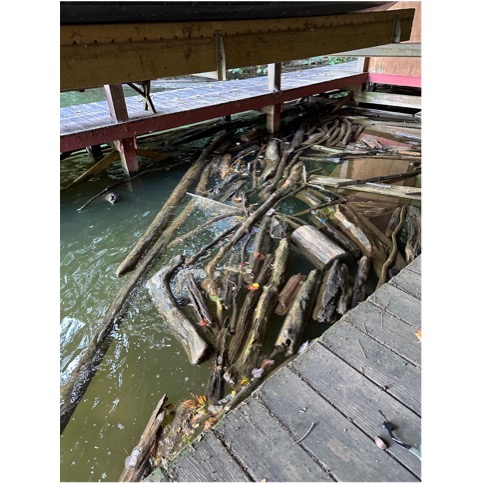
I live on Fort Loudoun lake and fill a trash bag down at my boat dock about once a month. You won’t believe what finds its way to the dock. Disposable diapers and feminine hygiene products seem to be popular, along with cans, fishing lures, prophylactics, the occasional syringe and assorted other stuff. I once even had an entire floating boat dock to deal with. I don’t touch anything, and I even keep a sharps container for that stray syringe.
Every now and then there’s an organized effort to clean up Fort Loudoun Lake, led by a nonprofit called Keep the Tennessee River Beautiful which hauled nearly 21,000 pounds out of Fort Loudoun Lake last year. (Here in East Tennessee, our “lakes” are really rivers, impounded between the dams.)
All that picking up got me wondering whether we might run afoul of the law, like what happened in Seattle. This summer, their local cleanup group We Heart Seattle was served a “notice of alleged safety or health hazards” by the Washington State Department of Labor & Industries, which enforces workplace safety. The notice alleged “improper handling and collection of hypodermic needles and fentanyl paraphernalia.” We Heart Seattle is the brainchild of local resident Andrea Suarez, who was appalled by the trash and discarded needles she saw on walks near the homeless settlements. The group says it has removed more than 2 million pounds of trash from Seattle’s parks and public spaces.
Seattle is a mess, literally and figuratively, with a socialist mayor who seems not to have a clue – although, to be fair, this investigation came from the state, not City Hall. Washington State is far more regulation-bound than Tennessee, and Knoxville is light-years away from Seattle. Our trash problem pales next to theirs, so it is unlikely that the Keep the Tennessee River Beautiful folks and I will be served a notice for “improper handling of trash.” But it could happen. Couldn’t it?


My wife says that Kroger knows everything we buy. And once sent coupons to encourage this spending.
But coupons have stopped; so have the products. If Kroger needs the reputation of the cheapest grocery store, they are driving us to go to other stores..
…yes, the minute we buy something, we know it will be disappear fm shelves. Don’t make a lick o’ sense..
“Marine Insight” site refers to shipping lanes as “choke points.” That name should be a clue on water transportation..
I was surprised by how many lanes are “traversed” by shipping pipes. Which would put any targets underground, and the war effort of “choking” shipping waters less attractive..
If “Russia’s oil all goes to Europe , and Mexico’s oil goes to the US”, those markets still want/ need to have a glut of oil, and a presence on the global stage is chosen…
I think about all the new subdivisions coming into Knox County, all the trash that is created from the utilization of building materials.
.. trash fm construction crews add to all the other trash- but that’s the greatness of (politically inspired) growing communities. Expect the most beautiful places in East TN to be future municipal dumps..
Thanks for author’s efforts in removing trash. If ever sighted for improper removal of trash- be assured developers won’t be.
LikeLike