Obamacare: Why Wasn’t This a Campaign Issue?
I’m puzzled. If the public is furious over the cost of health care, why has Obamacare escaped the public’s ire? It is also puzzling why republicans didn’t make it a campaign issue to answer all the media buzz about health care affordability. George Will once called the republican party the “dumb party.” This adds more evidence to that statement. Healthcare not affordable? IT’S OBAMA’S FAULT! All the democrats and not a single republican voted for it.
Peter Suderman writes in Reason:
https://reason.com/2026/11/02/dems-in-disarray
Obamacare premiums spike. In September 2009, then-President Barack Obama delivered a major speech to a joint session of Congress touting the Affordable Care Act, a.k.a. Obamacare.
“The plan I’m announcing tonight,” he said, “would meet three basic goals. It will provide more security and stability to those who have health insurance. It will provide insurance for those who don’t. And it will slow the growth of health care costs for our families, our businesses, and our government.”
That was 17 years ago. Next year, insurance plans sold through the health care exchanges erected under the law will increase by an average of 13 percent, according to the Kaiser Family Foundation. That’s in line with, but a little higher than, the average increase for employer-sponsored plans, which The New York Times reports will rise by about 10 percent.
As Tyler Cowen notes, there is an inherent political/policy instability in Obamacare. Democrats rarely brag about the law: “It is striking to me how infrequently I hear Democrats boasting about Obamacare,” Cowen writes. “They instead prefer to talk as if little or nothing has been done for America’s uninsured.” You hear a lot about Medicare for All these days, especially from left-leaning Democratic politicians like [Michigan Senate candidate Abdul] El-Sayed.
One reason for this year’s big price increase? The unintended consequence of a law touted as saving patients from surprise medical bills. The law included a provision prohibiting out of network doctors from billing a patient directly. Instead, providers have the option to make a case to an arbitrator approved by the government; if the provider wins, the insurer must pay the bill.
As the Times reported earlier this year: “The law is successfully protecting patients against bills from doctors they never chose. But it has also generated an expensive unanticipated consequence: Doctors have flooded the arbitration system with millions of claims. Most are winning, often collecting fees hundreds of times higher than what they could negotiate with insurers directly or what they could have earned from patients before the law passed.”
So: A law designed to protect people from the high cost of medical care has, instead, contributed to sharp jumps in the cost of medical care.
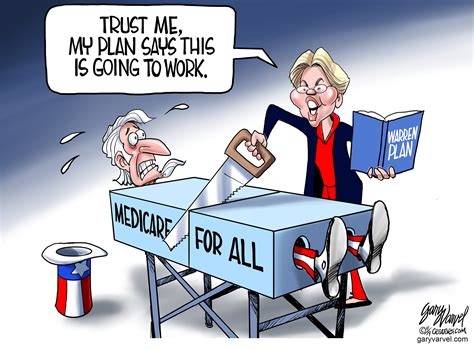
Perhaps this should be a lesson for those who support Medicare for All.
Here is what republicans should have said: “Obamacare is a disaster, and if you think it is bad, wait for Medicare for All, with the government deciding who gets treatment. The only way for the government to control costs is to ration health care. So-called ‘universal health care’ means long waiting periods, an exodus of physicians, and poor outcomes. Are you sure you want to go there?”
Medicare for All is the pet cause of progressives like Bernie Sanders and Elizabeth Warren. As Merrill Matthews explained in The Hill in August (“‘Medicare for All’ means Medicare for none”), Sanders has long pushed “to end the nation’s current mix of private health insurance (that is, employer-based and individually purchased) and government-provided health insurance (Medicare and Medicaid) and replace it with a new government-run program. Taxpayers would pay higher taxes — though no one would pay premiums — and the government would pay all medical bills.” I am reminded of what one of my outfitters said on a bear hunt in Canada: “Yes, we have lousy health care, but at least we don’t have to pay for it.” You think?
Matthews also reminds readers of Obama’s promise about Obamacare — the mislabeled “Affordable” Care Act: “If you like your health care plan, you can keep it.” That claim earned PolitiFact’s 2013 “Lie of the Year.” Progressives won’t even make that promise about Medicare for All, because no one would keep their current health plan, including people currently on Medicare.
I don’t think the American people will be as sheeplike as those in Canada and Great Britain and accept a starkly inferior system as the solution to health care affordability. Still, look for democrats in Congress to propose such a plan.
Matthews cites an NBC News poll, taken last December, that found 82 percent of Americans are “satisfied with their health care coverage,” and about 90 percent of seniors are satisfied with theirs. What about Britain, whose government-run National Health Service Matthews argues Medicare for All more closely resembles? Only 26 percent of Britons are satisfied with the way the NHS is run. As Matthews puts it, “we’re going to take a system that has 90 percent satisfaction and abolish it in favor of one that has 26 percent satisfaction.”
To be fair, the comparison isn’t perfectly apples to apples: the American numbers measure how people feel about their own coverage, while the British survey asks how the NHS is run overall. Still, the gap is hard to ignore. If democrats implement such a plan, it will be a sure ticket to a defeat that rivals the one republicans just suffered.


Obamacare was never about the end but the beginning of a journey to lull Americans to sleep on the trip to single payer. It has been repudiated by Republicans as such and it has been largely ignored by socialists who are clamoring for the worst possible result pointing to users/losers in the world economies: Europe, Cuba, Canada.
LikeLike
I completely agree but why didn’t it’s failure and high increasing costs weren’t a campaign issue for the republicans?
LikeLike