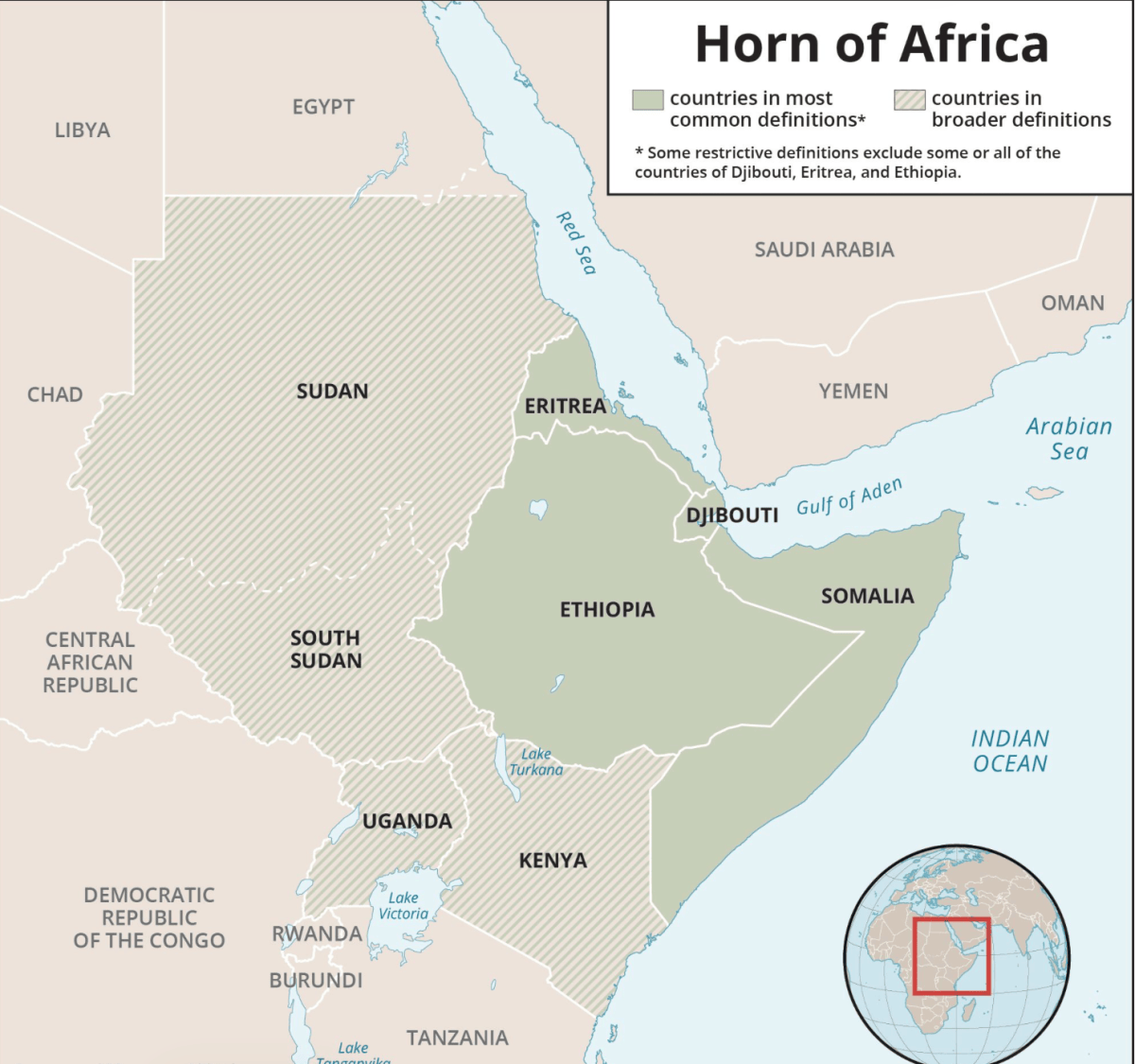
The Horn of Africa is a mess – a dangerous mess
Almost completely ignored in the North American media is what is happening in the Horn of Africa where conflicts are pulling in conflicting national interests. Countries are picking sides and there is a threat of regional war that may pull in the United States, Russia and China.
Ethiopia is now quarrelling with almost every neighbor that matters. In the space of a few weeks it has cut ties with Eritrea, traded expulsions with Sudan and thrown out an Egyptian diplomat. Each dispute has its own history. Together they point to something worse: a regional war in one of the most strategically important corners of the world.
Start with Sudan. Early this month Ethiopia shut Sudan’s consulate in Assosa, near the border, and gave six Sudanese diplomats 48 hours to leave. Within hours Khartoum’s government closed Ethiopia’s consulate in Gedaref and sent its staff packing. Neither side gave a formal reason. Neither needed to.
Sudan accuses Ethiopia of helping the Rapid Support Forces (RSF), the paramilitary group fighting Sudan’s army in a brutal civil war. Days before the expulsions, Sudan’s army-aligned government complained to the UN Security Council and the African Union. It says the RSF has been allowed to fly suicide drones from Ethiopian soil into Sudan to hit civilian infrastructure and claims to have documented some 70 such attacks. Ethiopia, for its part, accuses Sudan of backing the rebels it is fighting in Tigray. Each government, in other words, says the other is arming its enemies. Sudan insists it is doing everything it can to avoid open war with Ethiopia. That it feels the need to say so tells you how close things have come.
The bigger danger lies to the north, between Ethiopia and Eritrea. When Eritrea became independent in 1993, Ethiopia lost its coastline. It has been landlocked ever since. Most of its trade now goes through the port of Djibouti, where it pays more than $1 billion a year in fees. For a country of some 130 million people with large ambitions, that is both expensive and humiliating. Prime Minister Abiy Ahmed has said repeatedly that access to the sea is a vital national interest. His generals have been blunter. They have called control of Assab, Eritrea’s southern port, a survival interest worth any price.
Eritrea hears all this as a threat to its existence, and it is not paranoid to do so. The two countries fought a bloody border war from 1998 to 2000 where over 100,000 were killed. They became allies of convenience during Ethiopia’s last war in Tigray, from 2020 to 2022, when Eritrean troops fought alongside federal forces. That alliance is now dead. Eritrean soldiers stayed in parts of Tigray after the Pretoria peace deal. When fighting flared again in Tigray in September, Ethiopia said Eritrea had sent troops and mechanized units into its territory. In a letter to the Security Council in October, Ethiopia’s foreign minister called it an “all-out invasion” and said his country had no choice but to defend itself. Ethiopia also accuses Asmara of backing the Tigray People’s Liberation Front (TPLF), the rebel group from Tigray. Eritrea denies all of it. It says Ethiopia has been waging an unprovoked war of aggression for years and that Ethiopia’s talk of the sea amounts to a plan to seize Eritrea’s coast. The two have already severed diplomatic ties.
Why should anyone outside the region care? Because of the Red Sea is the shipping lane that links the Suez Canal to the Indian Ocean. Something like a tenth of world trade normally passes through it. It has already been disrupted by Houthi attacks from Yemen. A war over Assab, which sits close to the Bab el-Mandeb strait at the sea’s southern mouth, would put a second fire on the same shipping lane.
Then there is Egypt. Ethiopia expelled an Egyptian diplomat last month and Cairo returned the favor. Relations have long been poisoned by Ethiopia’s giant dam on the Blue Nile, which Egypt fears could choke the water supply on which almost its entire population depends. Addis Ababa now accuses Sudan, Egypt and Eritrea together of supporting the Tigrayan rebels. Whether or not that is true, it shows how Ethiopia sees its position: surrounded.
The outside powers make it worse. The Horn of Africa has become a playing field for the rivalries of the Middle East. Eritrea has drawn closer to Egypt and Saudi Arabia. Ethiopia leans towards the United Arab Emirates and Turkey. One wonders how the recent alliance between Saudi Arabia and Turkey will be affected. The UAE’s role is especially striking. During the last Tigray war it reportedly offered Ethiopia armed drones, surveillance and training from its own military base in Assab, which it used as a logistics hub for the war in Yemen. In 2021, satellite images and flight data suggested Emirati cargo planes were ferrying weapons to Addis Ababa. The very port Ethiopia now covets was once a foreign base helping it fight its own citizens. America, meanwhile, lifted sanctions on Eritrea in September to advance its own interests on the Red Sea. Everyone, it seems, has a stake, and almost no one is pushing for calm.
This is how regional wars start. Not with one grand decision, but with several conflicts that slowly bleed into each other. Sudan’s civil war is spilling over Ethiopia’s border. Ethiopia’s war in Tigray is drawing in Eritrea. Ethiopia’s hunger for a port threatens Eritrea’s sovereignty. Egypt’s fears over the Nile give it reason to back anyone who keeps Ethiopia busy. And Gulf money and weapons flow into all of it.
Any one of these quarrels could be managed. All of them at once, with diplomats being expelled rather than talking, is far harder. The Horn of Africa is a mess. It is a dangerous mess. And the rest of the world, which depends on the Red Sea more than it likes to admit, should start paying attention before it becomes a war.

