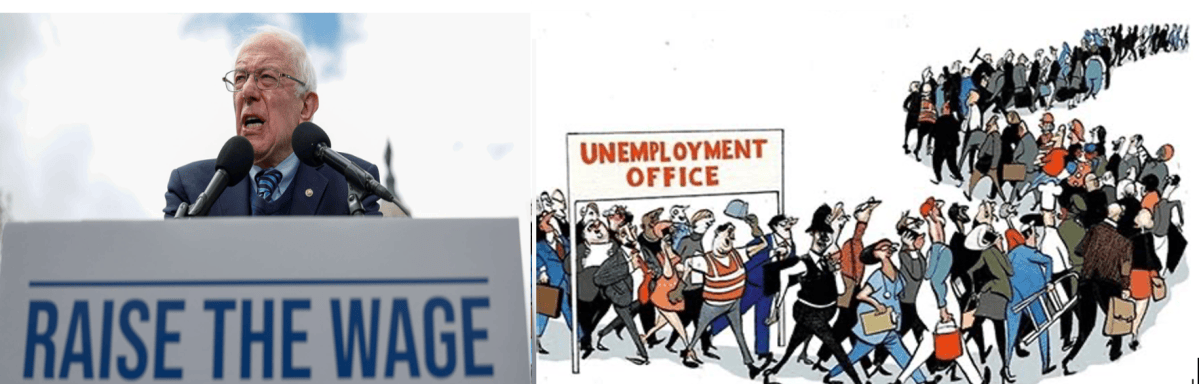
Raise the Minimum Wage?
There are three bad economic ideas that never die, regardless of the evidence against them: rent control, interest-rate ceilings and minimum wages. All three do more harm than good and hurt the very people they are supposed to help, but politicians love them because they sound good. I recall my father telling me, “That sounds good — if you are interested in sounds.”
Of the big bad three, the one I want to write about here is the minimum wage. That is because I heard an interview with Rahm Emanuel in which he said that raising it is at the top of his priorities. Emanuel makes no secret that he wants to be president, and he shrugs off the idea that as a democrat being Jewish would be an impediment. Here is what he said in that interview:
“It’s been 20 years since people have gotten a raise. 2007, January 9th. Hakeem Jeffries is going to be speaker. My view: 20 bucks by 2030. … Today the minimum wage is $7.25. Hasn’t moved in 20 years. Any show of hands? Have groceries gone up in 20 years? … Has gas gone up in 20 years?”
First off, hardly any head of household works at the federal minimum wage of $7.25. Only about 0.1 percent of hourly workers earn the federal minimum or less. According to the Bureau of Labor Statistics, 81.5 million workers were paid by the hour in 2025. Only 79,000 of them earned exactly $7.25, while 765,000 earned below the federal minimum. Many of these workers are in part-time or seasonal jobs, and some are tipped workers whose tips are not counted in their hourly wage. Many are also young — about 40 percent are under 25 — and are likely to be secondary earners in their households, such as teenagers, rather than heads of households. Today, 30 states plus Washington, D.C., have minimum wages above the federal minimum. Of the remaining 20 states, five have no minimum wage law at all, two (Georgia and Wyoming) set a state minimum below $7.25, and the rest simply match the federal rate. In all of them, the federal $7.25 applies to most workers.
If so few workers earn the federal minimum, why is this a campaign issue at all? Again, because it sounds good. Why not leave it up to the states and keep the federal government out of it altogether? Emanuel wants the federal minimum raised to $20. Experience has shown that a $20 wage (which doesn’t even count the cost of benefits) can be disruptive. A USA Today article is headlined “California’s $20 fast-food wage tied to unintended effects, study finds.” https://www.usatoday.com/story/money/2026/03/31/california-fast-food-wages-study/89406757007/
The study, a working paper from the University of California, Santa Cruz, finds that the wage hike may be producing unintended consequences across the state’s fast-food industry, including reduced worker hours, higher menu prices and growing pressure on franchise owners to cut costs or automate jobs. “Based on what we’ve found, I think this legislation is a classic case of ‘no good deed goes unpunished,’” said UC Santa Cruz economics lecturer Stephen Owen, who conducted the study.
The results are, of course, no surprise. In fact, an economist would have been shocked if they had been otherwise. Keep in mind, too, that the bigger the jump from what the lowest-paid workers had been earning, the greater the impact on that group. Microeconomics says that workers earn the value of their marginal product — that is, they are paid according to what they contribute to the profitability of the firm. If they are paid more than they are worth, they lose their jobs as the firm looks for substitutes (kiosks, anyone?).
What about Seattle? Seattle was the first major city to adopt a “Fight for $15” wage, more than a decade ago. According to the article “Seattle’s $22 Minimum Wage Adds to Restaurant Struggles,” since the law was implemented in 2015 the city’s minimum wage has climbed more than 130 percent, from $9.47 to the $22.14 that takes effect in 2027. https://minimumwage.com/2026/10/seattles-22-minimum-wage-adds-to-restaurant-struggles/ The article goes on:
“The negative consequences of Seattle’s previous wage hikes have been clearly documented. A University of Washington study examining the city’s minimum wage increases found that Seattle’s minimum wage has reduced employment and hours for local workers, while failing to reduce overall earnings gaps. Another University of Wisconsin-Madison study found that following Seattle’s minimum wage announcement, fewer new hospitality and retail establishments opened within city limits, while surrounding areas with lower wage floors saw an increase in business openings. One survey of small business owners found that the majority of respondents say they are worse off financially now than during the pandemic. More than seven in ten (71%) reported seeing fewer customers, while 63% said sales are down, with many reporting revenue declines of 20% or more.”
Generally, when a measure such as a minimum wage increase is put to voters, they endorse it, even though most of them will not be affected by it. Businesses, however — small businesses in particular — oppose such increases because the higher costs can hurt their bottom line so badly that they are forced to close. A rare exception came in November 2025, when voters in Olympia, Washington, rejected a proposal to raise the city’s minimum wage to $20 an hour. There, the example of Seattle and the objections of small business owners made the difference. And by the way, large retail businesses often support these increases. First, they may already be paying higher wages. Second, they can absorb the increase more easily. Third, they know that many of their small business competitors will go under. What’s not to love? Unless, that is, you are one of the workers who lose their jobs and must now go on the government dole. For those workers, the minimum wage is now zero.
I have written before about the racist origins of the minimum wage in America where its intent was to prevent minority workers who were looking for work from underpricing white workers, Today, that is why labor unions support the minimum – to make those who would work for a lower wage from underpricing union workers who make much more.
That Rahm Emanuel is advocating an increase — when he probably knows the consequences — is disappointing. But on this issue, he is simply trying to appeal to the many democrats who would not support him otherwise.


Agree. Raising the Minimum wage does nothing but increase prices for the entry level worker with little skill. The minimum wage worker gets a temporary bump that is quickly absorbed by others in the market who raise their prices for goods and services to accommodate the increase in money supply. Interesting that few on the left have connected rising rental prices with rising minimum wage. As you say, the minimum wage is a short term station on the way to healthy, productive employment.
LikeLike
100 percent. It hurts small businesses but as you point out adversely affects prices and rents as well. A bad idea that never goes away.
LikeLike
Again, this wa a topic that came up at my house yesterday. Good essay, links, and timing..
Burger King has an ad where they are touting a new look. The company is investing. I can’t name the last time I was in a Burger King. Maybe it’s the cost of food based on labor; maybe I’ll stay away now thanks to prices based on corporate improvements..
There is a cost to attracting more workers, like one link says. There is a cost for image, to get more customers…
When’s the last time Congress gave itself a raise, and taxpayers got value-added?
When’s the last time the mega techies became millionaires and we got a moral society?..
One link mentions putting more effort into the wages of “value-added” industry like healthcare. Did they mean the socialist, shared-risk, government redistribution of wealth industry?
Or am I thinking of another?…
If there was no inflation, wages could gladly stagnate. But there is a maximum profit ideal in business. Workers are also customers..
I do know people that have made a career of fast food. From the counter to the headquarters. Maybe not always; a franchise can’t work on advancement.
But low pay will lead to a revolving unreliable workforce. That don’t sound good..
I’ve been told I don’t understand HOW MUCH college-educated kids make these days. Inflation is negligible to them .
True- the kids I know have big houses, working on big families. And eat at fast food restaurants.
—They got money — and business wants it.
Maybe attracting a dedicated food workforce is worth a look-see..
So true! That Government needs to stay out of all of it , and stick to their own raises and payola and socialist corruption.
LikeLike
Were you really talking about the minimum wage in your house?
LikeLike
Yes- because of the Burger King ad, who’s new look shows willingness of investment.
Plus my wife, who is retired, was asked to do a special government project – in Antarctica. She says she won’t have to go there, but this shows money is being spent by the Trump era..
She opposes minimum wage.
I don’t think a punk baggin’ fries can destroy the American economy, no matter how much he’s paid.
LikeLike
You – and your wife – never cease to amaze.
LikeLiked by 1 person