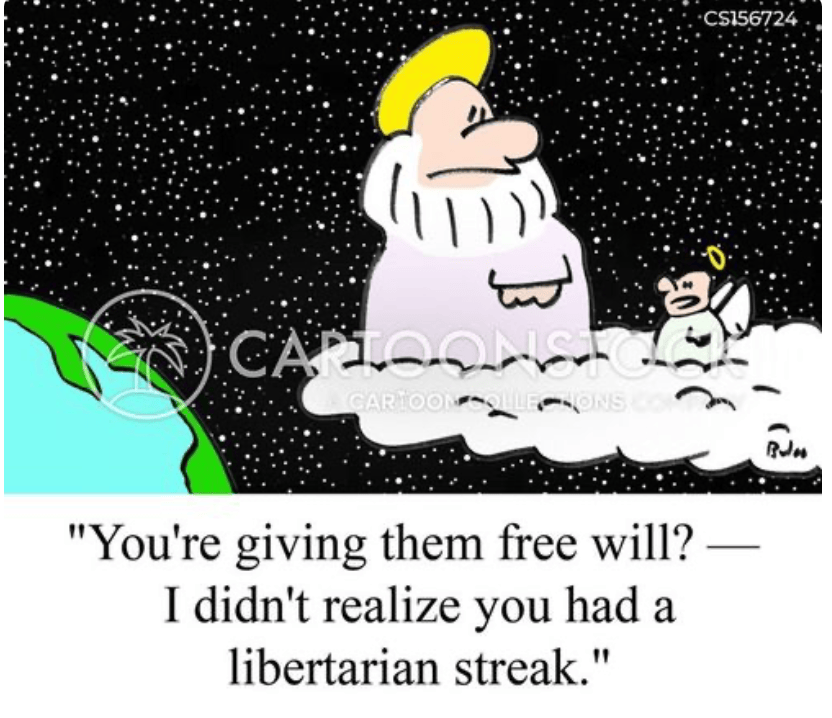
“Someone who can’t be trusted to run his or her own life cannot be trusted to run the lives of other people.”
My friend Don Boudreaux was kind enough to allow me to reprint this defense of libertarianism. I believe it is required reading for the informed and uninformed alike.
Here’s a letter to a new and very angry correspondent.
Ms. Becker:
I’m sorry that you so strongly disapprove of my recent AIER column in
defense of libertarianism. Your core complaint is this:
You libertarians have ridiculously high opinions of human nature,
assuming most people can approach saintliness. Serious
conservatives don’t. We are sober. We are grounded in reality.
We know that man is weak, fallible and most of all tempted into
sin.
With respect, I disagree that we libertarians have such a high opinion
of human nature. Precisely because we understand, as you put it, that
humans are “weak, fallible and most of all tempted into sin,” we insist
that the power of some individuals to coerce other individuals should
be kept to an absolute minimum.
No serious libertarian argues that freedom produces anything close to
heaven on earth, with no one succumbing to self-destructive or anti-
social temptations. But we recognize two related realities that are
missed by many conservatives as well as by progressives.
First, when adults are free to use their own (and only their own) private
property – including their own bodies – under a rule of law, each
individual personally experiences more of the costs of his or her bad
behavior, and reaps more of the fruits of his or her good behavior, than
is the case when that freedom is curtailed. This ‘internalization’ of
consequences obviously doesn’t turn everyone into a saint – or
prevent everyone from being a devil – but it does keep to a minimum
the amount of ‘bad’ behavior while encouraging the greatest possible
amount of ‘good’ behavior.
Second, any curtailment of libertarian freedom necessarily empowers
some individuals to coerce other individuals. Given that we humans
are indeed imperfect creatures, it is you – not any libertarian – who is
unrealistically optimistic about human nature. I cannot fathom your
faith that political power transforms individuals who cannot voluntarily
manage their own affairs well into individuals who can coercively
manage other individuals’ affairs well.
A truly sober and realistic assessment of human nature leads people
of goodwill naturally to a wish to reduce as much as possible the
power of the state.
Sincerely,
Donald J. Boudreaux
Professor of Economics
and
Martha and Nelson Getchell Chair for the Study of Free Market
Hands-Free Georgia. Apple News. The Trade Deficit. France.
Hands-Free Georgia
Drive into Georgia and you’re greeted by signs announcing that this is a “hands-free state.” No, that doesn’t mean you’ll be arrested and fined for not using Tesla’s self-driving mode. It’s a warning not to hold your cell phone while you drive. But there’s good evidence that even passively listening to music or the radio can distract a driver—usually less than texting or talking on the phone, but it distracts nonetheless. Even hands-free conversations can slow reaction times. In other words, hands-free doesn’t mean distraction-free. I’ll admit that I listen to music when I drive around town, and on the highway I tend to tune in to games and sports talk. Invariably, I’ll realize I have no memory of passing a particular exit or landmark and wonder, “Wasn’t I paying attention?” Apparently not. Somewhere between the third-down conversion and the call-in guy who is certain the coach should be fired, I misplaced a county.
Apple News
In the mornings, after reading the print edition of the Wall Street Journal—yes, the one on actual paper, ask your grandparents—I check Apple News on my laptop. From the very beginning, I noticed a left-wing tilt in the stories and sources it picked, and over time I’ve blocked perhaps a third of those sites. At this rate, my Apple News feed will soon consist of the weather and a recipe for turkey meatloaf. The latest to get the boot is Sports Illustrated. Why, you ask? Because Apple News serves up very few actual sports stories from SI, and virtually every one it does show features a swimsuit model. Mind you, I’m not averse to looking at attractive women—just not when I’m trying to find out who won last night. Last I checked none of them were playing shortstop for the Braves. Meanwhile, the Media Research Center reports that under new Apple CEO John Ternus, Apple News has taken a “decidedly leftist turn.” Critics point to Lauren Kern, the app’s editor-in-chief, who previously served as executive editor of New York Magazine and deputy editor of the New York Times Magazine—a résumé that doesn’t exactly scream “fair and balanced.” But if Kern was already in place when Tim Cook was CEO, then the sharper turn to the left is on Ternus, not Kern.
The Trade Deficit
In August, the trade deficit widened as imports exceeded exports by $106 billion. I expect Trump will soon fire off a missive, likely in all caps, condemning all those importers who, in his words, are making us worse off. Why doesn’t he just ban imports altogether and be done with it? We could all go back to whittling our own smartphones. The data-center boom has been a major driver of this year’s deficit: imports of semiconductors, computers and computer accessories were up a combined $234 billion in the first eight months of the year compared with the same period last year. I can just hear the president: “What? Don’t we make that stuff here? Why do we have to import anything?” Well, electronics are largely exempt from Trump’s tariffs, which is convenient for anyone who enjoys posting on social media. It’s also interesting that crude-oil imports from Canada rose by more than 8 million barrels in August, and the monthly U.S. trade deficit with Canada jumped to $7.1 billion from $3 billion in July. Our polite neighbors to the north, it seems, are still politely taking our money – in your face Trump! U.S. exports grew in August too, just more slowly than imports. None of this squares with Trump’s mercantilist agenda. He must be furious—or more furious than usual.
France
France, with a debt-to-GDP ratio of 120%, can’t pay its bills, and what began as a protest by high school students has become something much bigger. Is this a preview of what may be coming to the U.S.? Perhaps—and we’ll discuss that at length later. For now, France is going through one of its periodic implosions. Most reports describe high school students rioting in more than 40 cities over cuts to education. Pardon me, but since when have high schoolers cared about education funding? When I was in high school, the only cut we would have protested was to the lunch period. It has always seemed to me that rioting is something of a French national pastime, right up there with cycling and wine. Reportedly, leaders of France’s left are now fanning the flames. The left, wherever it is, never met a riot it didn’t like. France’s Bernie Sanders, Jean-Luc Mélenchon, leader of La France Insoumise and a candidate in next year’s presidential election, is deliriously happy. What better foil to push the left-leaning French even further left? France has long been the poster child for profligacy: spending like drunken (French) sailors, overregulating to the point of stifling growth, and borrowing to prop up unsustainable levels of spending. A President Mélenchon would make all of it worse. He says the central bank should simply forgive the French bonds it currently holds—a financial strategy some of us have tried with our credit card companies, with limited success. He has even accused the head of the French central bank of treason for suggesting spending cuts. Apparently in France, recommending a budget cut may now a wend one to the guillotine. He may think all this will get him elected, but he should look to his right—his far right—where he’ll find Marine Le Pen of the National Rally waiting with a smile. Of course, that assumes France holds itself together until next year’s election. And where are the yellow vests? Why aren’t they back in the streets protesting the cost of diesel?
By the way, all this somehow reminds me of Keb’ Mo’s “France” from his Keep It Simple album, which is advice the French government might consider. Personally, I’m no Francophile. I don’t even like French cooking—the heavy sauces give me gas. So, in my own way, if I ate blanquette de veau, I suppose I would end up protesting too.
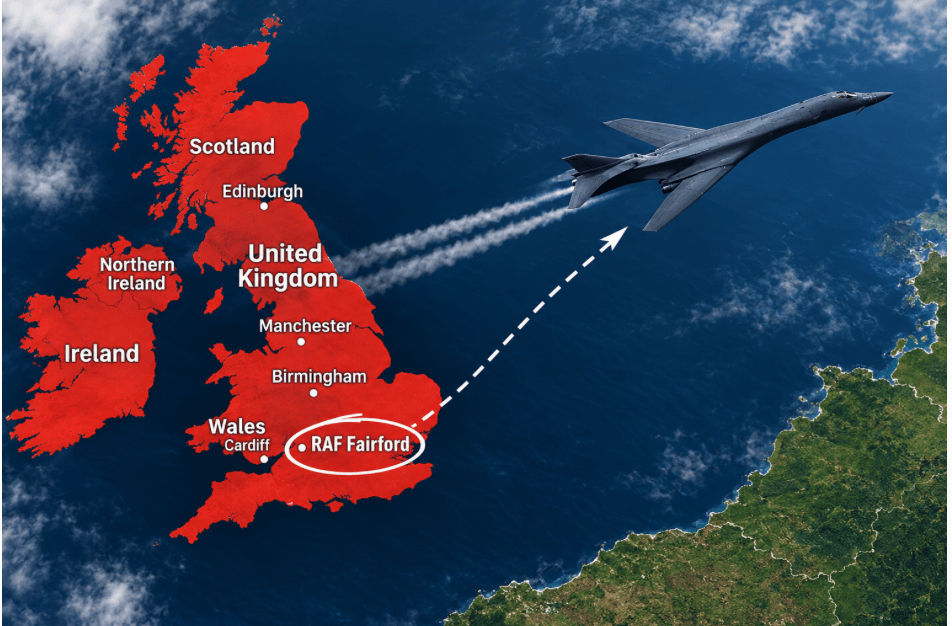
When the US pulled its B-1 bombers out of England and flew them home, most of the media greeted the news with a shrug. Air and Space Forces Magazine was a notable exception. Its headline read: “All B-1 Bombers Leave RAF Fairford in Hasty Departure from UK Base.” Hasty? Indeed.
Naturally, the administration insisted it was no big deal. “I think we can say that — I mean, they didn’t fly out by accident,” Trump said from the White House. “There were some threats, and rather than tempting the enemy, we’ll capture the enemy and beat the enemy. But why should we leave them there? So we moved them around a little bit.” If that isn’t word salad, I don’t know what is.
JD Vance was marginally more coherent: “I think that we’re going to be as careful as we possibly can be. We do feel with some confidence that the Iranians are, you know, they’re trying to do what the Iranian state has done for 49 years, which is engage in acts of terrorism against the United States and against a lot of other people as well.” Clearer, yes, but still at least a side salad.
For reasons known only to the White House, it was Marco Rubio, not Hegseth, who was quoted on the matter. He declined to “directly tie” the redeployment to the alleged Iranian plot: “The only reason why you guys are focused on how many planes are at Fairford is because of the threat that happened last week. But it’s not unusual to see rotations happen and movement of assets to different parts of the world based on exercises, redeployments, people changing out and new people coming in, new planes coming in, old planes going out.”
Let’s be honest: this was a big effing deal. British and American officials themselves said they had specific, credible information that Iranian-backed operatives were planning drone strikes on the planes and on US troops from just outside the base’s fence. Six people have been arrested in connection with the plot. Pulling the bombers out is, plain and simple, a retreat. Sure, as Trump says, the B-1s can still reach their targets from the US, but that means far longer and far more expensive missions. The drone and missile attacks of a supposedly “defeated” Iranian military have pushed US forces back from the very bases that gave them quick access to the war.
And Fairford isn’t the only case. A close friend who follows these matters tells me that American personnel have been evacuated from bases in Bahrain, Kuwait, the United Arab Emirates and Qatar, all within range of Iranian missiles and drones. Some of those bases were damaged so badly that there is little appetite inside the Pentagon to rebuild them. The naval supply chain now runs through Diego Garcia, 2,000 miles away.
Some context on the British bases: Fairford has no permanently assigned US Air Force aircraft, but it supports US operations and is the main American bomber site in Europe. The Air Force’s permanent UK presence is at RAF Lakenheath, home to F-35A Lightning II and F-15E fighters that have been deployed for operations against Iran. Lakenheath also serves as a stopover for fighters moving between the US and the Middle East. Nearby, RAF Mildenhall hosts the KC-135 tankers of the 100th Air Refueling Wing.
So my question is whether the US will pull its aircraft from those bases too. Either way, abandoning Fairford is a bad look.
I wrote earlier that the administration was crowing that oil was flowing through the strait again, the Saudis were hitting the Houthis, and the blockade had pushed Iran to the brink. I suppose the latest news is just postmortem twitching, the cadaveric spasms of a beaten foe. Right? Iran attacked a tanker near Qatar, causing several casualties. The Houthis then struck the international airport in Riyadh, killing three people and damaging aircraft and facilities. And oil prices jumped right back up.
Meanwhile, for whatever reason, Trump has announced that the US won’t resume the air campaign against Iran until after the midterms. Doesn’t that give Tehran every incentive to escalate, betting that enough pressure will push the president toward a diplomatic deal? Telegraphing what you won’t do strikes me as a bit foolish. But then, I lack the president’s cache of intelligence, his learned advisors and his military acumen.
I wonder if I will be accused of a racist slur due to the title of this post?
Daylight saving time is back in the news. For whatever reason, the president and Congress (with at least one exception) favor making daylight saving time permanent. However, Pat argued, quite convincingly, that it is standard time that should be permanent. It has something to do with circadian rhythms. (See my July 19 post.) But the House voted for it 318–117, which means a bunch of democrats actually voted for something the president favors! Mark your calendars, assuming we can still agree on what time it is.
In my home state of Georgia, the only representative who voted against it was Atlanta’s Rep. Nikema Williams, who said, “I’m never afraid to stand alone if it means standing up for the people I serve.” She voiced concerns about the safety of school-age children, since the change would mean darker mornings during their commutes, and she emphasized the importance of representing those who may not have a voice, like children. If you’ve ever seen school children standing in the dark waiting for a school bus at 7 a.m., it is already a pretty grim scene without subtracting the sunlight. Children, who can’t vote but can absolutely refuse to get out of bed.
Good for her.
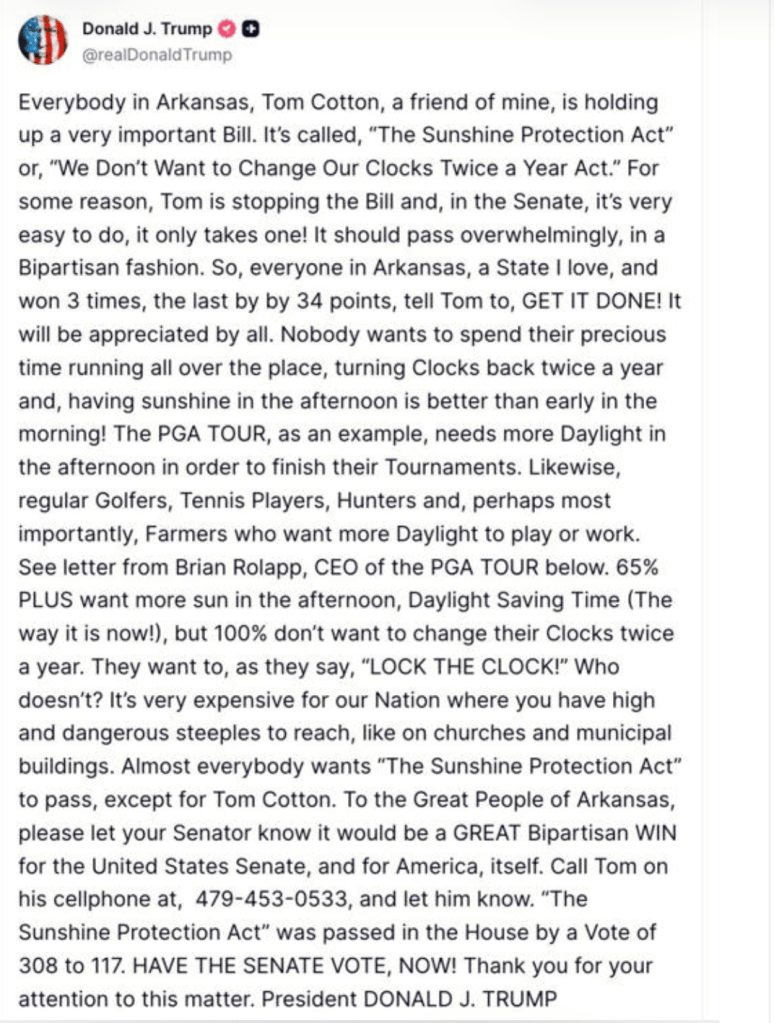
The bill would have sailed through the Senate were it not for Arkansas Sen. Tom Cotton, normally one of the president’s reliable allies. The president did not take it well. He blasted Cotton in a long post on “Truth” Social and, for good measure, shared the senator’s cell phone number with the entire internet. Isn’t that called “doxxing”? It certainly isn’t called “diplomacy.”
Almost immediately, the president was sharply criticized by Louisiana Sen. John Kennedy, who said Trump could go from zero to a-hole in about three seconds. Kennedy also said of the president, “He exists loudly. He can be tempestuous. I don’t think he should have given out Tom’s cell phone number. I don’t think that’s going to help convince Tom.”
Did Kennedy (who is not up for re-election) actually call the president an “a-hole”? Apparently freedom from campaigning is a wonderful thing and allows even a politician to tell the truth once in a while (although Kennedy is known for his candor).
Recall that Cotton said, “If permanent daylight saving time becomes the law of the land, it will again make winter a dark and dismal time for millions of Americans.” Little did he know his own winter was about to get a lot more dismal, thanks to the president who posted:
I guess the senator will be getting a new cell phone. Hopefully with a soothing ringtone.
An affordability move? Kroger has pulled Red Bull from all of its stores and Boar’s Head deli meats have disappeared from about 200 of its roughly 2,700 locations. Kroger hasn’t officially said why, but its website tells shoppers Red Bull is out of stock while it works with suppliers to keep prices affordable. News reports point to a dispute over price increases. Boar’s Head, for its part, denies that pricing is the reason.
I won’t miss Red Bull, since I’ve never had an energy drink. And Boar’s Head prices have always given me sticker shock, so I usually end up buying Kroger’s own peppered turkey breast instead.
What I find interesting is that Kroger chose to drop Red Bull rather than keep it on the shelf next to a cheaper alternative for comparison. Costco uses that side-by-side approach, though for the life of me I can’t figure out why it pulled its own lower-priced salsa. I suspect it’s because it was the one I bought.
Still, if customers were balking at the price of Red Bull and Boar’s Head, dropping them frees up shelf space for products that sell. Every retailer does this. Costco has long swapped in its own Kirkland Signature brand to hold prices down, and Walmart, notorious for squeezing vendors on price, seems to discontinue every product I like.
Red Bull fans will shop elsewhere and you can always get Boar’s Head at Publix if it is gone from your local Kroger. One more thing worth noting: Kroger’s CEO, Greg Foran, who took over in February, ran Walmart’s U.S. business from 2014 to 2019 and has pledged to cut prices and push back on suppliers who raise wholesale costs. Sounds like Walmart.
Gulf update
When I was in Georgia, diesel prices dropped by about 30 cents a gallon. It isn’t because oil is flowing freely out of the Gulf again. It’s because Georgia Gov. Brian Kemp suspended the state’s motor fuel tax, which is 37.3 cents a gallon on diesel and 33.3 cents on gasoline, from Sept. 29 through Oct. 29. Apparently Tennessee’s Bill Lee did not get the message, and our prices are now well above Georgia’s. Meanwhile, Iran has stepped up its attacks on tankers trying to transit the Strait of Hormuz, slowing oil exports yet again.
Personally, I don’t know which reports to believe. It is virtually impossible to believe anything coming out of the president’s mouth. Likewise, I don’t believe the Iranians either. So here are some recent reports. Take each one with more than a grain of salt.
Saudi Arabia is now flying air support for Yemeni government ground forces in a counteroffensive against the Houthis, who seized the strategic port city of Mokha in September. The aim is to push the Houthis back and remove their threat to oil exports through the Bab al-Mandeb strait. When Mokha fell, Yemeni commanders complained that the Saudi air support they had requested never arrived.
The Saudis are supposedly running their East-West pipeline, which can carry up to 7 million barrels a day across the kingdom to the Red Sea port of Yanbu, bypassing Hormuz altogether. Drone attacks shut it down on Sept. 11. It restarted later in the month and was reportedly pumping close to 6 million barrels a day by early October.
What about the Strait of Hormuz, where the Saudis shipped most of their oil before the Iran war? While the pipeline was down, Aramco pushed more crude out of its Gulf terminals at Ras Tanura and Juaymah, at one point loading nearly 12 million barrels in a single day, and had Asian customers pick up cargoes through ship-to-ship transfers off Sohar, Oman, just outside the strait. Shipments through Hormuz had been climbing, helped by U.S. naval protection and U.S. strikes that knocked out Iranian radar along the strait. In the last week of September, Middle East crude exports actually topped prewar levels on several days.
Now the attacks are back. At least seven vessels in and around the strait have been struck since Sept. 28, according to the U.K.’s maritime trade agency, and a U.S. official says Iran is getting better at hitting ships. On Saturday, Iran’s Islamic Revolutionary Guard Corps warned ships not to trust the U.S. Navy and to stay out of the U.S.-backed “south corridor” entirely. Traffic is already slowing. Will Aramco keep shipping through the strait? Will the pipeline stay up? Stay tuned.
Iran, meanwhile, can’t get its own oil to China because of the U.S. blockade, and it is about to lose a vital source of revenue. As Treasury Secretary Scott Bessent put it on Sept. 27: “Probably within the next two weeks they are going to make their final deliveries of oil to China, and then they will have nothing.”
That’s likely why Trump turned down Iran’s latest proposal, which reportedly asked for sanctions relief, unfrozen assets and an end to the blockade in exchange for reopening the strait. The question now is what Iran does next. Will it finally throw in the towel? Renew its drone and missile attacks with a vengeance? Expand the war into new areas? We’ll have to wait and see.
Got trash?
I love living in East Tennessee. I never tire of its scenic beauty – the lakes and streams, the mountains. The only thing that mars it is the litter. There is trash everywhere.
My neighborhood sits at the end of a two-mile winding country road, and there’s litter along every bit of it. I used to walk the first mile, turn and walk on the other side, once a month picking up trans. I’d take four trash bags and stop when the last one was full. I never made it through the entire two miles. Finally, I just gave up. Now I just pick up around the entrance to the neighborhood. I even put up “Don’t litter” signs. The result? A pile of trash at the base of the signs. And now the signs have disappeared. The county picks up maybe once every six months. One of my neighbors blames construction crews, but I’ve seen trash thrown out the windows of some very expensive cars and pickups. Young people? Probably.
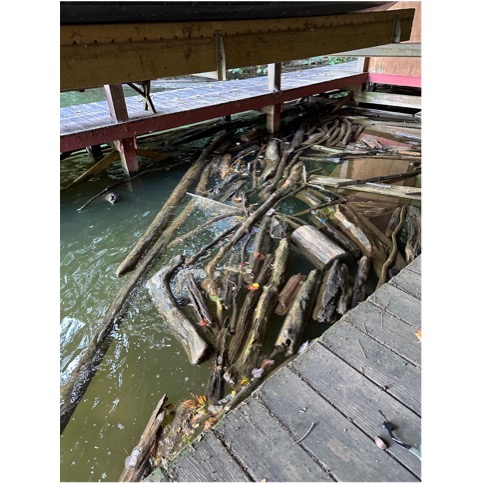
I live on Fort Loudoun lake and fill a trash bag down at my boat dock about once a month. You won’t believe what finds its way to the dock. Disposable diapers and feminine hygiene products seem to be popular, along with cans, fishing lures, prophylactics, the occasional syringe and assorted other stuff. I once even had an entire floating boat dock to deal with. I don’t touch anything, and I even keep a sharps container for that stray syringe.
Every now and then there’s an organized effort to clean up Fort Loudoun Lake, led by a nonprofit called Keep the Tennessee River Beautiful which hauled nearly 21,000 pounds out of Fort Loudoun Lake last year. (Here in East Tennessee, our “lakes” are really rivers, impounded between the dams.)
All that picking up got me wondering whether we might run afoul of the law, like what happened in Seattle. This summer, their local cleanup group We Heart Seattle was served a “notice of alleged safety or health hazards” by the Washington State Department of Labor & Industries, which enforces workplace safety. The notice alleged “improper handling and collection of hypodermic needles and fentanyl paraphernalia.” We Heart Seattle is the brainchild of local resident Andrea Suarez, who was appalled by the trash and discarded needles she saw on walks near the homeless settlements. The group says it has removed more than 2 million pounds of trash from Seattle’s parks and public spaces.
Seattle is a mess, literally and figuratively, with a socialist mayor who seems not to have a clue – although, to be fair, this investigation came from the state, not City Hall. Washington State is far more regulation-bound than Tennessee, and Knoxville is light-years away from Seattle. Our trash problem pales next to theirs, so it is unlikely that the Keep the Tennessee River Beautiful folks and I will be served a notice for “improper handling of trash.” But it could happen. Couldn’t it?
One of the problems with Trump’s attack on scientific research is that projects that seem to have little practical value can turn out to have enormous consequences. Consider this question: how does a bit of pond scum swim toward the light it needs for photosynthesis? That question led to this year’s Nobel Prize in Physiology or Medicine. The core discovery work was done in Germany at Max Planck institutes with a contribution from a researcher at Stanford.
The brain is incredibly complex, and so are the tools needed to study it. The most important of the tools is the brain power of the researcher. The other, optogenetics, won the 2026 Nobel Prize. It grew out of a scientist’s curiosity about how a single-celled alga manages to swim toward light.
The answer turned out to be channelrhodopsin, a protein that can make almost any cell it is placed into sensitive to light. Its discovery was said to have “jump-started the development of a whole range of new tools that let us selectively turn on and off brain cells with incredible precision. It has let us go from a Rand McNally road atlas of the brain to something more akin to Google Earth.”
The prize is shared by Karl Deisseroth of Stanford University, Peter Hegemann of Humboldt University of Berlin and Georg Nagel of the University of Würzburg, “for their discoveries concerning light-gated ion channels and optogenetics.” Starting from the study of algae that are attracted to light, they and others built the field of optogenetics using light to control nerve cells that have been genetically modified to carry a light-sensitive protein.
Some background: nerve impulses are generated by proteins called ion channels, which sit in the cell membrane and let charged atoms cross it. The nervous system relies on ion channels that open only under specific conditions, such as when they detect a neurotransmitter or a change in voltage. That fine control lets each type of nerve cell fire only when it should and keeps the brain from dissolving into a haze of electrical noise. What neuroscientists lacked was a way to switch specific cells on and off at will.
The solution came from a single-celled alga called Chlamydomonas. It’s one cell is remarkably sophisticated, with two flagella for swimming and an eyespot that detects the light it moves toward. In the early 1990s Hegemann, then at the Max Planck Institute of Biochemistry near Munich, recorded from Chlamydomonas with fine electrodes and found that a flash of light triggered an electrical response within about half a millisecond. That was so fast that he suspected the light-sensing protein might itself be the ion channel.
When researchers began cataloguing the messenger RNAs made by Chlamydomonas, Hegemann spotted two genes resembling bacteriorhodopsin, a light-driven ion pump found in salt-loving archaea. Experiments that blocked these genes with RNA interference reduced the alga’s response to light, implicating them in its light sensing.
Hegemann then teamed up with Nagel, an ion-channel specialist at the Max Planck Institute of Biophysics in Frankfurt. By producing the proteins in frog egg cells, they showed that both were light-gated ion channels. The first, described in 2002, appeared to let through mainly protons (essentially hydrogen ions), while the second, described in 2003, passed a broad range of positively charged ions. The two respond best to somewhat different wavelengths of light, and, like the light receptors in our eyes, both capture light using retinal, a chemical relative of vitamin A. The new class of proteins was named channelrhodopsins.
Nagel was instrumental in showing how widely they could be used. The 2003 work showed that channelrhodopsin-2 functions in cultured human and hamster cells, and in 2005 Nagel and collaborators showed that switching it on with light in the tiny worm C. elegans changed the worms’ behavior.
Deisseroth and his team at Stanford turned this into a broadly useful technology. In 2005 they showed that channelrhodopsin-2 works in mammalian neurons: blue light made rat nerve cells fire on command, with millisecond precision. In the years that followed, his lab and others found or engineered many more light-sensitive proteins, tuned to different colors of light, including ones that move negatively charged chloride ions into the cell. Those let researchers silence nerve cells as well as activate them.
Deisseroth’s group also tackled the engineering side, developing compact light sources and thin, flexible optical fibers that could deliver light into the brains of animals that were free to move around and behave relatively normally. Working with other researchers, he used the approach to wake sleeping mice on cue. The result is a light-operated switch that can turn chosen nerve cells on or off in a living brain.
The work has already had real-world medical impact, opening up a field known as optogenetic therapy. In one trial, published in 2021, it was used to partially restore the sight of a man who had gone blind from retinitis pigmentosa, a disease that destroys the light-sensitive cells of the retina.
Again: all of this began with the question of how a bit of pond scum swims toward the light it needs for photosynthesis.
Quicksand drags you down slowly. So why isn’t it called slow sand?
College football viewership is off
Wade and I are apparently not the only ones turned off by today’s college football, although one of my readers, Jolly Old, remains all in. According to Nielsen, viewership through the first four weeks of the season is down 11 percent from the same stretch last year. That slide came even though the sport served up a historic Saturday on September 26: six games between ranked teams, the most conference matchups between ranked teams on a single day in AP poll history. The public’s reaction was a big yawn. Even the season’s marquee game disappointed. Despite all the hype, this year’s Ohio State–Texas game drew 14 million viewers, down from 16.6 million when the two teams met last year.
Who could blame the fans? The players are forever changing. Ole Miss alone brought in 75 transfers this offseason. That would have been turnoff especially if Trinidad Chambliss and Kewan Lacy had answered Lane Kiffin’s siren calls and gone to LSU.
Defenders of college football have their excuses. This year’s Ohio State–Texas game kicked off at 7:49 p.m. instead of noon, weather pushed LSU–Clemson to a 9:40 p.m. start, and because more games are on TV, total viewing time is actually up slightly. Fair enough. But for me the explanation is clear: conference realignment, NIL, and the transfer portal are eroding the appeal of the sport.
GLP-1s and free markets
Wegovy’s cash price has dropped about 75 percent since 2021. With 11 percent of American adults now saying they take a GLP-1 drug for weight loss, you would think the price should have gone up, not down, because of all that demand. Right? Well, that ignores the beauty of free markets: competition.
When Wegovy came on the market in 2021, it was priced at $1,349 a month. At that price, employer health plans balked, and government insurance programs were barred from covering weight-loss drugs except in limited cases. Then a competitor emerged. Eli Lilly’s Zepbound launched at a list price of $1,060, and Lilly offered it to cash-paying patients (no insurance) for $550 a month through its LillyDirect pharmacy. https://www.lilly.com/lillydirect Novo Nordisk, Wegovy’s maker, answered with its own cash-pay program, NovoCare, at $499 a month for the lowest dose. Novo was then compelled to cut Wegovy’s cash price to $349 a month, with a $199 introductory offer. Lilly countered by dropping Zepbound’s typical maintenance dose to $299, and the new Wegovy pill now sells for $299 a month to self-paying patients. BTW, the official list price of Wegovy is still $1,349, although Novo has announced it will cut it to $675 in January 2027.
To be fair, the government hasn’t been entirely on the sidelines. The White House struck a pricing deal with both companies last November, and this July Medicare began offering these drugs to eligible patients for a $50 copay. But the cash-price war was well underway before Washington got involved. The point is that when private insurers won’t cover a drug because of its cost and patients pay for it directly, competition drives prices down.
Isn’t this a lesson worth heeding? Isn’t it a glimpse into why health care costs are so high? Instead of patients paying directly, bills go through third parties. This is why I believe Medicare for All would mean higher costs, less coverage, and worse outcomes.
It is now fashionable for politicians of all stripes to attack Big Pharma. This episode shows they should be promoting market solutions instead. But there is no political gain in that – and politicians are politicians.
America.gov
On September 29, the president rolled out America.gov, a government AI chatbot that the White House says will make it easier for Americans to deal with the federal government. For now, it answers questions using information from official government websites. Once fully operational, it is supposed to handle tasks like renewing passports and enrolling in Medicare. https://america.gov It is actually a rather cool site, greeting you with “Hello, America. Whatever you need from government, start here.”
In its first days, people who asked America.gov questions got answers that contradicted some of the president’s claims. For example, Trump has said America experienced its worst inflation ever under Biden. America.gov said, “No. Bureau of Labor Statistics (BLS) Consumer Price Index data do not show that January 20, 2021–January 20, 2025 was the worst inflation ever in US history.” It also said there was no evidence of widespread voter fraud in the 2020 election. And it contradicted the president’s claim that exporting countries pay tariffs, saying, “A tariff is a tax on imported goods. That extra cost is paid first by the U.S. importer.”
Those answers didn’t last long. Within a day, reporters noticed the chatbot had stopped answering many of those questions. When I asked it, “Are imports a threat to national security?” it responded, “America does not offer political opinions or commentary on whether imports threaten national security.”
I am not really interested in catching the president in a lie when it is apparent that he doesn’t care whether he has lied or misspoken thousands of times. So I will use America.gov for what it was built for: dealing with issues that would otherwise mean waiting hours on the phone or weeks for an answer from the federal government. Bon appétit!
The LED bulb, one of the signature products of the climate agenda, is coming under scrutiny. Glen Jeffery, a professor of neuroscience at University College London who studies the effects of light on the body, has issued a stark warning: “LED lighting is damaging mitochondria and therefore there is no question you’re damaging systemic health. This is a clear and present public health emergency and we need to take action.”
Hold it! You mean the LED bulbs we were all but forced to buy in the name of climate change might be hurting us? According to Professor Jeffery, yes. He has gone so far as to say LED lighting is a household health hazard on the same level as asbestos.
He isn’t the only one raising questions. One study found that daily exposure to short-wavelength blue light reduced measures of mitochondrial activity by about 50 percent in mice. (“Impact of short wavelength light exposure on body weight, mobility, anxiety like behaviour and cytokine expression,” https://www.nature.com/articles/s41598-025-89081-2)
Another study found that exposure to blue-enriched LED lighting altered activity, metabolism and liver function in mice. (“Influence of Daytime LED Light Exposure on Circadian Regulatory Dynamics of Metabolism and Physiology in Mice,” https://pmc.ncbi.nlm.nih.gov/articles/PMC6807725/)
But not so fast, my friends. Not everyone is convinced. The European Commission’s Scientific Committee on Health, Environmental and Emerging Risks concluded that “there is no evidence of direct adverse health effects from LEDs in normal use by the general healthy population.” And the government would never lie to us, would it? Where is RFK Jr. when we need him?
Recall how we got here. Under President Bush in 2007, Congress mandated tougher energy-efficiency standards for light bulbs, and the Department of Energy began issuing rules to implement them, phasing in LEDs along the way. As of August 2023, most incandescent bulbs were effectively banned. The stated goals were to reduce national energy use, cut carbon emissions and lower electric bills. (“Over 30 years, DOE projects these updated standards will save Americans more than $27 billion on their utility bills.”) In other words, Washington set out to push the entire lighting market toward high-efficiency LEDs and eliminate anything that couldn’t meet the new threshold. All in the name of energy savings.
This seems like an area where President Trump should direct Energy Secretary Chris Wright to review the mandate and assess Professor Jeffery’s research. Wright and EPA Administrator Lee Zeldin have already undone much of the Green New Deal agenda and its environmental zealotry. Why not take a closer look at the health risks that may come from LED lighting?
We are not going to invade Cuba — are we?
CBS News ran the headline “U.S. military lays groundwork for potential action around Cuba.” Since “around Cuba” is mostly water, I presume the headline really means “in Cuba.” According to the article, “The U.S. Army Reserve is examining whether it can provide the military’s Southern Command with police forces, medical personnel and other support units within the next four months.”
The president has been steadily escalating the pressure on Cuba. He has called it a “failed nation” and a national security threat, and he has hinted at a “friendly takeover.” The administration has filed charges against the island’s former leader, Raúl Castro, and Trump has said that previous U.S. presidents considered intervening in Cuba for decades but that “it looks like I’ll be the one that does it.” Secretary of State Marco Rubio says that over the years Cuba has grown used to “buying time and waiting us out.” “They’re not going to be able to wait us out or buy time,” Rubio said. “We’re very serious, we’re very focused.” Meanwhile, the administration has tightened sanctions and restricted oil shipments to the island in an effort to drive regime change.
Trump has repeatedly said the Cuban government is nearing a breaking point under the U.S. embargo, that the island is “seeing the end,” and that the United States could take additional action soon, though he hasn’t said what that action would be. He has also stated plainly that “Cuba is next.” However unlikely, could he actually mean military action against the island? That doesn’t seem to be in the cards while we remain involved in Iran. Trump himself has said that “they can’t move on to Cuba” until they have finished dealing with Iran.
But with this president, who knows?
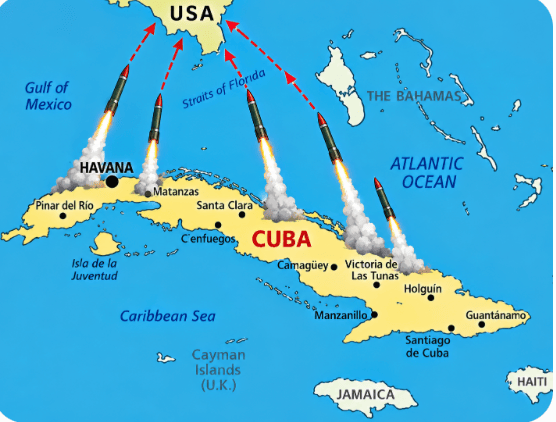
Cuban President Miguel Díaz-Canel has warned that any U.S. military action against Cuba would lead to a “bloodbath.” But what else would he say? Still, Cuba reportedly has more than 300 military drones, along with plans to strike Guantánamo Bay, U.S. naval vessels, Key West, Miami and other parts of Florida.
I Am the Code! Farm Exports. Cursive. Kennedy’s Worm
I Am the Code!
When the architect of Trump’s White House ballroom warned him that the project violated building codes, the president reportedly said, “I am the code!” The architect, James McCrery II, then withdrew from the project. That raises an obvious question: if the finished structure doesn’t meet code, can it legally be used?
The answer is murkier than you might think. As Reason points out, the Supremacy Clause and the doctrine of sovereign immunity broadly exempt the federal government from state and local rules, including zoning laws and building codes. But there’s a catch: federal law (40 U.S.C. § 3312) requires that any construction of, or alteration to, a federal building comply with one of the nationally recognized model building codes. So the president may not be the code after all. And will the building be allowed to open without adhering to some code or the other – besides the president’s?
Farm Exports
Trump’s tariffs have caused farm exports to tank, most notably exports to China. Remember soybeans? Exports plunged from 12 million tons to fewer than 2 million as Chinese buyers took their business elsewhere. Overall, American farm exports to China peaked at $38.1 billion in 2022 and fell to just $8.4 billion last year.
China was one of the few countries willing to match Trump tariff for tariff. As with Canada, every time Beijing retaliated, Trump raised the stakes further. Now the bill may be coming due if republicans lose seats across the Midwest as frustration with the tariffs grows.
Bring Back Cursive!
I’ve mentioned before that when I returned to the classroom at UT that fateful semester, my students were incredulous that I expected them to write their exams by hand on the paper provided. They wanted to use their laptops, but I held firm. Imagine my shock when every exam came back printed, one so neatly that I wondered why I hadn’t heard the printer. The students simply don’t know cursive. One told me her mother had to teach her how to sign her own name.
It turns out that dropping cursive is just one more in a long line of failures by our so-called “educators.” There are real intellectual and aesthetic values in the handwritten word and 27 states now require their public schools to teach cursive. Handwriting matters for retaining information, especially in elementary school, and writing of any kind beats typing for improving spelling accuracy, letter recognition, memory, and recall. Cursive may offer even more. Studies suggest its continuous, connected strokes do more than printing to build fine motor skills, strengthen neural connections, and encourage fluid thinking, and some research points to benefits for dyslexia and reading development.
BTW, why do we say “typing” when there are no typewriters and “dialing” when there are no telephone dials?
RFK Jr.’s Worm
It’s hard to deny that RFK Jr. is a bit of a kook, and it frightens me that this guy is in charge of HHS. One of his stranger claims is that a worm once ate part of his brain and then died inside his head. He made the assertion during his 2012 divorce proceedings, describing cognitive problems he feared were a brain tumor, until a doctor told him the dark spot on his brain scans was a dead parasite.
Well, a recent story in Ars Technica has made me reconsider:
A rice farmer in the Philippines began experiencing uncontrollable shaking in her arms and legs. A physical exam turned up nothing, but a brain scan revealed a bright cluster of nodules surrounded by fluid in her left frontal lobe. Her doctors immediately suspected worm eggs, specifically neuroschistosomiasis, an uncommon complication of infection with Schistosoma, a parasitic worm also known as a blood fluke. This infection occurs most often among those who work in water.
The adult worms can live in blood vessels undetected, producing no noticeable symptoms. It’s usually their eggs that cause the trouble and give them away. The parasite’s life cycle is the stuff of science fiction. The eggs hatch into free-swimming larvae that seek out particular kinds of aquatic snails, burrow inside them, and pass through two life stages there. The late-stage larvae then burst out, grow a forked tail, and swim off in search of an animal host. On rare occasions, eggs lodge in the brain, where they’re linked to seizures and other neurological problems.
With the MRI pointing to eggs, the doctors diagnosed cerebral schistosomiasis as the cause of her focal seizure. They saw a forked tail! They prescribed an anti-parasitic drug, an anti-inflammatory and an anti-seizure medication. Three months later she reported no further seizures, and a follow-up MRI showed the eggs were gone.
So there you have it! Maybe Kennedy really did have a worm in his brain after all.
Ohio State is playing Iowa today, and the president is busy patting himself on the back – a sport in which he remains undefeated. The occasion: a new $15 billion steel mill, the first in 50 years, coming to Iowa. Naturally, he credited his 50% tariffs. The project is expected to create 1,750 permanent jobs and support up to 6,000 construction jobs. Trump added that it would also create 2,000 new manufacturing and mining jobs. Over the next decade, it is projected to generate $95 billion for the U.S. economy. He took credit, saying his “powerful 50%” tariffs on steel imports last year meant that “our steel industry is roaring back to life. Everyone’s building their plant here because they don’t want to pay tariffs. It’s really not that complicated.”
Actually, it is a bit more complicated than that. The president is a short-timer. If the next president lowers or scraps the tariffs, will the math on a $15 billion plant still work, or does Iowa end up with one of the world’s most expensive machine sheds? Although not as apparent as beef or energy, Trump’s tariffs have made Americans to pay more for steel than any other country in the world. And while the president bragged that the steel will be “mined, melted, and made completely in the U.S.,” calling it “something very unusual,” he skipped a small detail: the mine’s owner is Mesabi Metallics, a Minnesota-based company owned by India’s Essar Group. Made in America, owned by India – which, to be fair, is “something very unusual.” The plant will be fed by a newly developed $2.5 billion iron ore mine that Mesabi opened on September 17 on Minnesota’s Mesabi Iron Range. And the Export-Import Bank of the United States (EXIM) will provide up to $10 billion in financing for the new Iowa steel mill. Hold that thought. Also keep in mind (mine?) that the US steel industry is being dominated by foreigners – US Steel is a wholly owned subsidiary of Nippon Steel. I thought Trump’s policy was America First?
But what is the Export-Import Bank and why is it providing financing for an Indian company? This is from its website: “The EXIM Bank is the official export credit agency of the United States. Our mission is to support American job creation, prosperity and security through exporting. We accomplish this by unlocking financing solutions for U.S. companies competing around the globe. We help level the playing field and fill gaps in private sector financing.” https://www.exim.gov
So let me get this straight: a U.S. government bank is putting up $10 billion of the $15 billion so an Indian corporation can set up shop in Iowa. And once this foreign-owned mill is running, Trump’s 50 percent tariffs will protect it from… foreign competition. Sounds like a sweet deal to me – sweet as Iowa corn. And timing, of course, is everything. The announcement comes just before the midterms. Between the tariffs and the price of fertilizer and diesel, Iowa is suddenly in play. The governorship, a U.S. Senate seat, two of the four congressional districts, and the attorney general’s office are all suddenly competitive in races where the republicans should have been favored. Surely that had nothing to do with the announcement. Right?
In a related blog post, Don Boudreaux notes what was said by Rep. Mariannette Miller-Meeks (R-IA) – whose seat is at risk – at the White House announcement of the steel mill: “For too long, Iowa families have watched their jobs shipped overseas and their communities hollowed out. Not anymore.”
Don points out this inconvenient truth:
Since 1997 (the earliest date for which I can find data), manufacturing output in Iowa has risen fairly steadily. It reached its peak in 2024, when it was 51% higher than in 1997 and 45% higher than in 2001 (the year China joined the World Trade Organization). (Manufacturing output in Iowa was down slightly in 2025, quite likely because of Trump’s tariffs.)
Over these same years, Iowans’ real median household income also rose. It peaked in 2018 (the first year of Trump’s tariffs) at $86,600 (in 2025 dollars), and in 2024 was slightly less (at $86,450). In 2024, Iowans’ real median household income was 36% higher than in 1997 and 23% higher than in 2001.
Where’s the evidence for the “hollowing out” of American manufacturing and income? To justify their schemes, protectionists incessantly prattle on about this “hollowing out,” but it’s a myth.
Trump was right. His tariffs were responsible for the new Iowa steel mill, because without them Iowa would be voting republican, and there would be no need to lure an Indian company into the state with financial incentives and EXIM financing. Just another example of the mess that this president has wrought upon us.