Trump’s tariffs – a wee bit of mischief perhaps?
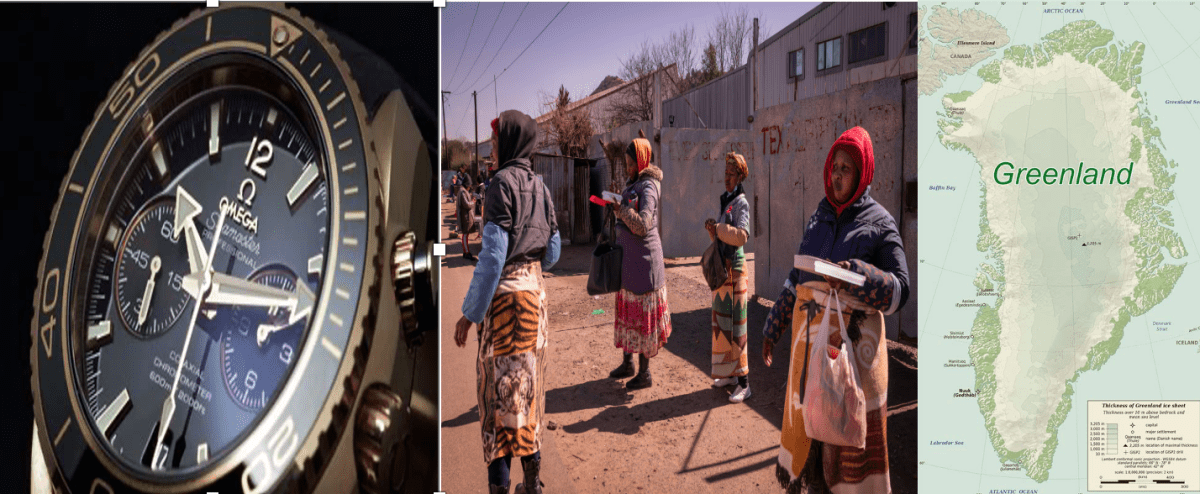
When Trump hit the Swiss with a stunning 39 percent tariff, one official bemoaned that he guessed that is the price the Swiss pay for independence. If they were in the EU their tariff would “only” be 15%. Trump said the 39% was because of a REALLY BIG DEFICIT, which happens to be a paltry $39 billion. I’m sure it is just a coincidence that their tariff equals their deficit. Hey, we know that Trump is not exactly a math whiz. Another Swiss official said that if every Swiss started drinking whiskey every day and bought a Harley, they would still be running a deficit. You just got to stop making Americans from buying Swiss goods Donald. Maybe they can become the 51st state. Or maybe they could move their watch, precision tool and chocolate companies to the US. Then they can export their products back to Switzerland. But the chocolate won’t taste as good.
Pity poor Lesotho a country with a GDP of only $2.3 billion – not trillion but billion. Mind you there are over 600 American companies with revenues over $2 billion that are doing business with China. Needless to say Lesotho is perhaps the poorest country in the world. Trump’s initial tariff was an astounding 50%. This devastated the country’s textile industry with garment exporters shutting down and laying off workers. The country declared a state of emergency. The country had been benefitting from the 25-year-old American trade program that granted duty-free access to the U.S. market to dozens of African countries. Their textile industry was supplying garments to Reebok, Levis and to Walmart. With the tariffs, the orders went away, factories shut down and workers were laid off. Trump had derisively called Lesotho the “country that nobody had ever heard of.” Trump has announced that Lesotho’s tariffs will now be 15% and it will be interesting to see if business will come back even at that lower rate. Before Lesotho benefited from the African Growth and Opportunity Act, which allows 32 African countries to sell some 1,800 products in the U.S. duty-free. The law expires this year and it is doubtful if Trump’s republican controlled congress will renew it. Lesotho’s textile plants pay about $168 a month and if there is no work there is no pay. One factory produces 90 percent of its output for the US market. It is shut down and may not reopen even with the lower tariff. But Trump doesn’t seem to care that his tariffs will increase the misery of some of the poorest people in the poorest countries of the world. By the way, Lesotho’s trade deficit with the US was only $234 million not exactly a REALLY BIG DEFICIT. Trump should be ashamed.
There are plenty of problems with the tariffs not the least being the seemingly randomness of it all. Trump once threatened a universal tariff of 10% and then it changed to 15 percent. Yet every one of the 193 countries could negotiate for a different tariff. This opens the door to all sorts of mischief. It seems that these numbers change almost daily, the tariffs range from 10% (UK) to 50% (Brazil). Countries like Laos, Myramar, and Syria are at 40%. India was at 25% but Trump has threatened to double it if they don’t stop buying Russian oil. Of course, within the tariffs are higher ones like those on aluminum and steel.
If there is one positive thing, and maybe the only positive thing, about the tariffs is that it will greatly simplify the accounting. Currently it is a nightmare. Go to the Harmonized Tariff book at where you will see a specific tariff dor each product imported from a specific country for every country in the world. Last year we imported over $4 trillion in goods from abroad.
The schedule comprises about 5,000 commodity groups, each identified by a six-digit code, arranged in a legal and logical structure, and supported by well-defined rules to achieve uniform classification. The system is used by more than 200 countries and economies as a basis for their customs tariffs and for the collection of international trade statistics. More than 98 percent of the merchandise in international trade is classified in terms of the HS. The HS nomenclature is updated every five years, with the most recent update in 2017. Whew!
But negotiating with every country with differential tariffs has got to lead to all sorts of mischief and even briberies, wouldn’t you think? Right now there are already dozens of carve outs. I wonder why? I want to know the logic – if any. I also wonder if Don Jr. and other members of the family are doing a Hunter Biden and doing some negotiations with side deals getting kickbacks for themselves and the Big Guy. Just saying. If Trump wanted to keep things simple then he would have simply imposed a flat tariff on all imports from all countries with which we run a deficit – say 10 percent – and none on those with a surplus. Now 10 percent of $4 trillion is $400 billion, a nice chunk of change. But he didn’t keep them simple. They are convoluted, complicated, confusing and without logic.
The deals are not even legally binding. There is no treaty. There is only a handshake so they can be modified either up or down on a whim – and Trump is pretty whimsical. Take for example, Denmark. Although that country is a member of the EU with 15% tariffs, Trump has levied a 54% tariff on selected Danish products. Actually, I am surprised. I thought Trump would put a 1,000 percent tariff on Denmark unless they relinquished Greenland to the US. Why hasn’t he done this? The same is true with Panama whose tariff is only 14 percent. Trump wants the canal back in US hands, so why doesn’t he hit Panama with a 1,000 percent tariff until they say uncle and give it back to us? If Trump can put a 50% tariff on Brazil – a country that we have a surplus – because he wants them to stop the prosecution of one of his buddies, then why doesn’t he do the same with Denmark and Panama?
Lastly, I wonder if the tariffs will cause a rift in the EU? Several nationalist leaders oppose being ripped off. Marine Le Pen, the leader of France’s National Rally party, which is favored to win the presidential election in 2027, has called the EU deal a “political, economic and moral fiasco.” And that is an understatement. What is the French equivalent of Brexit? Adieu EU!

 haroldblackphd.com