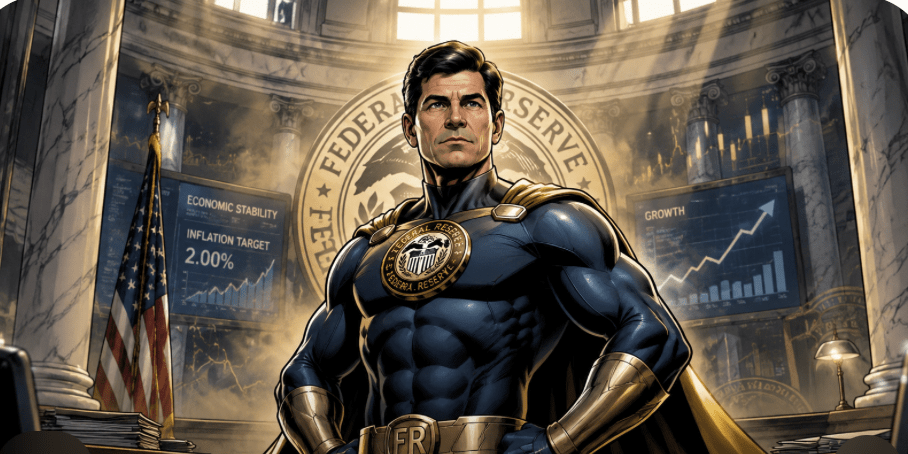
What Will Warsh Do?
The question of what new Fed Chairman Kevin Warsh will do has quietly shifted into something more uncomfortable: what can he do? The media, never content to let a story breathe, has already manufactured a crisis around the transition. Center stage in this drama is Jerome Powell, who has declined the customary exit — resigning his governorship as every Fed chair since Mariner Eccles has done — and chosen instead to stick around. Spite toward Trump? Perhaps that makes for a better headline. The more plausible explanation is that Powell has no appetite for becoming a private citizen while the Justice Department’s appetite for retribution remains unsated. His seat at the Fed offers a kind of institutional armor that evaporates the moment he walks out the door.
So what does Powell do with himself now that he no longer holds the gavel? Does he fade into the background, or does he keep talking? Powell and Warsh hold genuinely conflicting philosophies, which makes every Powell public appearance a potential grenade. Powell was a devotee of forward guidance — he loved the press conference, the signaling, the theater of Fed communication. Warsh couldn’t be more different. He has argued that the central bank should learn to work without applause, without an audience leaning forward in anticipation. Whether Powell can bring himself to honor that vision — or whether he’ll view Warsh’s reform agenda as a personal affront — is anyone’s guess.
History offers some comfort, if not much guidance. Under Volcker and Greenspan, disagreements existed but stayed behind closed doors. The Fed presented a unified front to the world, whatever battles raged internally. That discipline eroded under Bernanke and Yellen. Under Powell it effectively collapsed — dissenting voices grew louder, though the actual votes on the Open Market Committee held until Trump planted his proxy, Stephen Miran, who made a habit of voting for rate cuts regardless of circumstances. Powell is no fool. He understands that open warfare between himself and Warsh would rattle markets in ways neither man wants. Nobody has forgotten the chaos of the Bill Miller Fed under Carter — markets loathe a rudderless Fed, and Carter eventually had to install Volcker to restore confidence. That is not a legacy Powell wants any part of.
Then there is the balance sheet question, which is shaping up to be Warsh’s first real battle. Fed Governor Michael Barr has warned that shrinking the balance sheet now would be a mistake — threatening bank resilience, disrupting money markets, and potentially destabilizing the broader financial system. Dallas Fed President Lorie Logan has echoed similar concerns. But here is what both Barr and Logan know perfectly well: there is a workaround. The Fed can let its holdings run off while neutralizing any drain on system liquidity simply by ceasing to pay interest on excess bank reserves. The objections, however sincere, are not without a solution.
And then there is the curious rehabilitation of Christopher Waller. Trump once dangled the chairmanship in front of both Waller and Michele Bowman — and, right on cue, both began voting with Miran to cut rates, doing the president’s bidding with impressive punctuality. My read at the time was that Trump never seriously intended to elevate either of them; he was simply using the prospect of a promotion to extract compliance. Now that Warsh holds the chair, Waller has suddenly rediscovered his independence, putting rate hikes back on the table if inflation refuses to cooperate. You could almost call it admirable, if the timing weren’t so transparent.
If Warsh is genuinely serious about reform — and there is reason to believe he is — the obstacles are real. He can push the Fed’s model builders to take monetary aggregates seriously again instead of obsessing over interest rates. He can redirect the reserve banks toward regional economic concerns and away from the woke seminar circuit. He can tilt the institution back toward monetary policy and away from its recent playing of fiscal policy understudy. He can begin, carefully, to wind down the balance sheet. But none of it happens without allies, and allies at the Fed are earned, not assumed. He will need the reserve bank presidents. He will need the governors — Powell, Barr, Waller, and the rest. That is a lot of coalition-building for an institution not known for its love of change.
Warsh is going to need a cape. If he can pull this off, it would be a genuine achievement — a Fed reoriented toward principle, less addicted to discretion, and more predictable for it. If he cannot, well then welcome to the new Fed: less comity but more comedy.


Maybe I’ll have to read the essay again.
For I swear I see you representing Powell as more of a Hollywood Trump. Powell’s image of the forever-present , worked for Jimmy Stewart’s stick- in- the – mud image.
And do I read that Warsh is the image of the Steady Hand?..
Yesterday a NASCAR transporter drove past me on the Interstate. I had already seen videos of the late Kyle Busch’s specific truck, but the one yesterday had his Number on it, too..
Among friends, this will make my reputation. That’s America for you.
And I might add that crazy race car fans would feel good- if Busch had lived long enough to join The Fed.
Because……Busch’s skill , which is to keep turning Left,
may have involved road tracks, sometimes turning Right…
Trump has been praised for open meetings with the press, where Biden (oops) was less accessible.
You are right:
Is it better to really see the division in a government authority- is it better to not see? ..
Comity definition is interesting :
…”courtesy and considerate behavior toward others: a show of public comity in the White House….”
Does it make the Markets feel better if you are right, Powell will be prosecuted as soon as he’s not Fed?
LikeLike
I would be shocked if Powell actively worked against Warsh for the reason given – it would rattle markets. Not being a NASCAR fan, I know nothing about Kyle Busch so thanks for the analogy.
LikeLiked by 1 person
Not that interested in racing or bull-riding but I’ve known people who did these things. Their actual professions took second place to other concerns..
But I will always remember the day I walked into the garage of an acquaintance- and saw his racing helmet and jumpsuit.
“What? You race?”
LikeLike
I am so glad you brought up the balance sheet and it’s effect on money supply. The Fed truly has many arrows in it’s quiver. Let’s hope Warsh will use all his tools to fight inflation and gives some stern lectures about how Fiscal Policy greatly effects inflation too. Powell and Yellen failed at that the most.
LikeLike