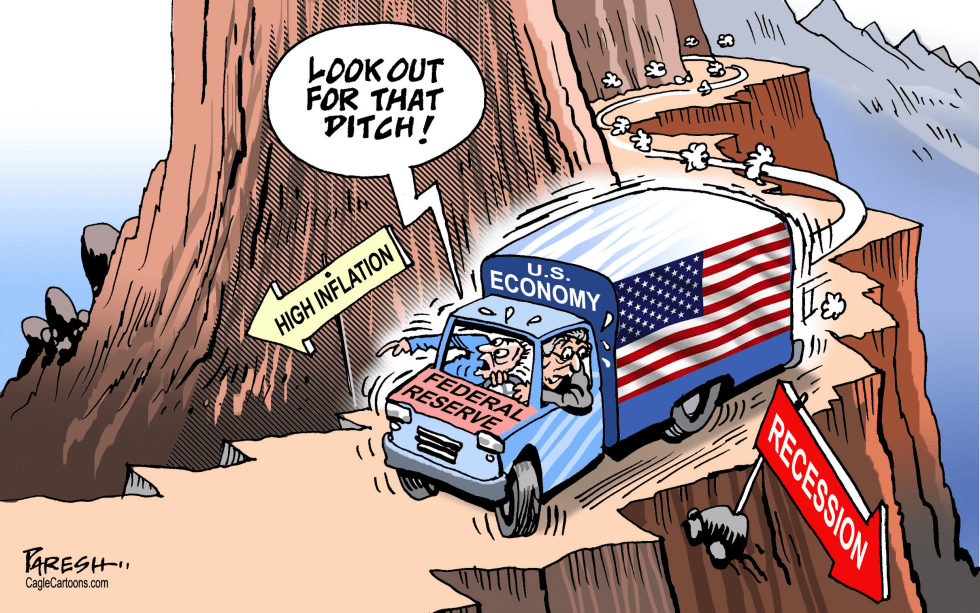
The Coming Open Market Committee Meeting
On July 16th I posted that “Warsh gets a reprieve — for now.” The memorandum of understanding with Iran had just been signed and Trump declared the Strait of Hormuz open. Oil prices plummeted and the CPI came in below 4 percent. Pressure had been building on the Fed to raise its Fed Funds target rate and for the moment that pressure was off.
Well, all of that has changed. The Iranians have declared the strait closed again, hostilities have ramped back up, and Brent crude, the global benchmark, has hit $100 a barrel. In the US, oil is at $92 a barrel, diesel has climbed over $5 a gallon, and unleaded is back above $4 — though here in East Tennessee we have, luckily, yet to see $4 unleaded at the pump.
All of this portends higher inflation. In anticipation, the ten-year Treasury jumped to 4.7 percent, its highest yield of Trump’s second term, while the Dow, Nasdaq, and S&P 500 all sold off. Mortgage rates rose to 6.58 percent and as one analyst put it, the recent move in the ten-year Treasury alone suggests mortgage rates are headed toward 7 percent within weeks.
The White House has said “As the U.S. military degrades the terrorist Iranian regime’s ability to attack commercial vessels and disrupt the free flow of energy through the Strait of Hormuz, oil and gas prices will plummet back to preconflict levels.” Maybe. But when? The Iranians have shown remarkable resilience to absorb punishment from over 20,000 air strikes. Aerial footage has shown them rebuilding even in the face of continued bombing and it seems they have an unlimited supply of missiles and drones. They have continued the attack on US bases and on their neighbors. The president is said to be incensed over the actions of the Iranians. Now what will Trump do? Will he be forced to do a limited invasion of Iran, targeting the islands in the strait? What impact will that have on public opinion and on oil prices?
The president is, of course, pointing fingers at everyone but himself for the runup in prices. He has threatened the oil companies. He has threatened retailers. And all the while, he has kept raising tariffs. The initial round of tariffs pushed consumer prices up and that increase is now baked into the inflation base — meaning if prices rose one percent because of tariffs and then held there, it would take a fresh round of tariffs to move inflation, which measures the rate of price increases from month to month. And that is exactly what is happening with new tariffs on Brazil, then Canada, and soon the rest of the world. Seemingly, he will never learn that US consumers, not the exporting countries, pay his tariffs.
Two weeks ago, the pressure was off Warsh to raise rates. Now it’s back on. Everyone expects the CPI and other inflation gauges to climb again. At the last FOMC meeting, members and the nonvoting Fed presidents were split on whether rates would rise this year. I’d wager that sentiment has now shifted to near-unanimous support for a rate hike — which will only add to the president’s fury. First Iran, now the Fed, led by a chairman he handpicked himself.
The Fed funds futures market has moved the odds of a rate increase to one in three, up from one in ten just last week. Even so, my bet is that the FOMC will vote to hold, though probably with a few dissents. The reasoning: the strait’s closure may again prove short-lived, so a wait-and-see approach is the safer strategy. Things are pretty volatile right now and waiting this time will not have an overall impact on the economy one way or another given the lag in monetary policy effectiveness.


All this is information that inspires me to listen for any news on the Fed. Last May, AOL did a story. I learned about something I’ve not heard before: the dot plot..
Now that Ive heard of it, the dot plot may be eliminated..
Powell started the talk to eliminate, and Warsh may just do it ..
Powell is quoted as saying the dot plot is like pointillist art where ….”many thousands of dots combined to a coherent painting, but don’t say much on their own..”
Which refers to each Fed member having their own dot..
Warsh says too much info goes out of the Fed. Too many scenarios & predictions..
“.any sort of forecast overload could mean markets stop paying attention..” AOL..
Maybe the dot plot is just too much- when ordinary people are looking at inflation vs high employment vs unemployment..
Yes, the Iran govt is resilient. But I wonder about the people- a different story.
The only question is how much is Russia helping. And is this why Russia isn’t interceding in Cuba?
LikeLike
I sort of mentioned the dot plot when I said that the forecasts were split 50-50. Warsh doesn’t participate so it will be interesting to see if it continues.
LikeLiked by 1 person