Costco emulates China!
Is China cheating in world markets?
The OECD recently reported that 60 percent of China’s market-share gains across 15 industrial sectors were driven by government subsidies with Chinese firms receiving three to eight times more state support than their domestic competitors. The implications are threefold. First, those subsidies allow Chinese companies to undercut foreign rivals on price, sometimes selling below cost. Second, this practice is a key reason the Chinese economy is under serious strain. One has to wonder how long Beijing is willing to bleed its own finances to capture global market share. Third, Western consumers benefit at Chinese citizens’ expense. We buy goods below market price while ordinary Chinese people foot the bill.
Source: OECD Finds 60% of Chinese Gains in Market Share Driven by Subsidies
It may surprise you but I support tariffs on subsidized imports set equal to the value of the subsidy, not as protectionism, but as a corrective measure to level the playing field. My preference remains zero tariffs and zero subsidies across the board. The United States is hardly blameless here. Washington heavily subsidizes agriculture and provides substantial support to aerospace, energy, and manufacturing, totaling roughly $150 billion annually. A more productive approach would be negotiating mutual agreements to eliminate export subsidies altogether.
Do you Costco?
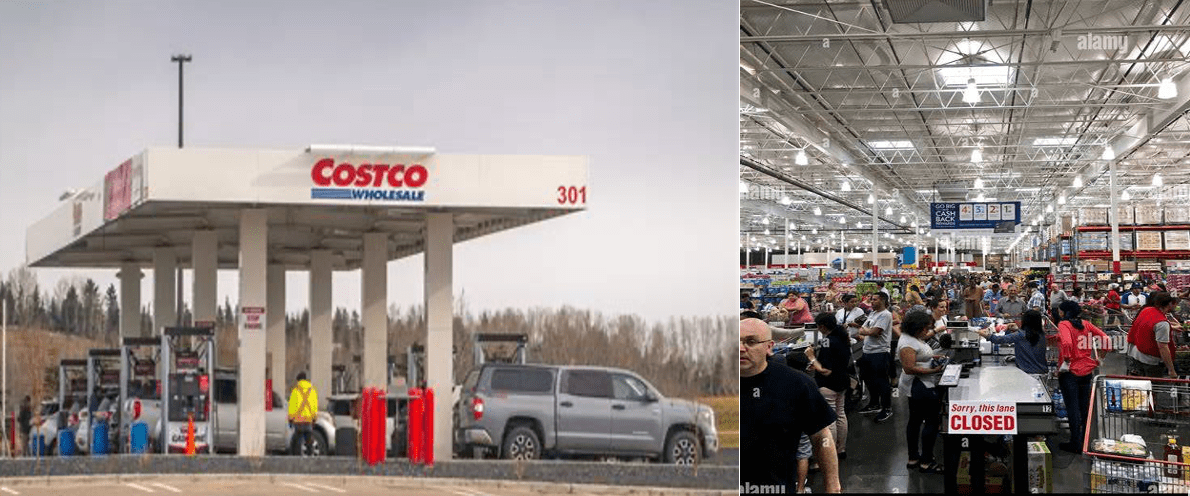
Which brings me to Costco. Have you noticed the gas lines? I pay $65 a year for membership for the privilege of making Costco my primary gas station. It is closer than Sam’s, is conveniently located and is 30 to 50 cents per gallon cheaper than other gas stations. That kind of pricing is classic loss-leader strategy. Costco acknowledges that members who buy gas are more likely to shop inside, generating revenue that offsets the below-market fuel prices. In other words, Costco is doing exactly what critics accuse the Chinese of doing, using subsidized pricing in one category to gain broader market advantage. Should Costco be penalized for it? If not, the logic of sanctioning China for doing the same thing subsidies deserves a harder look.
On a more personal note, I have never loved shopping at Costco. The parking lot is perpetually packed with the carts piled high as though a storm is coming. The Costco app is useless as are the employees. No one who works there knows where anything is. Also, Costco must pay Apple News, because every day there are articles about shopping at Costco. I don’t think a single item in any of the articles is healthy and not a single one I would buy.
Honestly, I hate Costco. I hate the crowds. I hate the lousy service. Despite the convenience, I am going to go to let my membership expire and buy my gas at Sam’s. I prefer Sam’s anyway. The checkout is faster. The stuff I buy is cheaper at Sam’s. And the clerks don’t have nose rings and assorted facial piercings – except for an occasional nose stud (what’s with these nose piercings anyway?). Also I only buy two things at Costco, their coastal cheddar cheese and their Kirkland brand salsa. Well, the salsa is now gone – slated for deletion (because of course, I buy it). I am therefore not renewing and will buy the bulk cheese at Sam’s, while not as flavorful, it’ll do.
So has Costco adopted the Chinese economic playbook of using subsidized pricing in fuel to erode competition from independent gas stations? It comes as no surprise that it has opened stores in Shanghai and Shenzhen. I wonder if gas is a lost leader there as well? Perhaps the saving grace for small businesses here may be the very things that frustrate Costco shoppers – the membership fee and the interminable lines act as natural barriers that keep bulk retail from completely displacing neighborhood stores. At least for now.


I’m totally with you on the Chinese tariffs. I prefer not, but there needs to be an equal playing field…but who shall,go first?
As for Costco and Sam’s…I like both, but for different reasons.
Sam’s is a “house of brands,” offering national name brands that communicate specific value and quality. Through years and dollars of advertising, I understand and appreciate their value. Where Sam’s loses is on the perimeter – their bakery, deli, prepared foods just can’t compare to Costco. Pricing is good, but from a shopper experience, Sam’s’ Walmart roots show up in the “cheapness” of the experience, from fixtures, to a well kept store. Getting gas is nightmarish, with only a single pump per lane. Somebody needs to change that fast. You’d really appreciate how different and beautiful the stores are when you’re in their homeland of NW Arkansas vs the hinterlands of East TN.
Costco, by comparison, is a “branded house,” leveraging the Kirkland brand across the store with equal or better quality to national brands, and I find their perimeter/fresh departments to be outstanding, particularly their prepared foods (bakery and ready to eat prepared meals). Even their nut selections are of superior quality to Sam’s as Sam’s gets more interested in price than quality on their Sam’s branded items (their buyers don’t source private label well). Where I dislike Costco is on their hostage holding technique over some national brands – look at Nature’s Path Pumpkin Granola as an example – a highly popular item. Costco has threatened them with discontinuance if they don’t allow Costco to put a Kirkland label at the top of the brand name, an attempt to leverage Kirkland as the key brand or Natures Path as some kind of white label manufacturer. That’s dirty pool.
A man of your knowledge and stature is fully aware that all grocers uses ”loss leader” strategies. As the sales lead over Oral Care for Procter & Gamble, I’d get pulled into bi-weekly conference calls with our local team and the Walmart buyer, being cajoled over “why am I losing $.30 per tube of Crest 6.4oz that we sell?” After a number of these calls, I reversed the question, asking “why exactly ARE you doing that?” We were getting hammered by other retailers who believed we were subsidizing it (which we absolutely were not). Of course, they were leveraging the largest brand in the category to create a value image with their consumers, consistent with their “always low prices” motto. There’s a reason Tide, Coke, and chuck roast are on sale every week…and they all jump into the game – no tariffs needed…..
LikeLiked by 1 person
I yield to your superior marketinng knowledge. It is just the items that you like at Costco I don’t buy. I am not a bakery patron, deli and certainly not prepared foods. As I noted I was astounded when they stopped stocking their Kirkland salsa. But then again, its because that’s one of two things that I do buy at Costco. The long gas lines don’t really impact me because both my gas vehicles have the caps on the passenger side. I buy basic goods – Deer Park water, toilet paper, paper towels tea, spices. So far someone like me, Costco is simply not worth the aggravation.
LikeLike
Comparisons of stores is the perfect place to tell you ..
I won’t be able to read your essays for a while. I’m going to a place in MS with no iPhone service.
Other than the parking lot of Piggly- Wiggly..
Interesting thing about one of the Piggly-Wiggly’s …
the store is slowly replacing signs with Spanish versions…
Is this a strategy, it’s to anger the farmer Republicans by emphasizing a new culture?.
Go figure.
LikeLike
You will be missed. Stay safe.
LikeLiked by 1 person
Can’t make comparisons myself- but will use this knowledge in conversation.
LikeLike
I’m totally with you on the Chinese tariffs. I prefer not, but there needs to be an equal playing field…but who shall,go first?
As for Costco and Sam’s…I like both, but for different reasons.
Sam’s is a “house of brands,” offering national name brands that communicate specific value and quality. Through years and dollars of advertising, I understand and appreciate their value. Where Sam’s loses is on the perimeter – their bakery, deli, prepared foods just can’t compare to Costco. Pricing is good, but from a shopper experience, Sam’s’ Walmart roots show up in the “cheapness” of the experience, from fixtures, to a well kept store. Getting gas is nightmarish, with only a single pump per lane. Somebody needs to change that fast. You’d really appreciate how different and beautiful the stores are when you’re in their homeland of NW Arkansas vs the hinterlands of East TN.
Costco, by comparison, is a “branded house,” leveraging the Kirkland brand across the store with equal or better quality to national brands, and I find their perimeter/fresh departments to be outstanding, particularly their prepared foods (bakery and ready to eat prepared meals). Even their nut selections are of superior quality to Sam’s as Sam’s gets more interested in price than quality on their Sam’s branded items (their buyers don’t source private label well). Where I dislike Costco is on their hostage holding technique over some national brands – look at Nature’s Path Pumpkin Granola as an example – a highly popular item. Costco has threatened them with discontinuance if they don’t allow Costco to put a Kirkland label at the top of the brand name, an attempt to leverage Kirkland as the key brand or Natures Path as some kind of white label manufacturer. That’s dirty pool.
A man of your knowledge and stature is fully aware that all grocers uses ”loss leader” strategies. As the sales lead over Oral Care for Procter & Gamble, I’d get pulled into bi-weekly conference calls with our local team and the Walmart buyer, being cajoled over “why am I losing $.30 per tube of Crest 6.4oz that we sell?” After a number of these calls, I reversed the question, asking “why exactly ARE you doing that?” We were getting hammered by other retailers who believed we were subsidizing it (which we absolutely were not). Of course, they were leveraging the largest brand in the category to create a value image with their consumers, consistent with their “always low prices” motto. There’s a reason Tide, Coke, and chuck roast are on sale every week…and they all jump into the game – no tariffs needed…..
LikeLike
The main question is why are the Chinese willing to sell goods below cost? Is it to extinguish manufacturing everywhere else in the World? Making China the only manufacturing super power and the rest of the World dependent on them?
LikeLike
Welcome back. That’s awfully difficult if not impossible to do. I think they have created an export driven monster that they have to keep feeding or else their economy will collapse – and the export subsidies will eventually be one of the causes of that collapse. If you sell at a loss you can’t make it up on volume.
LikeLike
This gentleman thinks their plans are nefarious.
https://en.wikipedia.org/wiki/The_Hundred-Year_Marathon
LikeLike
Costco is a place I’ve never been. After all the Jay Leno jokes, I couldn’t shop there with a straight face…
China- I’ll will have to absorb this, but will mention a situation I do understand…
Gotion is the Silicon Valley newest innovator of EV batteries. Who attempted to move into a Michigan community where they werent wanted..
Gotion is China- backed, but the elected officials OKd construction & incentives ..
The community then elected new leaders – who cancelled the money and said no to factories.
Democracy in a Republic, right?.
But…. Gotion is suing ; they won’t build but they still want the promised money, and comp for time tantalizing previous elected officials..
..” Gotion Inc.’s state-subsidized plans to build an EV battery factory near Big Rapids involved public officials signing off on it — but it angered the public. Protests against it grew, eventually including a 2024 campaign stop by Vice President JD Vance…”
(Paula Gardner/Bridge Michigan)
Corporate Leadership: Gotion High-Tech has an internal Chinese Communist Party (CCP) committee, and members of its North American leadership have been reported to attend CCP meetings.
Shareholder Ties: Germany’s Volkswagen Group is the largest single shareholder in Gotion’s Chinese parent company, owning approximately 30%. …” AI
LikeLike
Costco gas is a top tier gas similar to Shell. Sam’s gas is just common cheap gas. But I still go to Sam’s for gas. 1st it’s closer to my house and secondly it’s usually 3-4 cents cheaper than Costco. Same reason I shop at Sam’s. It’s closer. I like Sam’s credit card which I only use for gas. They give you 5 cents a gallon cash reward anywhere you buy gas.
LikeLike
I like Costco, though I don’t care for the crowds. It is a different menu of goods than Sam’s. And the gas price alone is worth the membership.
I think tariffs subsidized by taxpayers to gain international advantage is different than loss leaders subsidized by shareholders to gain domestic advantage. Prove me wrong and I’ll adopt your opinion.
LikeLike
If it walks like a duck …. And where have I heard that last sentence before?
LikeLike