
Save the SAVE Act?
The president is holding the housing bill hostage until Congress passes the SAVE Act. The housing bill is rare having strong bipartisan support—sponsored by Tim Scott and Elizabeth Warren—and is effectively veto-proof, having passed the House 358–32 and the Senate 85–5. It’s a sprawling bill that consolidates over 50 pieces of legislation from members of both parties. Its massive support reflects the pressure on both parties to do something—anything—about housing affordability. The bill’s stated intent is to increase housing supply and lower costs.
I’ve analyzed the bill before and won’t repeat that here. I’ve called it a “mess.” Its supposedly intent is to increase housing supply. That is doubtful because almost all impediments to increasing supply are at the local, not federal level. Among its well know provisions is Section 901, titled “Homes Are for People, Not Corporations,” bans large institutional investors—those owning 350 or more single-family homes—from purchasing additional properties, contending that such activity drives up prices,. This ignores the rental market entirely. In 2024, the build-to-rent market produced 39,000 single-family rental properties. What happens to the families who prefer to rent rather than buy when that market dries up? It’s remarkable that republicans support such a provision—but they do, including the president.
Some provisions would even allow a future (most likely democratic) administration to stop evictions and impose rent controls. Despite its stated goal of lowering housing costs, several provisions would do the opposite. To qualify for a grant to build multi-unit apartments accessible by a single staircase or elevator, developers must pay union wages—a mandate that will raise costs just as the two-staircase requirements did in the past. The Wall Street Journal summed it up: “The program is a make-work project for unions,” citing a New York City Housing Authority project that spent $1,973 per apartment installing LED bulbs under union wage rules. Rep. Chip Roy (R-TX), on his way out of Congress, called the bill “full of big government garbage & spending”—including a $200 million affordable housing pilot program. He was likely among the handful who voted against it.
The bill does include some useful reforms such as streamlining environmental reviews, modernizing manufactured housing rules, and reducing regulatory barriers to construction. It’s classic logrolling—some deregulation to win republican votes, some expansion of government to win democratic ones. Whether the good outweighs the bad is an empirical question.
For some reason the president apparently believes he can force passage of the SAVE Act by refusing to sign the housing bill. He posted on Truth Social: “Today’s Housing News Conference and Signing is hereby cancelled until such time as we pass the desperately needed SAVE AMERICA ACT, which I consider to be a National Emergency.” He followed up: “The Elizabeth ‘Pocahontas’ Warren centric housing bill, which is of minor importance compared to lower interest rates, and even FISA, pales in comparison to passing THE SAVE AMERICA ACT. That is what Americans, both Dumocrats, Republicans, and everyone else, care about.”
The SAVE Act passed the House but lacks the 60 votes needed to clear the Senate—one reason the president wants to eliminate the filibuster. He posted: “Get the bad Republicans to approve it or, better yet, Terminate the Filibuster and approve it, AND EVERYTHING ELSE REPUBLICANS HAVE EVER DREAMED OF. The Dumocrats will do it in hour one, 100%. Republicans will feel very stupid if they don’t do it first. I’ll be watching with tears in my eyes!!!”
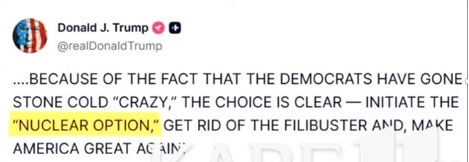
No chance. Maybe at one time the president might have cajoled the Senate republicans to pass the SAVE act by nuking the filibuster. But not now. He can threaten no legislator with being primaried, because the primaries are past. He engenders no more fear now being a lame duck president with fading power. I doubt if he could even muster 47 republicans to support him, much less fifty plus the vice president. So it is a real headscratcher to hold the housing act hostage. He won’t save the SAVE act regardless.
Of course, getting rid of the filibuster is shortsighted—and the president knows it. Senate Majority Leader John Thune knows it too. Killing the filibuster would open the door to all manner of mischief the next time democrats hold power. Nevada’s Catherine Cortez Masto, D-NV, urged Trump to consider all of the hard work of lawmakers from both sides of the aisle who put their party allegiances aside for the “common good of all Americans to help fund affordable housing.” She asked him to “Think beyond yourself’ and sign the bipartisan housing bill.
But thinking beyond himself has never been Trump’s strong suit.
 haroldblackphd.com
Imposing a 350 house limit for Fund owners is a waste of time. The capital behind the fund will just start a new fund and buy 350 houses in it. Then rinse, wash and repeat…..
Hopefully there is more to it. As it isn’t a good idea to let large funds control the supply available in local housing markets. Maybe a better regulation would be to limit the number of houses a fund could buy or sell in 1 year. Seems like that would make it harder for funds to play around in the housing markets
LikeLiked by 1 person
All good points provided any of this actually affects the price of housing in a local market. Rather I think it’s just Elizabeth Warren looking for a corporate scapegoat.
LikeLike
…”Its massive support reflects the pressure on both parties to do something—anything—about housing affordability. The bill’s stated intent is to increase housing supply and lower
costs. “.. …Well, sounds desperate..
Government involved in housing is a mystery to me. After all the talk about dwindling national population, as well as people fleeing CA , MI , MA, why are these states focused on a government- mandated housing boom..
.And why does Congress think suspending construction regulations is important, when construction companies admit they already do a “50% compliance”? ..
So- does the Federal govt really believe developers are charitable people? That developers care if poor people have homes?
Sounds like an unholy alliance, between Feds and developers.
If East Knoxville housing flip & out of control construction is making affordable housing- where are the original city residents and their children?..
Why do vacant houses sit empty, while developers wait for the right price timing?..
And why is government the answer?
A realtor told my neighbor and me that we were old, needed to get out of the way for young families…. “ give us your house. You don’t need it.”
We dont like being blamed for the housing shortage. We are not the enemy.
LikeLike
All on point. The so-called shortage is a local problem and has to be addressed locally. I wrote before about the people saying we need to downsize and let young people occupy our houses. Stupid.
LikeLiked by 1 person