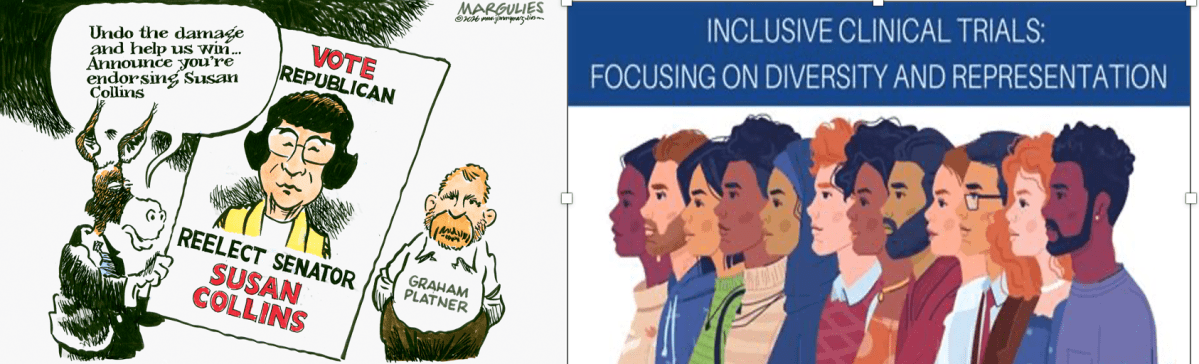
Graham Platner. Clinical Diversity Trials
The Last of Graham Platner
Graham Platner ended his Senate campaign after a self-described progressive democrat came forward with an allegation of rape. An earlier allegation — made by a republican — had been waved off by the same democrats who had spent months defending Platner despite a mounting pile of red flags. Once a fellow progressive leveled the charge, though, the same people who had shrugged off his Nazi tattoo, his odd tweets, and every other red flag suddenly bolted.
State law allows Platner to be replaced on the ballot if he withdraws by July 13. His replacement must be named by July 27. Platner himself isn’t going quietly — he’s accused the media and political establishment of acting as “judge, jury, and executioner,” denied any wrongdoing, and claimed he’s being targeted by democratic insiders threatened by his brand of populism. That’s garbage. Both the progressive and the democratic establishment have run from him as fast as their little legs can take them. Also the establishment showed that they would happily back Satan himself for a shot at flipping a Senate seat. But Platner’s comments do point to the rift between the Bernie Bros and the democrat establishment that is usually glossed over by the media.
The parallel to Biden and Harris is hard to miss — a candidate wins the primary, then exits, and party leaders anoint a successor. Maine democratic leaders will now pick Platner’s replacement from a bench that includes candidates already rejected by Maine voters in past elections. Do they recycle a previous loser or go looking for a fresh face? For now, Susan Collins looks safe either way.
Curiously, early polling had Platner leading among women and Collins leading among men — the opposite of what you might expect, given that the allegations against Platner would seem more likely to alarm women, while his rugged, tattooed, tough-guy image would seem to appeal to the men of Maine.
Even so, Platner was the perfect candidate for today’s democratic left: the son of well-off parents who adopted a working-class aesthetic while preaching the politics of the college-educated progressive class — the group I call the “downwardly mobile.” Their politics, though, aren’t the politics of the working class or of most minority voters, as election results keep showing.
What this episode really reveals is how little character matters in today’s politics, so long as a candidate makes the appropriate clucking sounds and holds some appeal. Swap the “D” next to Platner’s name for an “R,” and he would have been pushed out long before this last allegation surfaced. I found the whole episode a sad indictment of American politics and an embarrassment for democrats —if they can be embarrassed. Many of the same democrats went after Brett Kavanaugh over an allegation from his high school years while giving Platner a pass for vile conduct as an adult.
In the end, what stands out most is that Platner won his primary — defeating a sitting governor — despite everything already public about his past. Primary voters were clearly drawn to him. Prominent progressives campaigned at his side while establishment democrats stayed quiet or offered only tepid, hedging statements. It’s a far cry from the moment Republicans across the board condemned David Duke when he won a Louisiana gubernatorial primary — some going so far as to say they’d vote for his opponent, the famously corrupt Edwin Edwards, instead. Today, both parties are willing to trade honor for a winnable seat.
Bring Back Clinical Trial Diversity
I’ve argued before that the administration’s push to purge diversity efforts from government is shortsighted and clinical trials are the clearest example of why. Cutting funding for clinical trial diversity rests on the assumption that we’re all biologically alike. We’re not. Different ethnic groups carry different incidence rates for the same diseases and treating a homogeneous study population as universally representative produces medicines that don’t work equally well for everyone.
Kidney disease is the starkest example. The formulas long used to assess kidney function — and to determine eligibility for treatment and dialysis — were built on data that underrepresented black patients. The result was systematic bias, delayed diagnoses, denied treatment, and higher rates of preventable death. As one researcher has put it, “A lack of diversity in clinical trials compromises data quality, obscures critical safety signals, and produces treatments that may not work for everyone.” That isn’t an ideological claim — it’s simply a description of what happens when a sample doesn’t match the population it’s meant to serve.
BiDil makes the same point from the opposite direction. In trials on a general population, the congestive heart failure drug showed no meaningful efficacy and looked like a dead end. But when researchers analyzed subgroups separately, they found the drug worked dramatically well in black patients — a finding that led the FDA to approve BiDil as the first drug approved for a single ethnic group. Without that subgroup analysis, an effective treatment would have been discarded entirely.
Both cases point to the same conclusion: clinical trial diversity isn’t political — it’s a data-quality requirement. Folding it into the broader anti-DEI push is simply dumb or stupid producing consequences that are measurable and harmful, not abstract. Let’s hope the administration corrects this obvious misstep.


Interesting point on clinical trials. But how do you defend trials that impact people groups negatively? Then it could be portrayed as an effort to Tuskegee a people group. If it is conducted blindly to color don’t you eliminate that liability for a company/trial?
LikeLike
That’s a great point. I certainly don’t defend those kinds of clinical trials. I guess the point is to test a population and then the subpopulations of see if there are differential results.
LikeLike
Camden, ME is a place that caters to the likes of the late Walter Cronkite, whose yacht anchored there on occasion. Portland ME is where my Chattanooga niece goes for business. The rest of Maine is Platner country- country songs I’ve never heard of, all darkness and death, a state filled with Platners armed to the teeth…
I would vote for Susan Collins. Someone has to be in DC to be the Republican moral opposition to Trump…
My wife has warned me about changing fm ABC News to CBS, because Trump controls CBS. I would deny that until last night. When
Tony Dokoupil ( no ‘A’ as in Dokoupila) said of Platner , he looked bad to either party. He looked like a loser.
Trump talk…
Doctors can do surgeries and procedures and prescriptions all day long. But when they do all-that to you or me, it’s still an experiment..
My heart surgeon got mad when I referred to the pre-surgery data collection tests as ‘exploratory’.
But the time and data were gathering over months, AND proved she could do surgery all day long….. But what would happen with me.
LikeLike
I’d vote for Collins too, regardless. She has never missed a roll call either.
LikeLiked by 1 person
To all: Word Press is not sending me a verification code this morning. So I am unable to post until they send it.
LikeLike