The War of 1812: Memories of a High School History Lesson
I have pointed out before that my education in the segregated all-black Atlanta public schools was different than the history I was taught while at the University of Georgia. A case in point was that when I was in high school, I was in an honors homeroom full of really smart kids. We used to make fun of our history teacher behind her back because she “taught” simply by reading the textbook aloud verbatim. One day, someone asked her who won the War of 1812. She fumbled through the book until she found the right chapter, then began reading us from the book and said the war ended in a “checkmate.” Half the class struggled not to laugh. I remember that as we filed out of the room, one kid started reading the same passage aloud, mimicking her tone perfectly. We walked down the hall roaring, “Checkmate! Checkmate!”
What brought this memory back was a Wall Street Journal article, “Historic Homes: A Maryland Farm That Became a War of 1812 Battlefield.” (https://www.wsj.com/real-estate/luxury-homes/chestertown-maryland-farm-war-of-1812-0d3c2010).
My teacher never got around to telling us who won, but she did tell us the war was caused by the British pulling American sailors off their ships and forcing them into the Royal Navy and that many of those sailors were black. That part is historical fact. What she left out was that the impressment crisis was only one of the reasons leading to America’s declaration of war under President Madison. There were issues of trade stemming from Britain’s war with Napoleon and the British arming Native American resistance to American expansion, leading to the Battle of Tippecanoe in 1811.
When war was declared the Americans almost immediately tried to invade and annex Canada (an early version of an idea that’s come up again in recent years), seemingly forgetting how badly that had gone during the Revolutionary War. U.S. Secretary of War William Eustis predicted, “We can take the Canadas without soldiers; we have only to send officers into the province, and the people… will rally round our standard.” He was wrong. British forces and their Shawnee allies, led by Tecumseh, routed the Americans, drove them back across the border into Michigan, and forced the surrender of Detroit.
Most people know the next chapter: Fort McHenry in Baltimore withstood 25 hours of bombardment by the British Navy, and the next morning the fort’s defenders raised an enormous American flag, inspiring Francis Scott Key to write the poem that became “The Star-Spangled Banner.” After that failed assault on Baltimore, the British sued for an armistice and the Treaty of Ghent was signed in 1814, restoring the prewar status quo. Under its terms, the British abandoned their support for a Native American buffer state in northwest Indiana and agreed to end the impressment of U.S. sailors. Ironically, the Battle of New Orleans was fought after the treaty had already been signed, since word hadn’t yet reached the country. That battle made Andrew Jackson’s reputation and is also notable because he recruited enslaved men to fight by promising them freedom, then reneged on the promise afterward and returned them to slavery, prompting one of them to say later that he should have shot Jackson on the spot if he’d known.
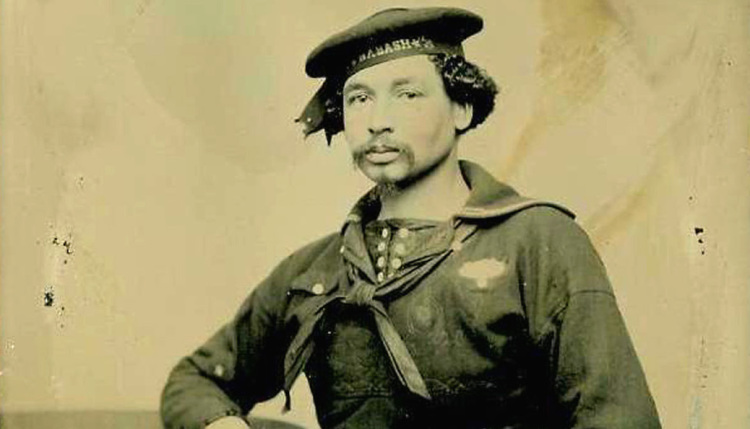
But back to the sailors. At the time of the war, roughly 15 percent of U.S. Navy’s sailors were black. They served in an American navy that was small and inexperienced, with only 18 seaworthy ships in 1812. Some were free men while others were enslaved who had been granted their freedom in exchange for enlisting. Life at sea was harsh everywhere, and navies around the world weren’t particular about who filled their ranks. In particular, the British Royal Navy, facing a severe manpower shortage, resorted to impressment, stopping American merchant ships and forcibly seizing sailors it claimed were Royal Navy deserters, carrying off thousands of U.S. citizens in the process. In 1807, the incident nearly boiled over into war when the frigate HMS Leopard fired on the USS Chesapeake and seized four sailors, three of them American citizens and two, William Ware and Daniel Martin, were black. Among black sailors taken by impressment, some willingly joined the British navy to escape slavery, or, if already free, to seek a better life. During the war, over 1,000 black sailors, were captured by British forces and held as prisoners of war.
Somehow the history professors forgot to mention the impressment of the black sailors – until I brought it up in class. But my high school history teacher did get the black sailor part right. Yet my most indelible memory of that class was her saying the war ended in a “checkmate”.


Imagine my surprise when I put a picture on NextDoor, in honor of Juneteenth. From the Medal of Honor Museum in Chattanooga. The picture was of Black soldiers onboard a Civil War vessel. The response was outrage fm ND readers. Altho they couldn’t tell why this outraged them- other than to promote the present Denier- in -Chief ..
Andrew Jackson traveled the Natchez Trace on the way back fm New Orleans . He at one point stopped to bury a deceased soldier. I think it was the soldier written in the history books- that got Jackson mad about something. So Jackson executed him.
Someone must have seen the burial, and seeing the ground as sacred decided to start a community cemetery.
A church was built to complement the cemetery, and became known as Jackson’s Camp Baptist Church. It remains still, in what is now a forgotten part of the original Natchez Trace. The same Trace and the same church that saw lines of slaves, transported and lost to delta plantations..
Jackson’s Camp is my heritage church. And I’m not hesitant to remind members of the history, now under assault in America.
LikeLike
Thanks. Maybe others will follow suit with their histories too.
LikeLiked by 1 person