The Escalation Trap
Robert Pape’s warning, and why it matters
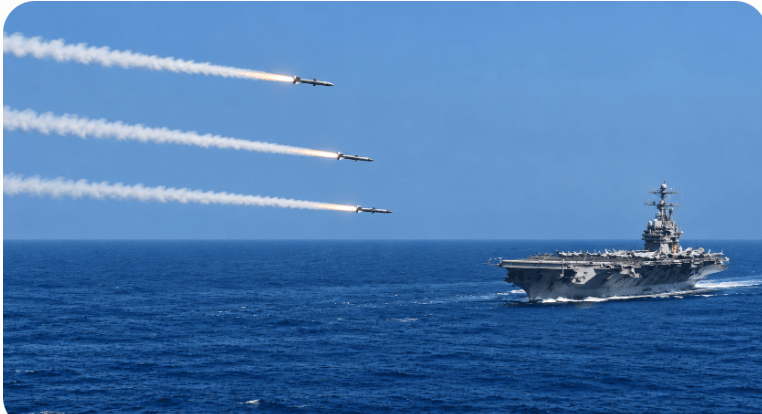
In case you missed it, the war with Iran has taken an even more dangerous turn. It’s been apparent to me for a while that Iran was holding back. Holding back? What about the thousands of missiles fired at our Gulf allies, or the strikes on American bases and Gulf infrastructure? Yes, holding back — because until recently, Iran had confined its attacks to ships trying to cross the Strait of Hormuz rather than directly targeting U.S. Navy vessels. That has changed. Iran targeted a U.S. submarine attempting to enter the Strait of Hormuz and it fired missiles at a U.S. destroyer and an aircraft carrier. U.S. Central Command then retaliated striking three Iranian vessels.
Notably, the Iranian attack used ballistic missiles rather than drones. U.S. Central Command said the missiles were shot down and caused no damage. Unsurprisingly, Iran claimed the opposite — that the U.S. warships were damaged — and announced additional attacks against U.S.-linked shipping, raising even further the threat to naval forces and commercial traffic across the region.
An inspection of the vessels would presumably settle who’s telling the truth. If the Navy ships really were damaged, I’d expect word to get out eventually. But consider the alternative. Imagine Trump’s reaction if an aircraft carrier — which typically carries 5000 personnel or more — were damaged with loss of life. That would trigger a far larger response than anything we’ve seen so far.
My real problem with this war is figuring out who’s telling the truth. Neither side has much credibility. I believe very little of what the president says, given his bombastic claims and thin follow-through — the pattern that earned him the label “TACO” (Trump Always Chickens Out). He’s called the war “small potatoes,” a phrase democrats have seized on ahead of the general election. This is no small potatoes war: thousands of personnel deployed, billions of dollars spent, and the defense of Gulf allies at stake. But we’re used to this president misspeaking by now. He’s declared the war over more than once, yet it continues unabated, with the Iranian regime nowhere near collapse despite what Trump, Hegseth, Bessent, and the rest of the administration keep saying. Tellingly, I haven’t seen a single military commander echo that assessment, which makes me wonder what’s actually true.
On at least seven occasions, the president has threatened Iran with annihilation, and seven times he’s backed down. Most recently, he said he decided against a devastating strike on Iran’s energy infrastructure — while warning that the U.S. remains “locked and loaded” and prepared for “military terror not seen since World War II.” Iran doesn’t seem impressed. Senior IRGC General Mohsen Rezaei warned that further U.S. escalation would provoke retaliation against American forces across the Middle East, declaring: “Trump has said his hand is on the trigger. We will cut off his hand and his finger.”
So is Iran nearing collapse? We’ve conducted over 20,000 airstrikes. We’ve seriously degraded its military, killed its leaders, and battered its economy. Yet the regime is hanging on. I’ve read a wide range of scholarly opinion, and while I don’t dismiss any of it, I don’t fully believe it either. I read the Israeli press and Al Jazeera both, and it’s hard for either to be truly dispassionate on this subject.
One prominent version of the imminent-collapse theory comes from geopolitical analyst Barak Seener, writing for the Henry Jackson Society, who concludes that the regime in Tehran is “on the verge of collapse” as pressure mounts from every direction — sanctions, economic turmoil, and escalating military action.
Read the Henry Jackson Society report
But that report was published last year, and the regime is still standing. Iranians are certainly suffering, but Iran has long experience managing severe sanctions and is resource-rich and economically diversified. Other experts argue collapse isn’t imminent at all, and that Iran will simply outlast Trump’s presidency.
How you define collapse? One Iranian economist defines it as famine combined with the government’s inability to provide basic services. By that measure, Iran isn’t close to collapse. Yes inflation is high and goods are relatively scarce, straining households, but the state cushions the blow with cash transfers and subsidies — a monthly cash payment plus electronic coupons for essential goods. It’s an expensive way to survive, but it does avoid collapse. The U.S. has bombed bridges, tunnels, and parts of Iran’s natural gas and electricity infrastructure, leaving manufacturers facing two-day blackouts. As one expert put it: “Households reduce consumption, firms postpone investment and educated workers consider emigration. The economy continues to function, but at the cost of a shrinking middle class, lower capital formation, weaker public services and declining confidence in the future.” He concludes that without a stable environment, the Iranian economy will keep surviving but has little chance of genuine recovery.
The upshot: no collapse is imminent. So if sanctions aren’t working, bombing isn’t working, and blockades aren’t working, what comes next? I’ve argued before that no war has ever been won without boots on the ground — and an invasion of Iran would be an absolute disaster. No sane leader would attempt it. Right?
That’s where the University of Chicago’s Robert Pape offers a sobering counterpoint. Pape points to the mass of Marines and soldiers aboard ships and at American bases in the Gulf and puts the odds of the U.S. using land forces along Iran’s coast at roughly 70 percent — potentially seizing Kharg and other islands in the Strait. He calls this the “Escalation Trap” where coercion rarely succeeds without battlefield success. Strategies built on punishment, decapitation, or limited strikes tend to fail because they don’t actually deny the adversary its strategic objectives. When the promised gains don’t materialize, leaders escalate further, trying to close the gap between military action and political results.
Here’s an interview with Professor Pape:
Pape on why America has no way out of the escalation trap
In Pape’s words: “Every bomb, every revenge attack, and every response drives the next decision to move up the rungs of the escalation ladder.” He argues that recent developments point to “Stage Three” of his Escalation Trap theory — the point at which political pressure increasingly outweighs military restraint.
See also his Substack, Escalation Trap
Pape is no ivory-tower academic. He’s a leading scholar of airpower, military coercion, and strategic bombing. He has taught airpower strategy at the U.S. Air Force’s School of Advanced Airpower Studies and has advised the military and presidential administrations – I don’t know if he is advising Trump. He now points to the escalation extending beyond the Strait of Hormuz. The Houthis have launched missile and drone attacks against Saudi Arabia and threaten to open a second maritime front centered on the Bab el-Mandeb Strait. If sustained, he warns, simultaneous threats to both Hormuz and the Red Sea would put two of the world’s most important energy chokepoints at risk at once, ratcheting up pressure on Washington and its regional allies to act.
But act how?
Military conflict and global energy markets are becoming ever more entangled. Case in point: the recent Ukrainian strike on an Iranian ship carrying drones to Russia. Sectoral wars have a way of growing into larger ones, and that attack prompted Iran to warn Ukraine that it now falls within range of Iranian missiles — an ominous signal in its own right. The world is a dangerous place getting even more dangerous.
So who do you believe? I lean toward Professor Pape and until proven wrong he will be my guiding source of information.


One of the most important essays you’ve done..and a sobering illustration..
On social media, the return of the draft is seriously being debated, as WeThePeople examine what Karoline said , while still spokesperson. Altho a draft is not stated by the Admin..
Not a source for Navy anything , but I do recall a story of an aircraft carrier story- where to sustain 10 pilots, a crew of 1000 was needed, including someone who only filled up candy bar machines. No such thing as Trump’s “small potatoes” deployment..
I think and notice what others don’t talk about: As in , what do all the bodies of water look like with all the tankers hit and leaking oil?
And , based on something that hit me during the Pape interview, can we expect another invasion of the Capitol by rioters trying to stop the official recognition of midterm elections?…
I think to have Congress driven fm the Capitol is an overthrow of the United States, committed by traitors and terrorists under the Administration of Donald Trump. He will do it again.
LikeLike
Glad you listened to the Pape interview. He seems analytical and interested in connecting the dots. I can’t find ab agenda. And thanks for the compliment.
LikeLiked by 1 person