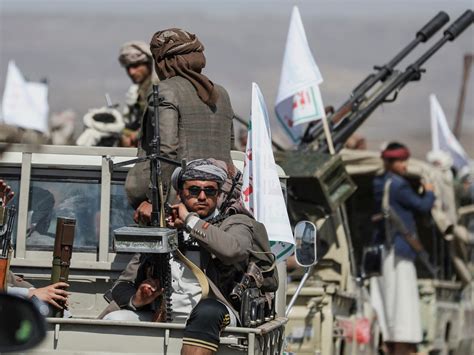
The Houthis Advance
The situation in the Gulf continues to deteriorate. The Houthis have seized the Red Sea port of Mocha, asserting control over Bab al-Mandeb, one of two critical outlets for oil shipments from the Gulf. Saudi Arabia has fought the Houthis in Yemen for years without success, and this latest advance marks a serious escalation. The Houthis also struck Saudi Arabia’s east-west pipeline, which carries roughly 5 percent of global oil flows, and shut it down. Iran continues to back the Houthis, and Iranian strikes on U.S. regional bases have further destabilized the region. With Yemen’s government unable to contain the offensive and Saudi Arabia unable to reverse Houthi gains, Crown Prince Mohammed bin Salman has requested U.S. military assistance. President Trump has said the United States will support Saudi Arabia in every respect short of direct attacks on the Houthis.
According to reports, the Houthis have taken Perim Island, which sits within Bab al-Mandeb and splits the narrow waterway into two shipping channels — a position that gives its holder significant leverage over vessels entering or leaving the Red Sea. Houthi forces have also reached the town of Dhubab, which lies directly on the strait. This raises the question of whether Washington will move to protect Red Sea shipping when U.S. forces are already struggling to end Iran’s hold on the Strait of Hormuz. Saudi Arabia’s oil industry, already under pressure, saw crude production fall by 2.3 million barrels a day to 6 million barrels a day in August. The Houthis maintain that Red Sea navigation remains safe for shipping companies, with the exception of vessels operating under the Saudi flag.
The toll extends beyond shipping and oil. The Houthis are now within 20 miles of the U.S. base in Djibouti, America’s principal base in Africa. Saudi Arabia continues to back Yemen’s government against the militants, who now control the country’s north. Roughly 1,400 refugees have fled the Houthi advances, some by boat across the Bab el-Mandeb Strait to Djibouti, and at least 76,000 people have been displaced within Yemen since July. Yemeni government, Iranian, and regional sources say the Houthi advance along the coast has been carried out under direct guidance from Iran’s Islamic Revolutionary Guard Corps, raising the question of how much further Tehran is willing and able to extend its support.
What triggered this latest offensive remains unclear, but its success has been striking. It also raises doubts about Saudi Arabia’s ability to respond. Can its air force and ground forces mount an effective campaign against the Houthis? Past experience suggests the answer is no. The Kingdom’s considerable military forces with its advanced jets and materiel have yet to translate into battlefield results. Experts say that the Kingdom’s large conventional war focused military is poorly suited to deal with modern proxy conflicts. We should have learned a lesson from Saudi Arabia’s conflict with the Houthis which relied almost exclusively on air strikes which have proved to be ineffective.
The consequences are already being felt closer to home. At the farm in Gray, diesel is now $6.36 a gallon, and regular unleaded is over $4 at many stations. Another bad sign is that Costco has begun limiting purchases of motor oil amid a rapidly worsening global lubricant shortage. A 10-quart box of Kirkland Signature full-synthetic motor oil, previously $30, is now $58, and Costco has imposed a strict two-box-per-customer weekly limit. A six-quart case of Mobil 1 is now $44, with purchases capped at five per member to deter hoarding and scalping.
A report says that the shortage traces back to Group III base oils, which are essential to modern synthetic motor oil. The United States imports nearly 44 percent of its Group III supply from three major Persian Gulf producers: Bapco in Bahrain, ADNOC in the United Arab Emirates, and Pearl GTL in Qatar. The conflict with Iran and the blockade of the Strait of Hormuz have effectively cut off these exports. Making matters worse, Iranian missile and drone strikes in March 2026 caused heavy damage to the Pearl GTL facility in Qatar, crippling a major share of global production for at least a year.
One of my closest friends, who runs a working farm, saw this coming and began stockpiling (hoarding) supplies as soon as the strait was first closed. At some point, sustained high fuel and lubricant prices will begin to meaningfully slow economies around the world. What comes next is an open question. We have already watched the Gulf conflict start to spread into the war in Ukraine. Will it spread further still? To date, Washington has shown no exit strategy while the impact of this conflict continues to impact us at the farm and the rest of the world. What a mess.


One of the best essays. The WSJ should be reprinting this essay..
Let’s all remember this last 9/11 Memorial, where one of the individuals , personally affected by the attacks, called on President Trump to admit Saudis Arabia played a role in 9/11. That’s exactly how I remember it, as well…
Every American should be assured their President is a visionary…
Of course, Trump has said he would do anything for the Saudi Prince- in a creepy, effeminate way…
As usual, this essay matches my reading this very morning, an old review of a fictional book where the US joins Afghan forces to fight the Soviet invasion.
The story line has to do with US forces wanting to capture a Soviet helicopter, trains an Afghan force to shoot one down ; the Afghans all die & the U.S. commits to Americans on the ground..
The history is real, this Soviet invasion. Of course I looked up the Soviet invasion, 1978-80. And the first sentence may be a prediction of America’s outcome in the Middle East:
. …”The war gradually inflicted a high cost on the Soviet Union as military, economic, and political resources became increasingly exhausted….”
LikeLike
Thanks. Ever get the feeling that established militaries regardless are not smart enough to fight these militants? And what of our military leadership since the advent of Pete Hegseth?
LikeLiked by 1 person
As far back as memory allows, I’ve heard the ‘adults’ say the Middle East are blood- thirsty savages- now no longer a judgement, but a resentful warning…And Hegseth doesn’t understand he is a punk, to a land of continued conflict.
LikeLike