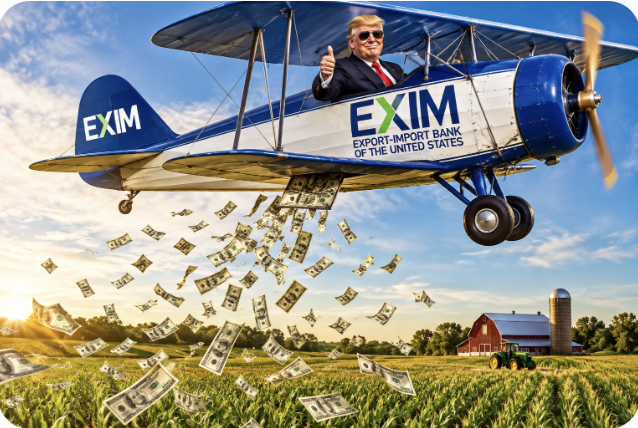
Iowa’s new steel mill
Ohio State is playing Iowa today, and the president is busy patting himself on the back – a sport in which he remains undefeated. The occasion: a new $15 billion steel mill, the first in 50 years, coming to Iowa. Naturally, he credited his 50% tariffs. The project is expected to create 1,750 permanent jobs and support up to 6,000 construction jobs. Trump added that it would also create 2,000 new manufacturing and mining jobs. Over the next decade, it is projected to generate $95 billion for the U.S. economy. He took credit, saying his “powerful 50%” tariffs on steel imports last year meant that “our steel industry is roaring back to life. Everyone’s building their plant here because they don’t want to pay tariffs. It’s really not that complicated.”
Actually, it is a bit more complicated than that. The president is a short-timer. If the next president lowers or scraps the tariffs, will the math on a $15 billion plant still work, or does Iowa end up with one of the world’s most expensive machine sheds? Although not as apparent as beef or energy, Trump’s tariffs have made Americans to pay more for steel than any other country in the world. And while the president bragged that the steel will be “mined, melted, and made completely in the U.S.,” calling it “something very unusual,” he skipped a small detail: the mine’s owner is Mesabi Metallics, a Minnesota-based company owned by India’s Essar Group. Made in America, owned by India – which, to be fair, is “something very unusual.” The plant will be fed by a newly developed $2.5 billion iron ore mine that Mesabi opened on September 17 on Minnesota’s Mesabi Iron Range. And the Export-Import Bank of the United States (EXIM) will provide up to $10 billion in financing for the new Iowa steel mill. Hold that thought. Also keep in mind (mine?) that the US steel industry is being dominated by foreigners – US Steel is a wholly owned subsidiary of Nippon Steel. I thought Trump’s policy was America First?
But what is the Export-Import Bank and why is it providing financing for an Indian company? This is from its website: “The EXIM Bank is the official export credit agency of the United States. Our mission is to support American job creation, prosperity and security through exporting. We accomplish this by unlocking financing solutions for U.S. companies competing around the globe. We help level the playing field and fill gaps in private sector financing.” https://www.exim.gov
So let me get this straight: a U.S. government bank is putting up $10 billion of the $15 billion so an Indian corporation can set up shop in Iowa. And once this foreign-owned mill is running, Trump’s 50 percent tariffs will protect it from… foreign competition. Sounds like a sweet deal to me – sweet as Iowa corn. And timing, of course, is everything. The announcement comes just before the midterms. Between the tariffs and the price of fertilizer and diesel, Iowa is suddenly in play. The governorship, a U.S. Senate seat, two of the four congressional districts, and the attorney general’s office are all suddenly competitive in races where the republicans should have been favored. Surely that had nothing to do with the announcement. Right?
In a related blog post, Don Boudreaux notes what was said by Rep. Mariannette Miller-Meeks (R-IA) – whose seat is at risk – at the White House announcement of the steel mill: “For too long, Iowa families have watched their jobs shipped overseas and their communities hollowed out. Not anymore.”
Don points out this inconvenient truth:
Since 1997 (the earliest date for which I can find data), manufacturing output in Iowa has risen fairly steadily. It reached its peak in 2024, when it was 51% higher than in 1997 and 45% higher than in 2001 (the year China joined the World Trade Organization). (Manufacturing output in Iowa was down slightly in 2025, quite likely because of Trump’s tariffs.)
Over these same years, Iowans’ real median household income also rose. It peaked in 2018 (the first year of Trump’s tariffs) at $86,600 (in 2025 dollars), and in 2024 was slightly less (at $86,450). In 2024, Iowans’ real median household income was 36% higher than in 1997 and 23% higher than in 2001.
Where’s the evidence for the “hollowing out” of American manufacturing and income? To justify their schemes, protectionists incessantly prattle on about this “hollowing out,” but it’s a myth.
Trump was right. His tariffs were responsible for the new Iowa steel mill, because without them Iowa would be voting republican, and there would be no need to lure an Indian company into the state with financial incentives and EXIM financing. Just another example of the mess that this president has wrought upon us.


“Sweet as lowa corn”. Liking that. Sounds like a Broadway play..
Running into headlines like ” Ford opens new plant in Spain to produce cars for China”, I don’t believe the
global economy is ever- America First..
So many steel plants are in Ohio. I don’t know who owned them during the George W. Presidency. But I recall American companies never consider the workers: in the early 2000’s one of my uncles lost his pension in a shutdown; another uncle lost his job…Nothing is guaranteed for working people..
….”of the nativist rhetoric and…..of the moment in time when workers proposed a radical departure from the strategy of begging and foreigner-bashing; when they said, simply, Why don’t we control the mills that our labor has built?..” theNation 2002..
My uncles only got their jobs back when Big government faced a November election – and Geo. W. started liking American steel products..
EXIM:
..”When private sector lenders are unable or unwilling to provide financing, EXIM fills in the gap for American businesses by equipping them with the financing tools necessary to compete for global sales…”
Doesn’t sound strictly Capitalist.
And looking at their illustrations, did anyone tell Hegseth about them DEI hires, which include …ugh….strong, professional women?!
LikeLike