
World’s Sickest Children? Prime Air. New Cat!
The US Has the ‘Sickest Children’ in World History?
The president’s taste for hyperbole seems to be contagious. At the republicans’ midterm convention, Robert F. Kennedy Jr. declared: “This country pays two to three times what every developing nation in the world pays, and yet we have the sickest children in the history of the world.” What! Even a casual listener would know that this can’t be true. Perhaps he meant the sickest children among developed — not developing — nations. That’s at least a testable claim. But sicker children than in Sudan? South Africa? Yemen? Sicker than children born in any century before ours? Hardly. Childhood mortality and infectious disease have fallen dramatically since the 19th century. In 1900, one in five American children died before age five. Compared with children in developing countries today, American children fare far better — the U.S. under-5 mortality rate is roughly 80% below the global average, and causes that still kill children worldwide, like diarrhea and malaria, now cause almost no deaths here.
Where the U.S. does fall short is against its developed-world peers. A 2025 study in the Journal of the American Medical Association found that from 2007 to 2022, the mortality rate for Americans ages 1 to 19 ran 80% higher than in other high-income countries — driven not by disease, but by gun violence and traffic deaths.
Kennedy is lying but why? He surely knows better than to make a claim this untrue. And the MAGA press simply repeated it, unchallenged. Why make such outlandish claims in the first place?
Prime Air
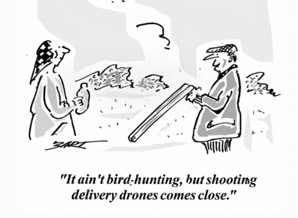
Amazon’s drone delivery service, Prime Air, now operates in eleven cities: Phoenix, Tampa, Kansas City, Kansas; Baton Rouge, Detroit, Omaha, Houston, San Antonio and Waco, Texas. Amazon plans to expand to nearly 500 cities and towns by the end of 2026 — which presumably includes Knoxville, where the drones will likely be shot down. Packages weighing five pounds or less that fit inside a large shoebox qualify for drone delivery: free for Prime members on orders of $50 or more, $2.99 for smaller Prime orders, and $4.99 for non-members.
The skies are about to get crowded. In the New Haven, Connecticut area, Prime Air has proposed up to 1,000 MK30 delivery flights per day from a single Prime Air Drone Delivery Center — roughly 365,000 flights a year. The New York Times reports that residents of one Texas suburb now describe living on a “drone highway.” Recently, an Amazon delivery drone crashed into a residential backyard in Richardson, Texas, sparking a small grass fire. No one was hurt, but the scorched earth, scattered debris, and rattled neighbors left a mark. Federal regulators, local officials, and aviation safety experts are now investigating.
The drones run on lithium-polymer batteries, which can become volatile when damaged or punctured — lithium fires burn intensely and are notoriously hard to put out. (Recall the lithium fires from EV batteries exploding during last year’s Florida hurricane.) What happens when a drone goes down on a wooden deck, near a gas line, or in a drought-stricken area full of dry brush? The consequences could be serious. Is Prime Air really ready for prime time? This seems like an advertising opportunity for Deion Sanders.
Here, Kitty Kitty
A new species of cat has turned up in the cloud forests of Bolivia’s Yungas region. Smaller than a house cat and marked with leopard-like spots, it’s been named Leopardus Tilcayo.

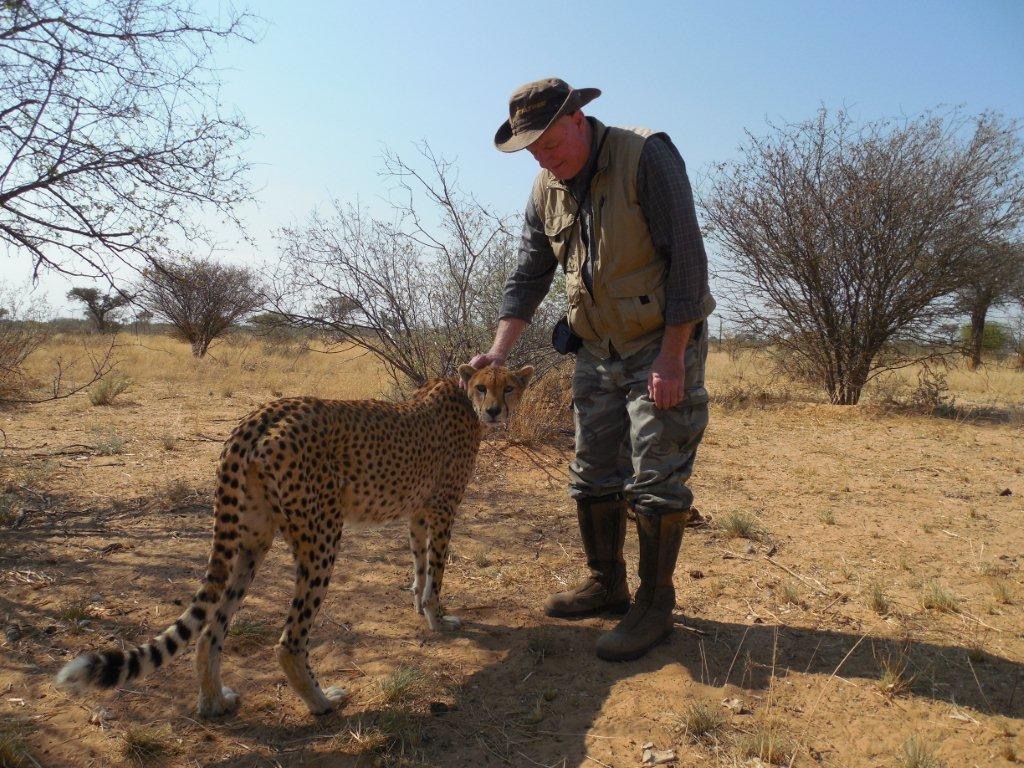
The discovery was pure accident. A man found the kitten and brought it to a wildlife sanctuary, where staff noticed it didn’t quite match any known tiger cat species. Genetic testing confirmed it as new — one that likely diverged from its closest tiger cat relative around 1.4 million years ago. It makes me wonder two things: first, what would have happened if the man had raised the kitty as a pet? When it matures the ticayo will be smaller than the average house cat. On the other hand, while in South Africa on safari, my outfitter had rescued a leopard kitty and raised it as a pet (see photo). Second, how many more undiscovered species are hiding in the Bolivian Yungas?


True words: drones will be targets if not victims. Old timers/ newcomers/ relatives tell me to be wary of East TN even now. Hill folks do order from their iphones, will worry that the government is spying on them. As they should. Seems big businesses like Amazon align with the White House…
Cats–and hunting: I’ve heard but never seen proof that Teddy Roosevelt hunted bear in N.E. Mississippi; if he did, he would have found them on Papow’s property. When his barn was no longer in use, Papow would find bear there. Not making any into pets like your outfitter, he did give them habitation..
Which leads to the legend of the white panther. In a hunting culture, you’d think they would be a target. But the unusual cries on pathways to corn fields … well.. deep woods are not inviting when the woods won’t let you run..
There’s no telling what are in these solitary places.
Even in America.
LikeLike