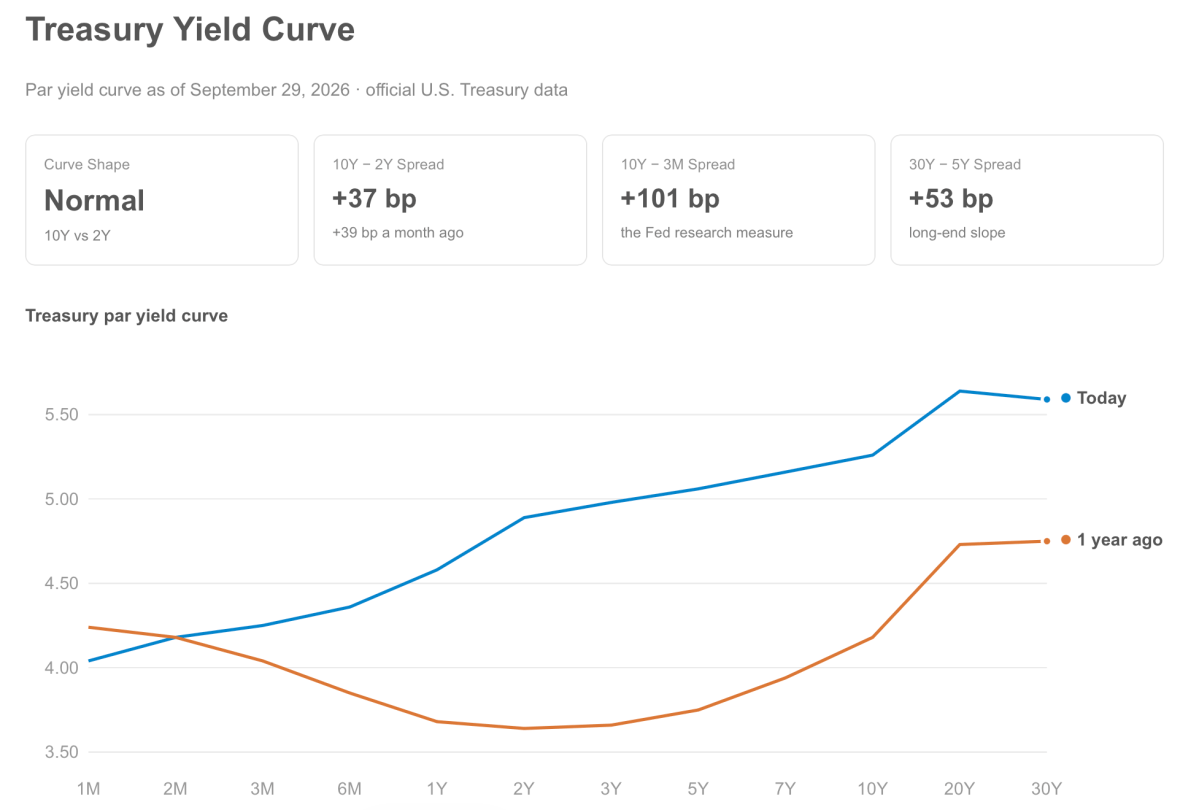
Mixed Signals from the Yield Curve.
The Treasury yield curve (redux)
I’ve written before about why the Treasury yield curve matters. It shifts every day as rates move, and when it inverts, meaning longer-term yields fall below short-term yields, a recession usually follows.
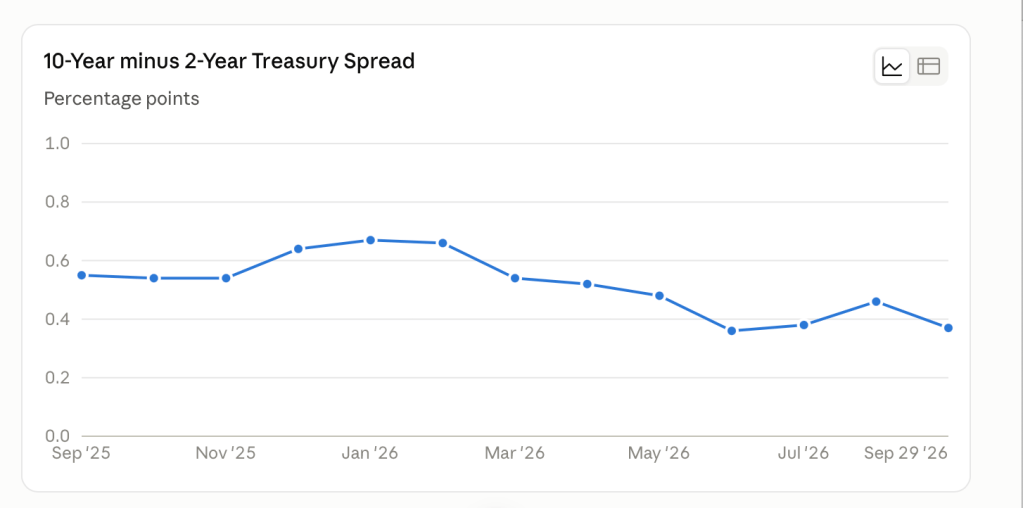
Most analysts watch the spread between the 2-year and 10-year Treasury. That spread has been narrowing, which raises the possibility that the 10-year could soon yield less than the 2-year. That kind of inversion has historically preceded U.S. recessions.
But there’s another spread with an even better track record: the gap between the 3-month Treasury bill and the 10-year. Between 1969 and 2020, every time that segment of the curve inverted, a recession followed. That’s eight straight recessions without a single false positive.
So here’s the interesting part. While some are sounding the alarm over the shrinking 2-year/10-year spread, the 3-month/10-year spread has been widening. In other words, the most reliable recession predictor on the curve is currently saying “no recession.”
I asked Claude to chart both spreads, and the picture is clear: they’ve moved in opposite directions over the past year.
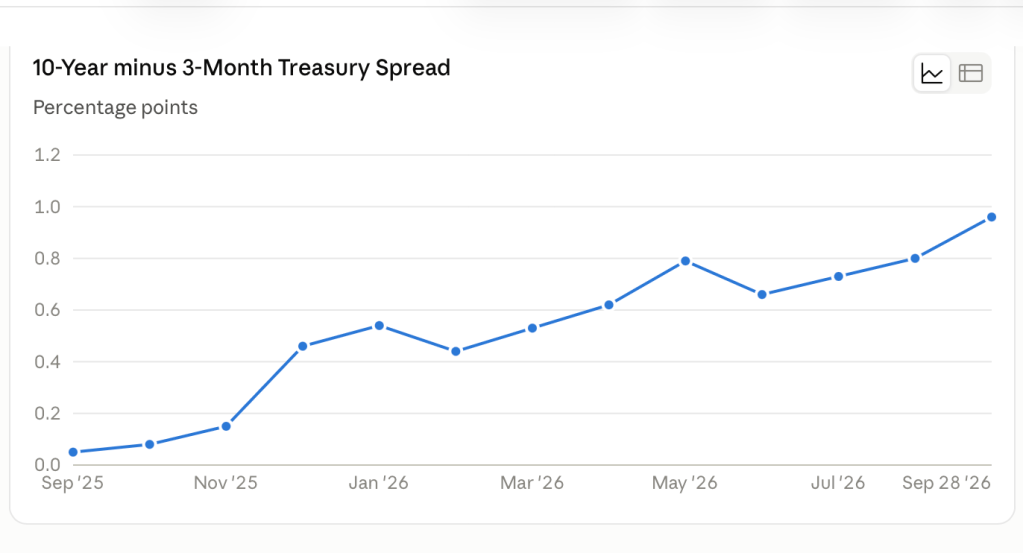
The 10-year/3-month spread has steepened sharply. A year ago it was essentially flat at 0.05 percentage points. On September 28 it reached 0.96, the steepest level of the past year.
The 10-year/2-year spread has done the opposite, flattening to 0.37 as of September 29. When the two spreads diverge like this, it means the 2-year yield has risen relative to the 3-month bill. That usually signals the market has scaled back how many near-term Fed rate cuts it expects, even as long-term yields have held up. Importantly, neither spread has turned negative at any point during the period.
The monthly figures come from the St. Louis Fed’s FRED database (series T10Y2YM and T10Y3MM). The last point on each chart is a single day’s reading rather than a monthly average, so it’s a bit noisier than the rest of the line.
Which predictor will prove right? We’ll have to wait and see.


While learning about yield curves [but not the 3-month] , I found everyone agrees on watch and see.
….with one saying we need to watch every move of the Fed- I thought that’s the opposite of what Warsh wanted..
…if the idea of a Ten-year investment is to believe the economy is going to be good, then is short-term an actual condemnation of the economy?…..a get-your- money -and- run scenario?..
I just always wonder where these decisions originate.
Guess these curves reflect the accumulation of activity.
…or does someone say — advise—“look to 2- yield over 10- year” …or a “3-month” ?
LikeLike