Musing on Baseball’s Playoffs and the NIL Legislation, too.
My love for baseball is well known. I am one of those few people who find the NFL and the NBA boring. I will try to watch an NFL game, but on Sundays I’d rather be outdoors on a beautiful day. On Sunday and Monday nights, I might watch the first half but invariably find myself working a jigsaw puzzle. I don’t even bother trying to watch the NBA. I don’t care for college basketball either, but I do like college baseball. As to college football, I am almost like Wade, who said he is “out.” But I still love my Dawgs and my Buckeyes and hope for a Tennessee win – so long as they are not playing Georgia or Ohio State. I still go to three Georgia games a year, but not to Columbus to see Ohio State like we used to. The travel and logistics have become too much. I only go to Neyland Stadium if the Vols are playing Georgia, and the next time they meet there (in 2029), I might be dead. But even going to Athens for a game is getting more and more difficult. It is now a year-to-year thing.
NIL and the money grab by the SEC and Big “10” (math not apparently it’s strong suit), in expanding their conferences have upended college sports and turned some of us off. Now athletes often show up at four different schools in search of bigger dollars or more playing time. The Senate just passed, by a vote of 77–22, a law to deal with this, and like all laws, it will probably make things worse. It now will to go to the House. The president will sign it. Basically, it limits an athlete to only one transfer, which limits their ability to earn income in what are the highest-earning years of their lives. Colleges will now be able to pay their players $49 million, up from the current $21.5 million – even though many already pay $40 million. Players will be subject to the NCAA’s five-year eligibility rule, with the clock starting the academic year after they turn 19 or when they first enroll full-time in college, whichever comes first. It caps agents’ fees at 5% of players’ earnings and bars college football coaches from bolting for another job in the middle of the season (the Lane Kiffin amendment). Scholarships would be guaranteed for ten years after eligibility ends to allow athletes to complete their degrees. (Which of the colleges would provide the guarantee? Likely the last one.) Schools generating $80 million or more in revenue must keep at least the same number of roster spots and grants-in-aid for non-revenue sports as they did in 2024–25. Conferences would also be capped at 20 members. In addition, any school moving between the four power conferences (the ACC, Big 12, Big “10”, and SEC, or any other conference with $700 million or more in annual revenue) would have to be independent for three years before joining a new power conference one – a sort of athletic witness protection program. The pushback from some senators included the limit on the number of transfers and the limit on the player compensation pool. The bill is said to face an uncertain fate in the House.
Personally, I would have liked to see the number of schools in the conferences reduced and regional rivalries renewed – Georgia/Tennessee, for example. I would also have liked two additional provisions: first, mandating that the power conferences share revenue with the smaller FCS conferences, and second, requiring that if an FCS player transfers to an FBS school, the FBS school must compensate the FCS school. In the end, like Wade, I’m mostly opting out of college football. Exhibit A: the weekend headlined by Georgia–Oklahoma, LSU–Texas A&M, USC–Oregon, Texas–Tennessee, and Ole Miss–Florida – an all-you-can-eat buffet for a college football fan. I watched exactly one of those games, Georgia–Oklahoma. In my defense, I was there in person, with my son, my grandson, and my great-grandson. Four generations, one row of seats, and two knees of varying reliability.
As fate would have it, I found myself on the receiving end of some hero worship. The fellow in front of me had graduated from Georgia in 2006. He spotted my 2018 Rose Bowl T-shirt – the one commemorating Georgia’s overtime thriller over Oklahoma – and asked whether I’d been at that game. I said yes. Then he asked when I graduated. I told him to go ahead and guess, and not to worry about insulting me. He said, “1988.” My son chuckled and said, “Only off by 22 years.” (I have chosen to hear that as “You look fantastic” rather than “You are still alive!”) He said, “What! What’s your name?” I told him, “Harold Black.” A few minutes later – you could almost hear the wheels turning – he turned back around: “Not Harold Alonza Black?” I said yes. He said he couldn’t believe it and announced to his friends, “They named a dormitory after him!” From then on, the praise never stopped. He was from Athens and said he had learned about me in elementary school – which is a remarkable thing to hear while you’re still around to enjoy it. He told his wife and friends that without me he couldn’t have gone to Georgia. He kept saying he couldn’t believe it was me, shaking my hand, hugging me, and thanking me over and over. It was almost embarrassing. But at least my great-grandson was impressed.
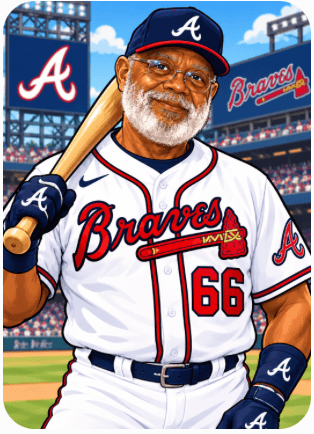
Back to baseball. What about baseball? Isn’t it like college football, where the richest teams simply buy the best free agents? I used to like the Dodgers. No more – they’ve become the Yankees with better weather. But baseball can still produce a Tampa Bay winning a division that includes the deep-pocketed Yankees and Red Sox. It can have a Milwaukee winning the division over the big-market Chicago Cubs. It can have the big-payroll Mets being perfectly, expensively awful. And how does a team that had Mike Trout and Shohei Ohtani for six years fail to make the playoffs? That takes a special kind of talent. Still, if they stay healthy, the Dodgers should win it all. I don’t have to like it. I want the Braves to win.
Sadly, the season is winding down, and only the playoffs remain. I’m a Braves fan, so my fingers are crossed – anything can happen in October and usually does. They’re playing the Phillies and took game one, so by the numbers they’re now heavy favorites to win that series, though the Braves have humbled better mathematicians than me. One thing I don’t like about the playoffs is that teams from the same division can be paired up (the Yankees are playing the Red Sox, too). They’ve already seen each other thirteen times this season – at that point it’s not a playoff series, it’s a family reunion nobody wanted. I wish MLB would change this. I also don’t like a team with a worse record getting home-field advantage just for winning its division – like the 81–81 Astros, who are being rewarded for perfect mediocrity. I think I’ll pass that along to my youngest granddaughter, who works at Major League Baseball in New York. I’m sure the commissioner will be calling any day now. So go, Braves! I’ll miss you, and I’ll circle the date when pitchers and catchers report for spring training. Until then, there are always more books to read and more jigsaw puzzles to ponder.


Thanks for updating us on NIL.
…it’s an aspect of sports hard to ignore..
Yes, I know it’s possible to grow out of full participation in sports. But it’s still easy to have an emotion, the latest shock being : appalled to hear the kids coming in, who have never heard of Phil Fulmer. And watch out, old man Peyton.
There have been discussions on how and who , if any , would inspire our football ‘ hometown team’…
Which means—Your accolades at that game puts you in the forefront of the Legends…
When I wanted to take my visiting nephew to the SEC birthplace- the now Hyatt on Gay Street- he said I’d already taken him there. Just a different type of aging out..
Dad always liked to go to college baseball games. He said he liked that because the kids would always take chances. The unpredictability was at one time the fun in all college sports.
Put a price tag on a player, and NOW the game had better be won .
LikeLike
Are you a UT fan?
LikeLike
Not now. When UT had the pregame lectures, & old timers that I knew would host parties in Circle Park, or I’d go to a party and Heath Shuler was there- yes, I enjoyed events- but not go to games.
I felt the people and socializing was 3/4 of a game.
Now fans are losing interest- or can’t afford tickets. So I’m out.
LikeLike