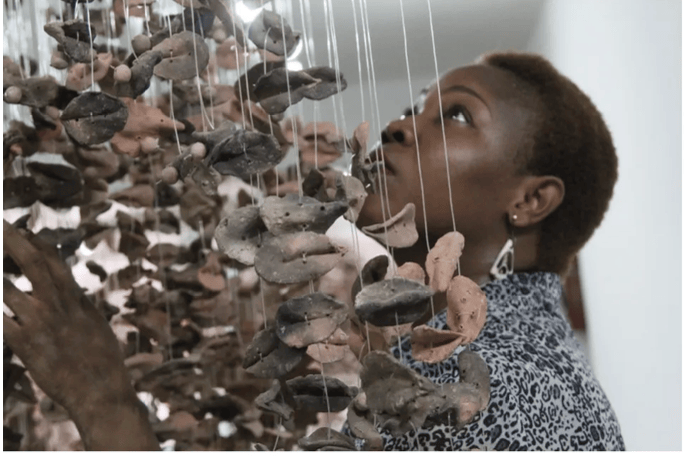
A Nobel Prize for Ngozi-Omeje Ezema
Why isn’t there a Nobel Prize in the visual arts? Yes, I know that Alfred Nobel’s wishes were that the prizes be given in physics, chemistry, physiology or medicine, literature, and peace. Then how come there is a prize awarded for economics? Here is what the Nobel website says:
In 1968, Sveriges Riksbank (Sweden’s central bank) established the Sveriges Riksbank Prize in Economic Sciences in Memory of Alfred Nobel. The prize is based on a donation received by the Nobel Foundation in 1968 from Sveriges Riksbank on the occasion of the bank’s 300th anniversary. The prize amount is the same as for the Nobel Prizes and is paid by the Riksbank. The first prize in economic sciences was awarded to Ragnar Frisch and Jan Tinbergen in 1969.
https://www.nobelprize.org/prizes/economic-sciences
Okay, but that still does not tell me anything, except that if Sveriges Riksbank can, out of the blue, say that there is a Nobel Prize in economics, then surely it can conjure one up in the visual arts. Perhaps such a prize would be controversial, since beauty is in the eye of the beholder. But certainly the prizes in literature, peace, and even economics can be controversial. Paul Krugman’s prize in economics is a joke – not because I don’t like his economics, but because his economics never rises above that of a decent graduate student. The peace prizes have not gone without controversy. In fact, I would wager that every one of them has its detractors. Consider that Al Gore and Barack Obama have won peace prizes. The same is true for the prize in literature. Bob Dylan comes to mind.
What I would like to propose to the committee and Sveriges Riksbank is that they establish a special award, given for outstanding achievement in any field other than the ones in which the prizes are now given. My first nominee is Ngozi-Omeje Ezema, a Nigerian artist who is a pioneer in the use of clay and its transformative capabilities. Her work is breathtaking in its creativity. It is simple but complex. Its detail leaves one in awe. Born and raised in eastern Nigeria, Ezema studied Fine and Applied Arts at the University of Nigeria, Nsukka, where she also received her master’s degree in the same field. This is from the website Art Formes: https://www.artformes.com/ngozi-omeje-ezema/
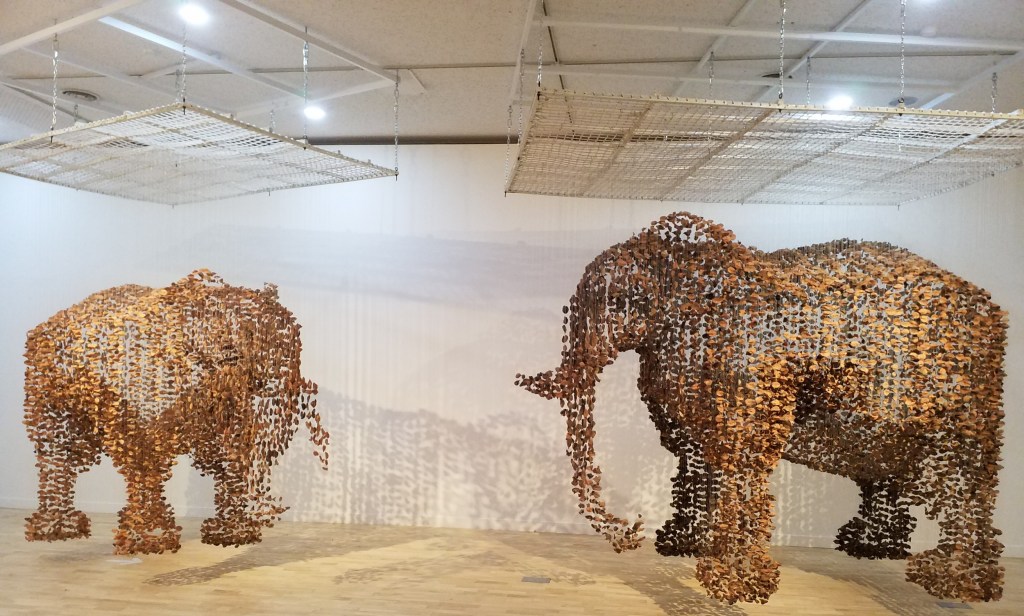
Ezema was first drawn to clay for its malleable, tactile properties, finding that it gave her the freedom to expand the boundaries of traditional ceramics. With a preliminary understanding of the fundamentals of ceramic technique, such as wheel throwing and hand-coiling, Ezema began, what has since developed into a pioneering exploration of the diversification of the medium. Through her work, the medium, often seen in tandem with the earth, is raised and left suspended in the air. Using thin nylon threads to suspend small leaf-shaped clay pieces, Ezema creates unique reimaginings of various familiar objects: ranging from elephants, teacups, whales and vases. By doing so, she redefines the medium as the substance of the definitive object and instead interjects notions of negative space into our perception of everyday imagery.
All right, so what does that mean? Here is just one example. Recall that these are small leaf-shaped clay pieces held together by nylon threads (probably fishing line). What does that look like?
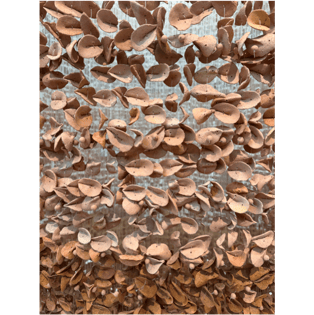
And what does this look like when finished?
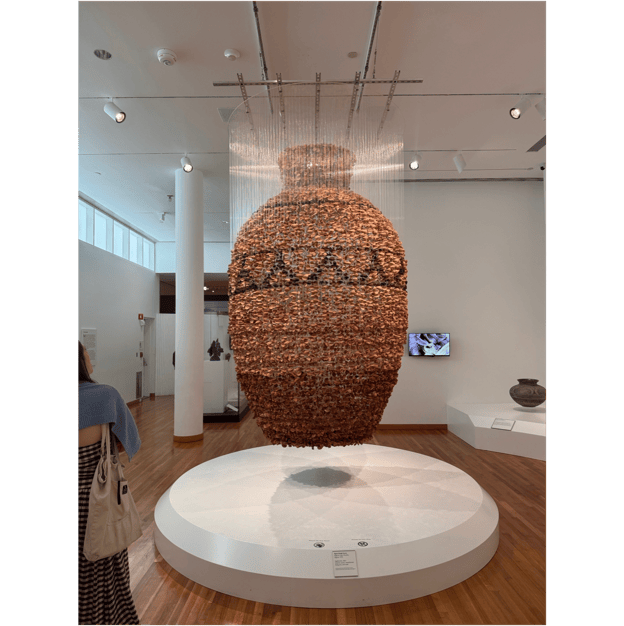
Goodness!
Here are some other examples:
I am just in awe!
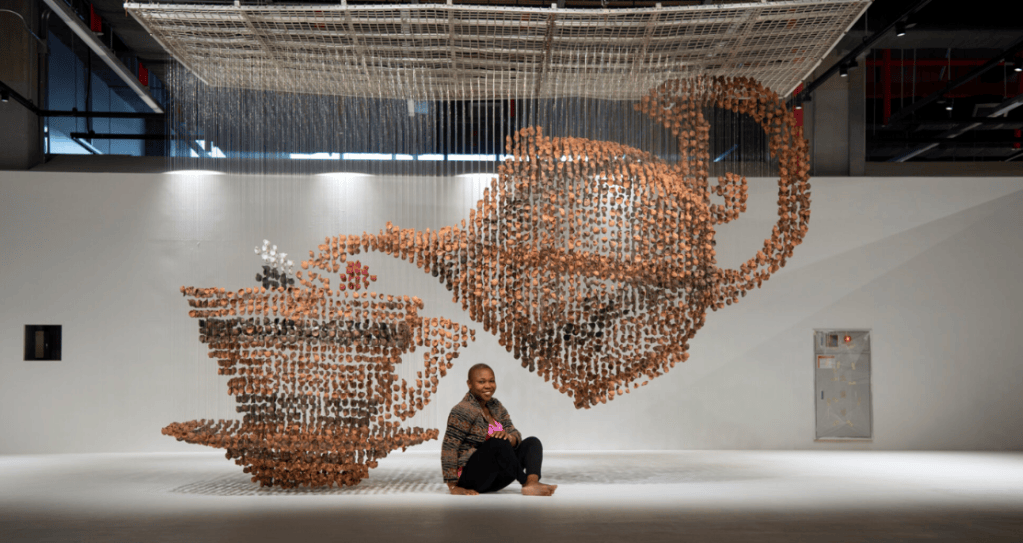
The artist in her own words:
“Being limited in describing my world in its societal evolution through utilitarian wares like cups, plates and vases, I tilted towards more open-ended and discursive means – ceramic installation. The string gives life to my works, as if allowing challenges to be sources of strength. Using strings to produce my installation depicts this very life on balance, thereby reassessing the frailty of life.”
Could not have said it better myself.
Give Ezema a Nobel Prize!


I disagree with the author on the frailty of life. Life is not frail. Consider seeds which endure thousands of years in silence yet when planted germinate producing life. Or consider a small crack in concrete in which a seed falls, germinates and comes up from the bottom of the crack, creating an enlarged space . Or consider a life that endures hardships yet continues to thrive and overcome adversities. Circumstances can be difficult, but life is overcoming.
LikeLike
Okay. But don’t you think that her art is amazing?
LikeLike