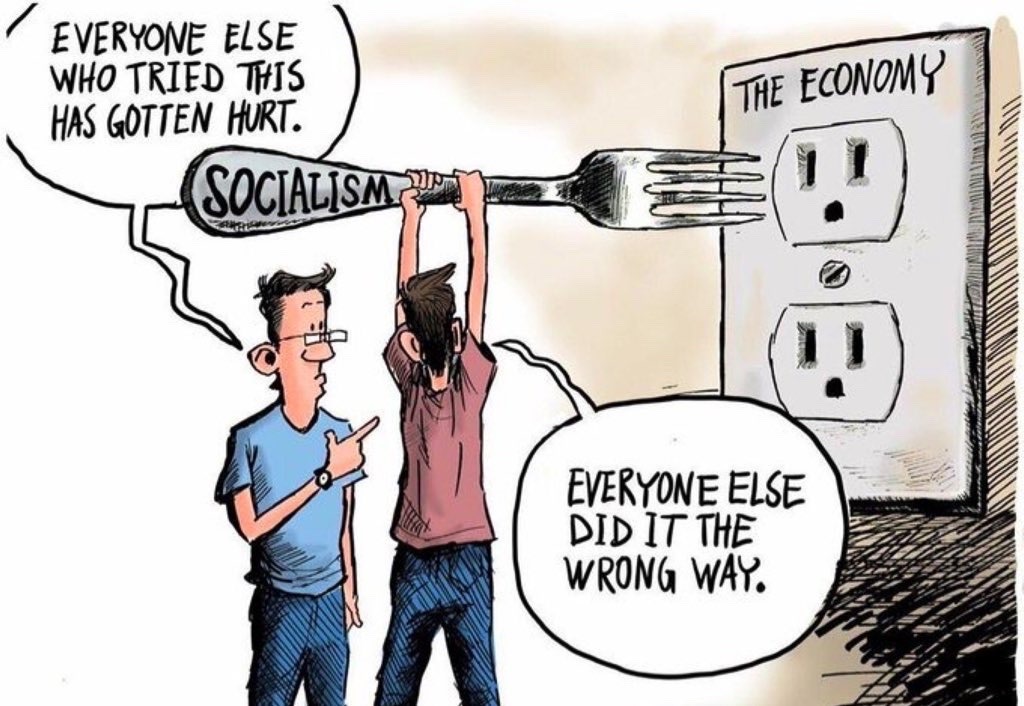
“Socialist governments traditionally do make a financial mess. They always run out of other people’s money.”
― Margaret Thatcher
We know that socialism always fails — except in the liberal arts colleges at our universities. But why? I think that the socialists know their system is a failure, but they don’t care so long as they are the ones in power. Who was it that said that the worst nightmare for a socialist is having other socialists in power who do not like him? Much has been written about the leaders of American socialists who are spoiled rich kids who have never held a job and are criticizing the system that made their parents wealthy enough to pamper them. These folk remind me of all the white kids that used to drive around listening to hardcore rap cursing white privilege. Or Hillary Clinton affecting a black accent. Fakes all.
But today’s socialists are just emulating Karl Marx, who himself came from a well-off family and spent much of his life sponging off Friedrich Engels, who provided him financial support for over 40 years. So all those loud socialist voices are simply following Marx’s lead, coming from backgrounds of real privilege — people who have never had to build anything from nothing, lecturing everyone else about the evils of the very system that gave their own families the comfort to raise them that way.
Socialism fails because it misunderstands or ignores human nature.
It Ignores Incentives
At its core, socialism takes the product of some people’s labor and redistributes it to others. This runs directly against basic incentive structures. When people cannot keep the full rewards of their work, they have less reason to work as hard. And when people receive benefits regardless of their effort, they have less reason to work at all. The result is falling productivity and a shrinking economic pie for everyone. Socialist economies have repeatedly had to reintroduce private incentives just to keep functioning — for example, letting farmers keep and sell what they grow on private plots even within otherwise collectivized systems.
Socialists talk of taking over the means of production and either having the government run businesses or putting businesses under government control. For socialists, profit is a dirty word. Yet it is ignoring profit that dooms all government-run enterprises to inefficiencies and waste. The energy industries in Russia and Venezuela are the poster children here. But the same is true for all government-run enterprises, even those in capitalist countries. That is because in order to maximize profits, businesses are incentivized to minimize losses, and in doing so they must operate as efficiently as possible, which minimizes waste. A business that ignores efficiency is doomed to fail. Not so with a government-run business, which can waste resources forever. That wastefulness means that socialist governments are less productive with lower economic well-being for their citizens.
It Ignores Individual Choice
Central planners inevitably substitute their own preferences for the preferences of millions of individuals. That mismatch is what produces the shortages and surpluses that have characterized planned economies — the empty shelves in some categories and the useless overstock in others. Variety isn’t waste — it’s the visible result of a market responding to what people actually want, rather than what a planner has decided they should want.
As Adam Smith put it, “It is not from the benevolence of the butcher, the brewer, or the baker that we expect our dinner, but from their regard to their own interest.” Freedom of choice and private property are the foundations of capitalism — and they are precisely what socialism sets out to override. Socialists only want the freedom of their choice and the power to impose it on others. That is why socialism always fails: it ignores individual tastes, preferences, and choice.
Misdiagnosing the Cause of Real Problems
Much of today’s frustration with the cost of housing, health care, and education is genuine — but it’s frequently pointed at the wrong target. In many of these sectors, prices are inflated not by free markets but by heavy government regulation and, often, by close partnerships between government and industry. Higher education continues to receive enormous public funding while administrative bureaucracies grow largely unchecked. Pharmaceutical companies benefit from regulatory structures that limit competition. And according to a 2026 National Association of Home Builders study, government regulations add about $132,000 to the price of an average new single-family home. Calling on the same government that created these distortions to now “fix” the affordability crisis asks the arsonist to put out the fire. To make these affordable, one must fight Big Pharma, Big Education, Big Developers and Big Government who say that they are operating to the benefit of the consumer.
The socialists say that big business and the wealthy have rigged the system in their favor. Maybe, but look at the statistics of how well off Americans are. That was brought into sharp relief with the World Cup when our visitors marveled at the abundance that we take for granted. The socialists will never say that what they want is to make us worse off. But that will be the result of their actions. So ask yourself: do you want to be worse off? Do you think that you can become better off by making others worse off? Do you think that taxing the rich will somehow benefit you, or are you advocating that because you are just jealous?
A Question of What Actually Helps
And that, my friends, is why socialism always fails. It goes against human nature. Resources are scarce. People want to profit from their own initiative and hard work. If they choose to share it with others through philanthropy, that’s one thing, and it won’t discourage their work. However, if it is taken from them by the government, they will be incentivized to offer less effort not more. Prosperity does not trickle down from the government. It comes from individuals pursuing freedom of choice and that choice is not from a bunch of “elites” dictating what they think is good for you.
Socialism fails because it is built on a denial of how people actually behave: individuals respond to incentives, and they value the freedom to make their own choices. A system that tries to override both eventually has to fall back on coercion to sustain itself, because voluntary cooperation breaks down once the connection between effort and reward is severed. Real, durable improvements in living standards come from expanding freedom and choice — not from concentrating more decision-making power in the hands of the state. The state is not the solution to the problems caused by the state.
And now some words of wisdom from that former Marxist, Thomas Sowell.
Socialism is a wonderful idea. It is only as a reality that it has been disastrous.
I have never understood why it is “greed” to want to keep the money you have earned but not greed to want to take somebody else’s money.
The fact that the market is not doing what we wish it would do is no reason to automatically assume that the government would do better.
Much of the social history of the Western world over the past three decades has involved replacing what worked with what sounded good.
No government of the left has done as much for the poor as capitalism has. Even when it comes to the redistribution of income, the left talks the talk but the free market walks the walk.
The welfare state is the oldest con game in the world. First you take people’s money away quietly and then you give some of it back to them flamboyantly.


One additional note: Socialism is Godless. Not that it has no god, only that its god (idol) is the government. As you said Socialism does not recognize the condition of man apart from Jesus: Corrupt and without remedy.
LikeLike
Great comment! Thanks.
LikeLike
It’s hard to respond to such a great essay with anything other than “wow….truth!”
Socialism taps into our worst proclivities – our desire for control….of the means of production, of the selection of pet industries, and eventually – the consumer/citizen. I can’t think of anything that the government does that the private sector couldn’t do better, more efficiently, more productively – including the military (but we’ve seldom had good experiments there).
It makes me wonder – what role should government actually play? It seems that when aggregated resources or coordination is a benefit to a large process, that’s a good place. For example – the building of the Interstate Highway system. It stretched across multiple states, it was a massive project that required some degree of cross border coordination, and national resources were utilized for the benefit of all. Could it have been done more efficiently if privatized (and maybe it was?) – I don’t know. Assuming that a shift to EVs was a move that a high percentage of Americans wanted, would it be a good role of government to standardize charging stations (like fuel pumps) and spend money on infrastructure to make them as ubiquitous as a gasoline station so that adoption was easier?
I read the other day that Trump has invested government resources in 25 companies now. If “Government” is the least efficient operator due to a lack of competition requirements, how could congress idly sit by and allow it? Who owns the purse strings?
Your statistic regarding $132,000 of added costs to a home due to regulation is maddening – truly. When will people demand that these socialist shackles be removed? If these idiot socialists would place as much energy into a focus on true freedom, maybe they’d come to realize that government is not the answer to many – nay, any – of their perceived problems.
I’d love to see an essay on how to cure healthcare….
LikeLike
Wow! Thank Pat. I have an earlier post “What would Adam Smith do” that addresses some of the issues you mention. Also the piece on GlP-1 pricing has implications for a market approach to healthcare. But there I am no expert. Great comment.
LikeLike
Dear Mr. Black, One unrelated question: Is there any way to quantify the financial impact on Credit Card companies whose illegal immigrant patrons have been deported? Copilot could not quantify. Regards, Jeff
LikeLike
That I don’t know but I will try to find an answer. I wonder what is the incidence of issuance to illegals. Seems like the risk of default would be awfully high.
LikeLike
Yes, I had asked Copilot how a credit card issuer determines the risk of lending other than a credit score. Seems like immigration status would weigh in?
LikeLike
When America was young, there was a phrase “beholden to your neighbor”, which is capitalism for how we were socially connected.
I know people who make their own shoes. But I think making shoes was easier when ancestors- independent business – took shoe-making as a profession.
I know people who grind their own corn- but they depend on others to GROW corn.
Same with our ancestors.
Capitalism can mean we are still dependent on neighbors; it doesn’t mean strict self-reliance…
Construction companies admit in TV investigations, they only follow 50% of the guidelines. What if there was no government oversite? ..
The best way to build capitalism is to make capitalist responsible. Is that possible? ..
I am disgusted by the buyer-beware philosophy, where it’s on the consumer to be responsible in choosing reputable vs. crooked business, with lawyers ready to sue to protect the reputation of their clients..
I like Thomas Sowell’s quotes- but I wonder if they are copyrighted. And if his family benefits fm the industry that puts Sowell-quotes on T-shirts..
Ironically, JD Vance’s 2016 book has a quote
in back ( to avoid Trump eyes) that it is time to stop blaming Obama, Bush, (and Biden?) , and faceless corporations , and take responsibility for ourselves. Isn’t that capitalism, too?
LikeLike