Oil versus Beef: A Primer on the Elasticity of Demand
Our neosocialist president has been on one of his usual rants, going after the oil companies for booking large profits following his conflict with Iran. He complained: “When you look at one company where they made 12 times what they made the year before, they ought to give some of that back to the public. And they better cut the retail price, the consumer price.” This from a man who made $2 billion last year while sitting on his butt. At ExxonMobil, quarterly profits more than doubled from a year earlier to their highest level since 2022, reaching $14.5 billion. Chevron posted its highest quarterly earnings on record, at $12.1 billion.
Trump’s carping doesn’t sound like a republican – he really is an economic socialist. He actually sounds like Joe Biden who made the same accusation, charging fossil-fuel companies with profiteering on the Ukraine war after oil prices spiked following the Russian invasion. Biden asked Congress to pass legislation penalizing oil-and-gas companies. At least Trump hasn’t gone that far — yet.
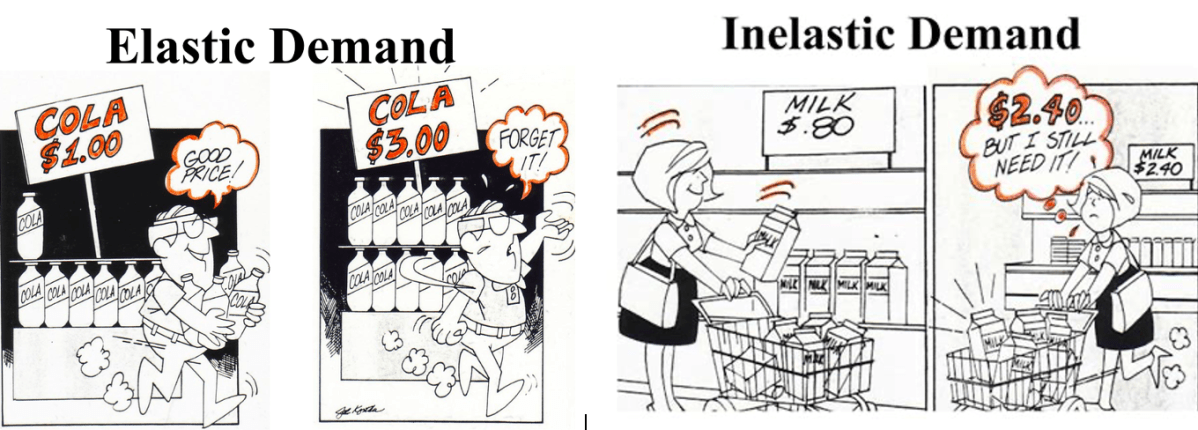
What would an economist say about oil? They would say that its demand is inelastic with both prices and profits going up. What about beef? Tyson Foods, the country’s largest meat processor just lowered its profit forecast because of the runup in beef prices. So why would an oil company’s profits rise as its price soars, while Tyson’s profits fall even though the price of beef is soaring too? Economists have a name for this: the elasticity of demand. It describes the relationship between a change in a product’s price and the resulting change in total revenue. When that relationship is positive, demand is said to be inelastic; when its negative, demand is elastic.
Consider beef. When its price climbs, consumers buy less of it and substitute other meats. So when the price rises but the quantity purchased falls enough that total revenue actually declines, economists call that elastic demand — and that appears to be exactly what’s happening with beef. Consumers are substituting. Since Tyson also processes pork and chicken, it will be worth watching how the company’s overall profits hold up as chicken and pork consumption likely rise (eat mor chikin! – and the other white meat). Tyson’s beef costs rose by $575 million last quarter, pushing up its prices with falling beef revenue. The company’s beef sales price rose almost 12% year over year, but sales volume fell 16%. Tyson now expects an adjusted operating loss of $500 million to $650 million for its 2026 fiscal year — though it says its chicken business should keep overall profits steady.
Oil is a different story. Like beef, oil has substitutes — green energy, shale, hydrogen, natural gas, electricity, nuclear, and hydropower. But those substitutes are useless for immediate use. I can’t simply swap hydrogen for diesel in my F-250 or gas in my GLS 450. My only real alternative is to drive less – or ride my motor scooter more. Beyond cars, oil heats our homes and serves as a critical industrial input well beyond simply fueling engines. It’s the foundation for plastics, synthetic rubber, and countless other chemicals. As someone once put it, “petroleum is everywhere.” It’s an input to transportation, electricity generation, and heating, and to the production of everyday consumer goods — smartphones, clothing, make-up, toothpaste, medicine, carpet. Given all that, we’d expect demand for oil to be relatively inelastic in the short run, since it takes time to retool production processes and transport systems around alternative inputs.
So did the quantity demanded for oil fall when prices rose? According to the U.S. Energy Information Administration, the answer is actually yes. Oil demand has declined in recent months. But that drop wasn’t large enough to bring total revenue down at the higher prices.
https://www.eia.gov/outlooks/steo/report/global_oil.php
None of this should surprise us. We’ve seen this story before, and we should come to expect it. The oil market is inherently volatile, driven by OPEC’s production decisions, geopolitical events, and natural disasters that disrupt refineries and supply lines. Trump’s confrontation with Iran is only the latest in a long, unending line of events that move the price of oil.
Markets are dynamic. Prices change constantly. If Trump is unhappy about how much money Big Oil is making, he shouldn’t point his finger at the executives of Shell and ExxonMobil. He should point it at himself.


The sainted wife pointed out a sign in a rural community, offering a gas alternative. Don’t know why I don’t notice them in Knoxville but I do hear podcasts like …
….”discussions regarding fuel alternatives like year-round E15 (higher ethanol blended gasoline) center on creating stable domestic demand for corn. The hosts and their industry guests view E15 expansion as a practical way to support grain markets and utilize farm- grown commodities rather than focusing on consumer-side environmental debates…”
I might mention here- with today’s essay talking gas and meat- that row- crop farmers question the encouragement to stop raising grains & vegetables, and concentrate on meat. Of course fuel is needed to get cattle to feeder stalls. And where’s the crop farmers to grow the feed?
In fact, farmers conclude any change in how land will be used will open the door to Developers…
While my best example of elasticity is Weigels, whose gas prices fluctuate between supporting Trump( low) , high ( reevaluation) or price that lets me buy Grandma’s Cookies, I will point out the court- inspired refund of money to those companies hit by tariffs/ market functions….never mention a price break for consumers. In fact the WSJ pod says companies will invest that money in America, & that means an investment in themselves.
LikeLike
Many fertilizers are petroleum based. My neighborhood Weigels has the highest gas prices of all of them. I mentioned previously the windfall profits importers make when the tariffs are refunded. Is E15 good for your engines? I use 100 percent gas in all my small engines due to the damage done by ethanol.
LikeLiked by 1 person
Don’t know about E15. Of course some will promote it , as in their best interest.
And some say this focus on E15 will create inflation – because corn is used in ‘ everything’.
Making corn cost bigger than beef. ..
Most consumers just gas-and-go.
LikeLike
Trump misses the fact those profits help folks with retirements plans invested in US large caps.
I remember back in the 1990s when chicken surpassed beef as the most of consumed meat in the
U.S. The National Cattlemen’s “Beef. It’s What’s for Dinner” campaign ran shortly thereafter. The main ad was to the backdrop of “Hoe-Down,” composed by Aaron Copland, with Robert Mitchum and Sam Elliot providing narration. Big time sponsor of the Vol Network!
LikeLike
Where’s the beef!
LikeLike
The WSJ had a great piece this week about a poultry glut and consumers rationally pivoting from expensive beef to chicken that’s on sale. Does this explain why the Fed prefers the chain-weighted CPE to the fixed basket CPI?
LikeLike
You mean chain weighted CPI. The answer is probably yes since it takes into account substitutions. But I don’t know how much difference that makes in the long run.
LikeLike