Intel’s drop comes back to bite the president
Note: At this writing, the election looks like a nationwide repudiation of the president with the democrats winning the House and in somewhat of a surprise the Senate with flips in Texas, Maine and South Carolina. Also Keisha Lance Bottoms is the next governor of Georgia. Full analysis will follow later when all the results are in for the House and the Senate.
But now: Intel
Under President Trump, our neosocialist president, Washington is now a shareholder in roughly 40 companies and counting. You know the drill: it’s all for national security. Chips should be made, and rare earth minerals mined, here, not in Taiwan or China – heaven forbid. The CHIPS Act was the catalyst. On October 22, 2026, the Commerce Department signed letters of intent for up to $389 million in CHIPS Act research awards to four private companies. As a condition of each award, the Commerce Department takes “a minority, non-controlling, non-voting equity stake.” Helion gets up to $175 million, Commonwealth Fusion Systems $85 million, Vertical Semiconductor $73 million, and Sibelco up to $56 million.
The government paid $8.9 billion for a 9.9% stake in Intel that was worth roughly $40.6 billion at Intel’s October 27 closing price. The government also holds a five-year warrant to buy another 5% at $20 a share, but only if Intel’s ownership of its foundry business falls below 51%. The stake was funded with the remaining $5.7 billion in grants previously awarded, but not yet paid, to Intel under the U.S. CHIPS and Science Act, plus $3.2 billion awarded to the company under the Secure Enclave program.
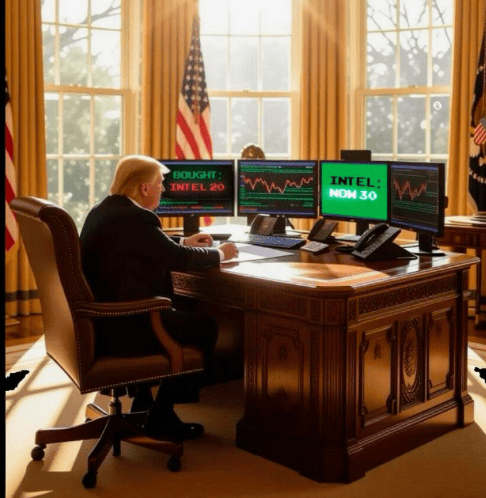
On September 19, 2025, the president posted on Truth Social an AI-generated image of himself trading Intel stock while sitting inside the White House. He probably was not actually trading the stock; more likely, he was trying to encourage investors to buy Intel shares. The image showed him at the Oval Office desk with the text “Bought Intel at $20” and “Intel now at $30.” Was Trump taking credit for Intel’s recent stock surge? When the Trump administration acquired its stake in Intel in August 2025, it agreed to purchase 433.3 million primary shares at $20.47 apiece, a 9.9% stake in the company. That explains the “Bought Intel at $20” in the image.
Furthermore, the stock had surged nearly 23% on Thursday, September 18, to close at $30.57, which explains “Intel now at $30.” That jump, however, was driven by Nvidia’s announcement that day of a $5 billion investment in Intel.
A month earlier, when the deal was announced on August 22, 2025, President Trump had crowed: “The United States paid nothing for these Shares, and the Shares are now valued at approximately $11 Billion Dollars. This is a great Deal for America and, also, a great Deal for INTEL.”
He returned to the theme this fall. In early September 2026, with Intel having just closed at $95.80, the president posted a nearly identical AI-generated image of himself at the Resolute Desk, this time reading “BOUGHT: INTEL $20” and “NOW $95,” along with a claim that he had made “Hundreds of Billions of Dollars” for America.
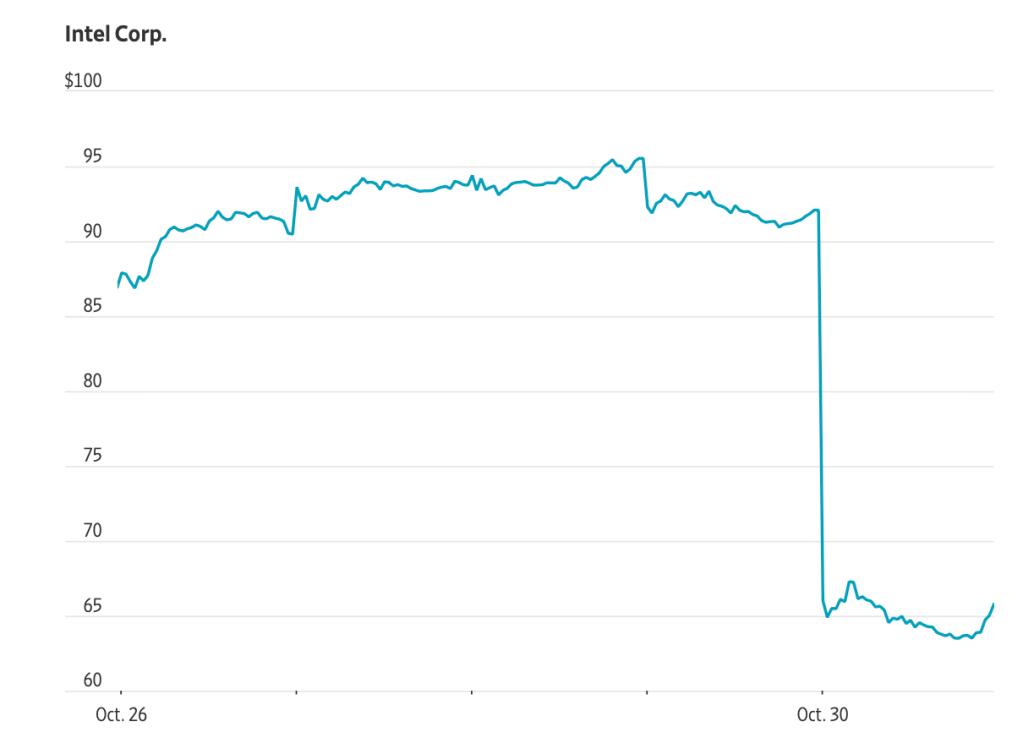
So what does the president say now that Intel has lost nearly 29 percent of its value in a single day? Does he take credit for that? On Friday, October 30, a sell-off in tech stocks wiped out more than $1 trillion in value as investors finally grew nervous about the enormous costs of the AI craze, wondering whether there will be enough profit to justify them.
Alphabet had led the way the day before, shedding about $500 billion in value on Thursday, but Alphabet is a roughly $4 trillion company. In percentage terms, Intel’s plunge was one of the biggest. Intel fell nearly 29 percent even though it reported a stronger quarterly profit than the market had anticipated. A day later it fell another 9 percent. The drop came because its forecast for the final three months of the year fell far short of analysts’ expectations. Intel guided fourth-quarter revenue to $15 billion to $16 billion, against the roughly $17 billion analysts were looking for, and adjusted earnings of 25 cents a share, well below the 43-cent consensus.
So much for forward guidance! Recall that Kevin Warsh, over at the Fed, has forsworn forward guidance. This is precisely why. If you tell the market what to expect, you gain nothing when you hit the target. If you exceed it, the stock price goes up. But if you miss it, you get hammered. Intel got hammered. I wonder what the president has to say now that the plunge has knocked about $12 billion off the value of the taxpayers’ stake. (Even so, at Friday’s close of $65.76 a share, the stake is still worth more than three times the $8.9 billion the government paid.)
A fake Truth Social post, falsely attributed to the president, also circulated, calling the stock a piece of you-know-what and declaring that “someone’s getting fired.” https://news.meaww.com/fact-check-did-trump-really-post-on-truth-social-criticizing-intel-stock
The decline in the company’s share value has also sparked discussions, memes, and criticism about the financial risks of government investment. But that is old news, something we all knew already. The government has no business picking winners and losers, but it always does.
The irony is that Intel’s business itself is booming: revenue in Intel’s data center unit grew 78% from a year earlier. It was the weak fourth-quarter outlook that sank the stock, handing Intel its worst day since 1974 and wiping out roughly $140 billion of its market value on Friday.


While the government has a vested interest in the security and success of specific entities that support Constitutional requirements that the government must maintain, investments from the government needs to remain clear of these or any other companies to avoid incursions into socialism. I do not agree that these investments should be made.
LikeLike