
Happy Post-Election Day (Part 2)
The Senate
As of this writing, the democrats have flipped seven Senate seats and are leading in the two races not yet decided. Kansas, Texas, North Carolina, Maine, South Carolina, Ohio and Iowa are official, with Alaska and Mississippi yet to be called. Going somewhat under the radar is Mississippi, which is on the verge of electing not only a democrat but a black democrat: Scott Colom, district attorney of Lowndes County. Colom leads incumbent republican Cindy Hyde-Smith by a razor-thin margin, roughly 1,800 votes in the latest count with the polls officially closed. Mail-in ballots that arrive during the grace period and potentially 10,000 to 15,000 provisional ballots have yet to be counted. Mind you, this is Mississippi we are talking about. This is sweet payback for Colom who was nominated by President Biden to a federal judgeship in the northern district of Mississippi only to have it blocked by Hyde-Smith who cited his support for transgender rights and having received a donation from a PAC funded by George Soros. The last time Mississippi elected a democrat to the Senate was John Stennis in 1982. The last time it elected a black senator was during Reconstruction. Blanche K. Bruce, a republican born into slavery in Virginia, was elected in 1874 and served from 1875 until 1881. Before him, Mississippi elected another black senator, Hiram Revels, also a republican, in 1870. Again, this race (no pun intended) has been almost totally ignored. One would have thought the leftist media would have highlighted it.
Also completely under the radar was the Senate race in Louisiana, where republican Rep. Julia Letlow barely squeaked by black farmer Jamie Davis. Letlow beat incumbent Bill Cassidy in the primary after Trump turned on Cassidy for voting to convict him in his second impeachment trial (dumb on Cassidy’s part) and endorsed Letlow. Letlow beat Davis by only 50.9% to 49.1%, a margin of just under 26,000 votes. Davis’s only previous elective experience was a single term on the Tensas Parish Police Jury and a seat on the Louisiana Democratic Party’s state central committee. He farms his family farm of about 3,200 acres of corn, cotton and soybeans in Tensas Parish and neighboring parishes. Davis campaigned on improving affordability for all, from healthcare to housing. I thought Davis had a chance given the anger among Louisiana’s black voters over losing their second majority-minority district. Maybe I was the only one outside of Louisiana who found this race interesting, because it was almost completely ignored.
As expected, former North Carolina Governor Roy Cooper defeated republican Michael Whatley. But, dramatically, democrats won 10 of the state’s 14 congressional seats, according to unofficial results (before the election, they held only four of the 14), and flipped the state House. In Maine, Susan Collins lost to Troy Jackson. I suspect that even if Graham Platner had remained in the race, he would have won. In Maine this year, a ham sandwich could have beaten Collins, and in essence it did. Jackson finished third in the democrat primary for governor, so his consolation prize was the U.S. Senate. In Texas, weird James Talarico beat ethically challenged Ken Paxton, and the democrats flipped the state House. In a monumental upset, ousted Greg Abbott from the governorship. Gina Hinojosa will be the new governor. Given the Texas results, I that even if John Cornyn had been the republican candidate, he would have lost. It was pretty stupid of that state’s republicans not to loudly tell Trump to cool it with ICE actions in Texas. Nothing says defeat more than ticking off one of your state’s largest constituencies. In Kansas, incumbent Roger Marshall was beaten by Adam Hamilton, a former megachurch pastor. Also under the radar is that the democrat religious left will have two senators in Talarico and Hamilton. It will be interesting to see how this plays out in the Senate. Iowa elected Josh Turek, a state representative, who beat Rep. Ashley Hinson. The incumbent republican, Joni Ernst, did not seek reelection. In Ohio, Sherrod Brown is back! Two years after losing his seat to Bernie Moreno, Brown defeated incumbent Jon Husted, becoming only the seventh former senator since 1946 to lose his seat and then return to the Senate in a later election.
Only two results surprised me. The first is Michigan, where democrat Abdul El-Sayed defeated former republican congressman Mike Rogers and will be the first Muslim U.S. senator. I had thought El-Sayed would lose for two reasons. First, black voters had not heretofore supported a socialist candidate and had voted for Haley Stevens in the primary. Second, I thought that, given El-Sayed’s open hostility toward Israel and antisemitism, he would lose the Jewish vote. The other race was in South Carolina, where I thought Darline Graham Nordone would win simply by being a republican. She lost to Annie Andrews, a 45-year-old pediatrician who had expressed emphatic support for transgender people. This is one loss I put squarely on President Trump. Graham Nordone had no business being on the ballot. Trump endorsed her and campaigned in the state for her. Rep. Ralph Norman would have been a far stronger candidate. Graham Nordone had been appointed to replace her brother, Lindsey Graham, after his death in July, and at first was thought to be a placeholder. I guess the brief stay in Washington was intoxicating enough for her to declare for the seat, facing Norman in the primary. Trump’s endorsement got her through that election even though she was embarrassingly bad at addressing the issues.
So the democrats have control of the Senate. What does that mean?
Question: What does the Senate do?
Answer: Together with the House, the Senate passes federal laws, sets federal budgets and declares war. On its own, it approves treaties, confirms presidential appointments such as judges and cabinet members, and conducts impeachment trials of federal officials.
What will this Senate do? Very little aside from rejecting presidential appointees and conducting impeachment trials. Remember, we have been here before. The democrats flipped the House in the 2018 midterms, and all it did was investigate Trump and impeach him – twice. This time it will be more of the same, with the same outcome. The Senate may end up with 56 democrats (counting the independents who caucus with them), but 67 votes are needed to convict in an impeachment trial.
Actually, what I expect is significant legislation to come from the House dealing with healthcare, housing, financial reform and accountability for the Trump administration. And I expect the president to veto all of it.
What would be interesting is to see whether the democrats move to codify Trump’s excursion into his neosocialism. Here we could see more government ownership of companies in the name of national security, or even the nationalization of, say, the rare earth minerals industry. What will be especially interesting is to see what happens to AI, whose data centers were an under-the-radar issue in the election. I suspect that the democrats will try to stop Trump’s actions against the universities, DEI and transgender rights. Also look for laws governing immigration – in particular legal immigration – and the funding of academic research.
It will also be interesting to see if there is a change in Senate leadership. Virtually all of the new democrat senators have called for new leadership. Recall that none of them wanted Chuck Schumer to campaign for them. Send money, yes, but campaign, no. Who is likely to challenge Schumer. Kalsi, the prediction market says Brian Schatz, Chris Murphy, Chris Van Hollen and Cory Booker are the leading alternatives. Look for Booker because the democrats would love to have a black Senate majority leader as well as a black House speaker.
The democrats winning the House was expected. Even a wide margin was anticipated, but not this wide. In anticipation of the change in the House, Hakeem Jeffries put together five working groups: healthcare, housing, groceries and consumer goods, gas and utilities, and caregiving. I would presume that Medicare for All will be front and center. We will see legislation from each of the working groups that will eventually be sent to the Senate for passage and to the president to be vetoed. Any presidential veto will be used as campaign fodder for the democrats in the presidential election two years hence: “Here is our agenda, and we need a democrat president to implement it.” I think it significant that all of the working groups are on domestic issues rather than foreign policy. Perhaps those are left to the Senate.
Here are the Senate’s most important committees and the likely changes in their chairmanships:
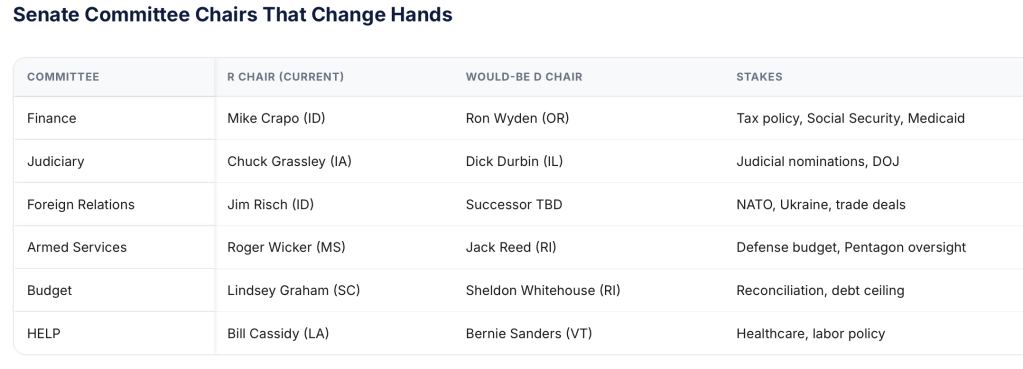
With Ben Cardin (D-MD) retired and ranking member Jeanne Shaheen (D-NH) leaving the Senate, the Foreign Relations gavel will likely go to one of the committee’s senior democrats, such as Chris Coons (D-DE). Only Whitehouse and Sanders label themselves as “progressive” although all have strong progressive tendences.
So buckle up. These will be interesting times – and remember, the saying “May you live in interesting times” is a curse.
Coda: BTW ICYMI, Across the old Confederate south. South Carolina will have a black senator and a woman senator. Georgia will have a black senator, a Jewish senator and a woman governor. Florida will have a black governor and a woman senator. Alabama has a woman senator and a woman governor. Mississippi has a woman senator and may soon have a black senator. Louisiana will have a woman senator. Texas will have a Latina governor. Tennessee will have a woman governor.
DEI reigns!


As far as elections go, I’m looking to Northeast Ms to see how they voted. And I was not surprised. Tishomingo County is where the movement continues, to add the confederate flag back into the state flag; where a Republican meeting is a call to arms- held in restaurants with Bible verses on the walls..
I will be interested in the observation of people there-
but I’m not in a hurry:
Cindy Hyde-Smith (R): 5,078 votes (~83) Scott Colom (D): 1,033 votes (~17%) ..
North central and west central went blue, and the explanation was MS has inherited suburban flight fm Memphis..
The only city I would be interested in, is Columbus, MS, which appears to be the hometown of Colom..
As far as I can tell Northeast-Central MS went with Colom..
The MS University for Women is in Columbus. I remember they participated in the first Earth Day. Not necessarily a Southern Belle school.
But now the ‘W’ will stand out for the decision to cancel a Colom rally that included Kamala Harris..
Due to a nightmare parking scenario, as the sheriffs office reported..
[ Colom] said The W, founded in 1884 as the nation’s first publicly funded college for women, declining to host the nation’s first female vice president is “disappointing.” ..Columbus Dispatch
LikeLike
DEI reigns ?! I like that terminology for Blackburn. She would not like being compared to DEI.
However….
She kept quiet about her own accomplishments, which were Bipartisan, to worship at the feet of her Savior, Donald Trump.
She won , and yet DEI now means something else; she’s not bothered that she will be a placeholder, controlled by Trump.
LikeLike
I seriously doubt if Trump will exert any influence for the next two years.
LikeLiked by 1 person