Blog

Random Thoughts #79

Random Thoughts #79

Nukes for Taiwan?

I’ve grown weary of China’s endless posturing toward Taiwan. I’ve argued before that this is largely a rope-a-dope — China would be strategically foolish to attempt an invasion. Their real objective, I suspect, is the reunification with Manchuria. But here’s a thought: why not end the Taiwan drama once and for all by simply giving Taiwan a nuclear weapon? A credible nuclear deterrent would silence Beijing’s bluster overnight. Short of that, the U.S. could station nuclear weapons on Taiwanese soil under American control — a bold but defensible move that sends an unmistakable signal.

Loyalty Over Competence — Once Again

Trump appointed his stooge Bill Pulte as acting Director of National Intelligence, replacing Tulsi Gabbard. Pulte will add that title to his other two. Currently he is director of the Federal Housing Finance Agency and also chairman of Fannie Mae and Freddie Mac. Pulte’s sole qualification as DNI director appears to be unwavering loyalty to Trump. Even reliably Republican voices pushed back: deposed Texas senator John Cornyn flatly stated he saw “no evidence of any qualification for the job,” and Senate Majority Leader John Thune warned, “We don’t need a weaponized DNI.” Others worry Pulte will be used to target political enemies — and not without reason. Don’t you think Pulte has enough on his plate already? But Pulte is merely the latest in a parade of Trump loyalists shoehorned into roles they aren’t qualified for. When you demand fealty above all else, the talent pool shrinks fast — and you end up just stacking new titles onto the same old cronies.

Because it’s an acting appointment, Pulte skips Senate confirmation — where he would almost certainly fail. His selection is also a pointed insult to Treasury Secretary Bessent, who reportedly once threatened to punch Pulte “in the f—ing face.” But there’s a deeper signal here: Trump may simply view the Office of the Director of National Intelligence as useless, another layer of government he has little use for. 

Trump’s Endorsement Streak Hits a Speed Bump

Trump’s otherwise reliable endorsement record took a hit when his pick for Iowa governor — Rep. Randy Feenstra — was defeated in the primary by businessman and farmer Zach Lahn. Lahn ran with the backing of Charlie Kirk’s Turning Point Action and had known Kirk since he was seventeen. Apparently, in Iowa friendship with Kirk trumps Trump.

The journal Nature Takes Aim at Academic Fraud

The journal Nature is finally doing something meaningful about the academic fraud that has long plagued its pages. It will now accept “registered reports” — proposals in which researchers submit their hypothesis, methods, and planned analyses before running any experiments. If accepted, Nature commits to publishing the paper regardless of whether the findings reach statistical significance, provided the protocol was followed and the results interpreted reasonably. Pre-registered protocols are stored in a public repository, preventing researchers from quietly bending or cherry-picking results after the fact. Crucially, this also opens the door to publishing negative or inconclusive findings — results that are systematically absent from the scientific literature today.

I’ve had papers rejected precisely because the results were “negative.” Think of the climate research that never saw the light of day for the same reason. Kudos to Nature for this overdue reform.

Heat Deaths, Old Age, and the WHO’s silly recommendation

A recent Wall Street Journal piece by Bjørn Lomborg — “Global Warming or Just Getting Old?” — takes aim at a WHO committee’s push to designate climate change a global health emergency. Their evidence: heat-related deaths in Europe have climbed to 63,000 per year, up 82% since 1990. Lomborg points out the obvious — Europe’s population has aged significantly over that period, and aging alone accounts for virtually all of that increase.

Two things Lomborg didn’t mention are worth adding. First, a rise in European deaths hardly constitutes a “global” emergency. Second — and most glaringly — only about 20 percent of European homes and buildings have air conditioning. The most direct remedy sits right there but recommending it is apparently off the table because of those pesky greenhouse emissions. I guess the WHO feels it is better to have old folk dying of heat stroke – right?

Americans Are Leaving — Would You?

Americans are expatriating at record rates — nearly 200,000 left last year alone. Is it a Trump-driven flight, à la Ellen DeGeneres? For some, perhaps. But most expats cite the cost of living. Retirees are stretching their pensions further abroad. Remote workers have discovered, as one old girlfriend of mine put it, “I can write code anywhere” — she chose Turks and Caicos for the diving and sailing. Hard to argue with that.

Germany baffles me, though — more Americans relocated there last year than Germans came here. Why trade sunshine for a contracting economy and a cold winter? Why move to a collapsing country that is cold? Portugal, Spain, the Netherlands and the Czech Republic have seen the numbers of Americans doubling over the past 10 years and growing by 36 percent since COVID. The dollar may be falling making living abroad more expensive, still a middle income American salary makes you rich in most other parts of the world. So the question is that if you expatriated, where would you go? I am partial to Grand Cayman but ultimately I would have to leave having claustrophobia living on an island. Maybe Mexico? What about you?

When Is Transitory Transitory?

When Is Transitory Transitory?

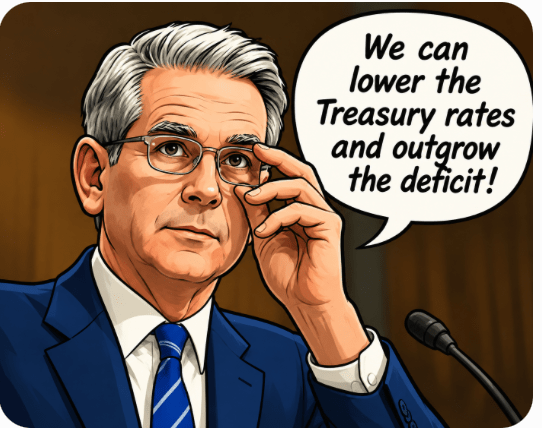
Remember when Janet Yellen and Jerome Powell declared that inflation was “transitory”? They were ultimately proven wrong. Their critics went ballistic, accusing them of lying to protect the Biden administration. Powell was branded a political hack—just as many had long viewed Yellen in her role as Treasury Secretary. But here’s the thing: they weren’t actually wrong at the time. They were relying on a specific measure of inflation that did, in fact, suggest the price surge was temporary. That measure—the Fed’s preferred gauge—was the Personal Consumption Expenditures (PCE) price index, not the better-known Consumer Price Index (CPI).

The PCE is similar to the CPI but differs in a few important ways. First, the PCE captures certain indirect purchases excluded from the CPI, such as medical care paid for by insurance. It also covers rural and urban consumers, nonprofits, and items purchased on behalf of consumers—like employer-provided fringe benefits. Second, and more critically, the PCE’s formula accounts for the fact that consumers adapt to rising prices by substituting lower-cost goods or services for more expensive ones. The PCE captures this substitution effect on an ongoing basis, while the CPI only updates its basket of goods and services every two years. The PCE is therefore more comprehensive than the CPI. But it excludes food and energy prices, which tend to be volatile due to temporary factors such as weather or geopolitical disruptions (think the Strait of Hormuz). Under this framework, if prices rose because of COVID-19—and were expected to fall once the pandemic subsided—policymakers would reasonably classify that inflation as “transitory.” And so they did.

There are other inflation measures worth knowing. The Producer Price Index (PPI) and the GDP deflator are two examples. The Dallas Fed computes something called a “trimmed mean PCE,” which strips out the top 31 percent of the fastest-growing price categories and the bottom 24 percent of the slowest-growing ones. There is also the Median PCE, which can be thought of as a more aggressive version of the trimmed mean—it symmetrically removes the top and bottom 50 percent of categories (sorted by spending-weighted growth rates), leaving only the category sitting precisely in the middle. Each measure has its proponents and detractors. Research suggests, for instance, that the Dallas Fed trimmed-mean measure was downwardly biased when price changes became more positively skewed during the inflation surge of 2021.

Why does any of this matter? Because monetary policy operates with a significant lag. My advisor Karl Brunner drilled this point into us, drawing on Milton Friedman’s landmark study A Monetary History of the United States and subsequent research. Friedman wrote: “There is much evidence that monetary changes have their effect only after a considerable lag and over a long period and that the lag is rather variable.” At the November 2022 Federal Open Market Committee (FOMC) meeting, Fed Chair Jerome Powell invoked this same concept of “long and variable lags.” The implication is straightforward: when the Fed acts—say, by adjusting the federal funds rate through open market operations—it takes considerable time before those actions ripple through to the broader economy. Friedman found that, averaged across the 18 business cycles studied, “peaks in the rate of change in the stock of money tend to precede peaks in general business by about 16 months and troughs in the rate of change in the stock of money to precede troughs in general business by about 12 months.”

That was then—what about now? Asset prices, such as stock prices and government bond yields, typically respond to changes in monetary policy within hours or even minutes. But those rapid asset-market reactions are far ahead of what happens to real goods and services prices and actual economic activity. Federal Reserve Governor Christopher Waller has noted that, in more recent cycles, lags tend to run nine to twelve months—shorter than in Friedman’s era, but still meaningful. Meanwhile, the president of the Kansas City Fed has warned that it may be a mistake to view the current rise in oil prices as “transitory,” even though Powell has suggested it might be. On the other side of that debate, Fed Governor Michelle Bowman has argued that reacting to temporarily elevated energy-price inflation would impose unnecessary restraint on the economy and labor market: “I am optimistic that, once the conflict is resolved, supply disruptions will ease, leaving a temporary imprint in [PCE] inflation and minimal impacts on domestic economic activity.” And yet the Cleveland Fed’s Beth Hammack, who sits on the Open Market Committee, has cautioned that waiting for definitive proof that inflation has become entrenched could force the Fed into larger, more disruptive rate adjustments down the road. Translation: if inflation stays above the 2 percent target, rate hikes will follow.

So it is noteworthy that in the Fed’s Open Market Committee there is significant disagreement over whether spikes in prices are transitory or not. Also should the Fed take action now because of those spikes that will have impacts not felt in real economic activity for a considerable while. Consider, it the spike is transitory and the Fed takes immediate action to raise rates, then the impact in the future will be less economic growth than otherwise.

To recap: different inflation measures produce different results. The Fed favors measures that filter out temporary price volatility because reacting to short-lived fluctuations—given the long lags involved—tends to produce suboptimal outcomes. I used to describe monetary policy to my students as turning around an aircraft carrier. Well, the U.S. economy is a $30 trillion aircraft carrier. If the price increases are concentrated in volatile categories likely to reverse on their own, the Fed will generally view them as transitory. That reasoning is sound—until it isn’t.

Enter Kevin Warsh, the new Fed chair, who wants to revisit the PCE as the primary inflation benchmark. Consider the divergence: the PCE’s “core” measure (excluding food and energy) ran at 3.3 percent over the past year, while the Dallas Fed’s trimmed mean came in at just 2.3 percent. If the Fed were to formally adopt the trimmed mean as its standard, it could declare victory and cut the federal funds rate—something that would surely delight President Trump. At his confirmation hearing, Warsh said: “What I’m most interested in is what’s the underlying inflation rate, not what’s the one-time change in prices because of a change in geopolitics or a change in beef.” That framing should also encompass Trump’s tariffs and the wave of geopolitical disruptions currently buffeting the global economy. If these shocks are truly one-offs, the trimmed mean gives the Fed less reason to tighten. If they are masking deeper demand pressures, these alternative gauges offer false comfort—and would expose the Fed to withering criticism if inflation resurges.

My concern is this: although Warsh has said all the right things about Fed models, the Fed’s historical overreach into fiscal policy, and the dangers of discretionary excess, his push to change the inflation benchmark looks uncomfortably like a search for whatever measure produces the lowest number. To be fair, Fed policy decisions are genuinely difficult—especially when long and variable lags mean that today’s correct call can easily become tomorrow’s mistake.

Here is a research paper that might be of interest.

The Long and Variable Lags of Monetary Policy: Evidence from Disaggregated Price Indices

By S. Borağan Aruoba and Thomas Drechsel

The Democrats Sell Their Soul (If They Ever Had One)

The Democrats Sell Their Soul (If They Ever Had One)

What does it mean to be “hoisted on one’s own petard”? The Democrats are so desperate to reclaim power that they will embrace some truly strange, bizarre and odious candidates for public office. The poster child is Maine’s Graham Platner, but he is hardly alone — there is also Texas’ Talarico, Michigan’s Abdul El-Sayed, and New York City’s Darializa Avila Chevalier, who has the backing of Zohran Mamdani as she seeks to oust Adriano Espaillat, the chair of the Congressional Hispanic Caucus representing New York’s 13th Congressional District. Never mind that Chevalier has called Joe Biden a “rapist” and a “war criminal,” declared the U.S. a “f—ing disgrace” on social media, posted “f— Kamala Harris,” and attacked even leftists like Bernie Sanders and Alexandria Ocasio-Cortez. She wants to close all prisons, legalize all drugs, end U.S. military support for Israel, and — like a committed communist — seize the means of production. Mamdani likes her, apparently eager to attack the democrat establishment just as much as the country’s foundations. We shall see whether voters in New York continue to reward that kind of thinking.

Platner, who I find genuinely repellent, has been embraced by Bernie Sanders, Elizabeth Warren (“he’s my man”), and the progressive wing of the party. Beyond his public trashing of a war hero, Platner has a well-documented appetite for crude content that makes light of sexual assault and other sensitive topics, and he has struggled to explain away a Nazi-themed tattoo on his chest. Most recently, it came to light that his own wife alerted his campaign early on about sexually explicit texts he had sent to six women — messages she discovered on his phone. He also maintains an account on a private messaging app called Kik, which has a reputation for facilitating sexual hook-ups for pedophiles. None of this has moved Sanders and the left who continue to support him on the grounds that Trump’s economy is the bigger issue. It is a remarkable position to take.

You would think a Nazi concentration camp tattoo would be disqualifying. And it would be, if Platner were a republican. Yet some polls show him running nine points ahead of Susan Collins — one of the Senate’s most respected members, who has never missed a roll call vote during her entire tenure. Platner recently tweeted that “Senator Collins is bought and paid for by Benjamin Netanyahu and votes accordingly,” a statement that sits rather uncomfortably alongside that tattoo. It also ignores the fact that Collins voted for the War Powers resolution to stop Trump’s Iran war. If Maine somehow elects this nutcase Platner then they truly deserve to be called “Mainiacs.” Also the tattoo is fitting since the Nazis were socialists too. 

Planter went to Washington to meet with democrat senators and emerged with their endorsement. Brushing off criticisms of his conduct New York’s Kirsten Gillibrand said “I am very confident we will win Maine.” Sanders said “He is going to stand up to the oligarchies.” I bet Sanders doesn’t mean George Soros, Tom Steyer and Michael Bloomberg. Sanders continues to beclown himself. I am tempted to call him a fool. I should also call Warren a fool as well for criticizing Pete Hegseth (maybe my least favorite cabinet member) for his Christian tattoos while giving Platner a pass on his Nazi tattoo. 

Perhaps that towering intellect – someone name Sonny Hostin on something called the View – said it best about Platner: “So he’s a liar, a racist, an antisemite. He’s a homophobe. So he has all the things and character does matter. But we have someone that has almost unbridled power in the White House at this point. There are no checks and balances and the only way that we can maybe bring a bit of our democracy back is by having a Congress that functions and that has these checks and balances. And I do think one of the only ways is to win that seat in Maine.” I guess she hasn’t seen Collins’ voting record. What an idiot.

Recall also the vocal antisemite who ran for a congressional seat in Texas and advocated putting all American Zionists in jail. Jewish democrat representatives in Congress said they would petition to block her from being seated if she won. Senator Jacky Rosen of Nevada, along with Representatives Josh Gottheimer of New Jersey and Jared Moskowitz of Florida, forcefully condemned her rhetoric, with Gottheimer and Moskowitz vowing to force expulsion votes “every single day” if she were elected. So why haven’t Rosen, Chuck Schumer, and their colleagues in the Senate taken the same stand against Platner? The silence is telling.

This strikes me as a genuine opportunity for Republicans to make inroads with Jewish voters. Senate Majority Leader John Thune should put out a statement from his caucus committing to challenge Platner’s seating should he somehow win. I have several Jewish friends who are moving away from the democrats driven in no small part by the antisemitism they see flourishing in democrat ranks. One told me recently that he feels uncomfortable wearing his Star of David here in Knoxville — genuinely worried that someone might follow him from synagogue and vandalize his car or worse. I told him that this feeling echoed what black southerners lived through in the 1950s and ’60s. When I was admitted to the University of Georgia, an administrator warned me not to walk the campus perimeter with my books for fear of being shot. I took that advice. And yet, even then, certain fraternities openly threatened students like me just for walking on campus.

I am glad those days are behind us. When my youngest granddaughter attended Georgia — graduating in 2023 — she said she never experienced a single instance of racism in her four years in Athens. Hopefully, before long, we will be able to say the same for Jewish Americans as well.

Would the Founding Fathers Impeach Donald Trump?

Would the Founding Fathers Impeach Donald Trump?

A Constitutional and Historical Inquiry

I. The Question the Founders Never Anticipated

The impeachment clause of the United States Constitution was not an afterthought. The Framers placed it at the heart of the republic’s design as a last line of defense against the corruption of executive power. They had read their history — they knew what unchecked rulers looked like — and they were determined to build a system that could correct itself. Yet, for all their genius, the Founders could not have imagined Donald Trump.

That is not an insult to the Founders. It is a testament to how far outside the norms of American political life Trump truly operates. Jonah Goldberg, writing for the American Enterprise Institute, has not surprisingly argued that the Founding Fathers would have moved to remove Trump from office long before the republic reached its current state of institutional exhaustion. https://www.aei.org/op-eds/the-founding-fathers-wouldve-gotten-rid-of-trump-long-ago/

That the historical and constitutional evidence support that conclusion is open to debate. And yet the mechanisms the Founders created have not produced the outcome they envisioned — a failure worth examining carefully. At the outset, my own inclination would not favor impeachment. But my academic side says that this is an issue worth investigating and discussing.

II. The Founders’ Conception of Impeachment

To understand what the Founders would have thought of Trump, we must first understand what they intended impeachment to accomplish. Alexander Hamilton, in Federalist No. 65, described impeachment as the mechanism for addressing “the misconduct of public men” and “the abuse or violation of some public trust.” Crucially, impeachment was never limited to criminal conduct. It was designed to address something broader and, in many ways, more dangerous: the betrayal of the constitutional order itself.

James Madison, the principal architect of the Constitution, was equally clear on the moral foundations that should govern a republic. In Federalist No. 10, he wrote that “no man is allowed to be a judge in his own cause; because his interest would certainly bias his judgment, and, not improbably, corrupt his integrity.” This was not merely an abstract philosophical principle. It was a load-bearing pillar of the constitutional structure Madison and his colleagues were constructing. A president who sat in judgment of himself — who used the machinery of the executive branch to settle his own legal disputes in his own favor — would have struck Madison as the precise corruption the Constitution was designed to prevent.

Edmund Burke, whose thinking deeply influenced the Founders, articulated this principle as one of the “fundamental rules” of a decent society: no man should be judge in his own cause. Burke’s political philosophy was woven into the fabric of the founding generation’s worldview. He would have been appalled by what has transpired.

III. The Settlement That Madison Never Imagined

Consider one specific episode that crystallizes these concerns that may indicate Was Burke’s prevision about Trump’s $1.766 billion settlement with himself?  Trump’s settlement of a civil lawsuit against himself, brokered by attorneys operating within his own Justice Department, for the striking sum of $1,776 billion — a figure that is too cute by half. That the settlement amount is a pointed reference to the year of American independence is not a coincidence. It is a performance, a provocation dressed in patriotic numerology.

The substance beneath the theater is more troubling still. The Justice Department — nominally an independent arm of the executive branch, charged with administering the law impartially — agreed to a massive payout to the president himself at a moment when the government appeared likely to lose the underlying case. A president using the public’s legal apparatus to enrich himself while avoiding an adverse judgment is precisely the kind of self-dealing Madison warned against. It is an abuse of public trust in the most literal sense Hamilton described.

This is an impeachable offense. It does not need to rise to the level of a criminal statute — the Constitution’s framers were explicit on this point. The standard is “high crimes and misdemeanors,” a phrase drawn from British parliamentary practice that encompassed abuses of power and betrayals of public trust, not merely violations of the penal code. Trump has now been impeached twice, and yet he remains in office — a fact that would have astonished and alarmed the Founders in equal measure.

IV. Where the Founders’ Design Failed

Here we encounter the painful irony at the center of this inquiry. The Founders designed impeachment as a corrective mechanism, but they made a critical assumption: that the Senate would act as a genuinely deliberative and independent body. They did not fully anticipate the emergence of rigid partisan tribalism — or, more precisely, they hoped the constitutional structure itself would prevent it. Madison’s Federalist No. 10 is, at its core, an argument that the size and diversity of the republic would prevent any single faction from seizing total control.

They were wrong — or at least, they were not right enough. When the president’s party controls the Senate, the body designed to serve as an independent check becomes an instrument of protection. Conviction requires a two-thirds majority; a disciplined partisan minority can prevent it regardless of the evidence. Trump’s two acquittals were not verdicts on the merits of the charges. They were demonstrations of the limits of a constitutional mechanism that assumed more institutional independence than the modern party system permits.

Even if Democrats were to retake both the House and the Senate, conviction would require 67 votes — a threshold that, in the current political environment, functions as a near-absolute barrier. The Founders built a high bar for removal deliberately, to protect against purely political witch hunts. In doing so, they may have inadvertently made genuine accountability for the most powerful man in the country nearly impossible to achieve.

V. The Other Side: A Friend’s Dissent

It would be dishonest to present only one side of this argument, and a close friend of mine offers a perspective that deserves serious consideration. When I expressed my outrage at the settlement, he pushed back with conviction. His response is worth quoting at length:

“In an age of constant outrage, I save outrage for worse matters. The outrageousness perpetrated on Trump has been so many that we no longer even feel outraged about them. So I am not outraged about this settlement. The Democrat-controlled government mobilizing against Trump is beyond any precedent I think in this country previously. There is an obvious conflict of interest. But that is not his fault. He should be free from abuse from the IRS like all of the rest of us. Because he has been framed, railroaded, arrested, defamed in all manner of ways, shot, and had his entire family threatened, I give DJT lots of latitude. I do believe he loves the country and I do not believe his family is all there just to grift off the taxpayer like Biden was. Besides, Donald Trump won’t send a goon squad to kick my door in the middle of the night to seize my AR-15. If I had to write a test and had only one question on it, that would be the one. Tells me everything I need to know.”

This is not a fringe view. It reflects a sincere and deeply held conviction shared by millions of Americans: that Trump has been the victim of an unprecedented campaign of political persecution, and that whatever excesses he may commit are dwarfed by the abuses directed against him. My friend raises a legitimate point when he notes the conflict of interest inherent in a political opposition using the instruments of government to pursue a former and future president.

And yet if a previous government abuses its power in persecuting an individual who is then elected president, does the newly installed president therefore acquire the right to have that government pay him a settlement from the public treasury? My friend says no penalty should attach. I say he has a point about the conflict of interest — but that the remedy cannot be self-enrichment at public expense, adjudicated by the president’s own appointees. Two wrongs, as the Founders would have noted, do not make a constitutional republic.

VI. Conclusion: A Republic, If You Can Keep It

When Benjamin Franklin emerged from the Constitutional Convention in 1787, he was reportedly asked what form of government the delegates had created. “A republic,” he replied, “if you can keep it.” That conditional clause has never felt more weighted than it does now.

Would the Founding Fathers have impeached Donald Trump? Based on the standards they articulated and the principles they embedded in the Constitution, the answer is almost certainly yes. The more troubling question is why the system they designed has been unable to achieve what they intended. The answer lies not in the failure of the Constitution itself, but in the failure of the institutions and political culture that are supposed to give it life.

Madison feared factionalism above almost all else. He built a system designed to tame it. What he did not — could not — anticipate was a faction so cohesive, so disciplined, and so willing to subordinate constitutional principle to political loyalty that the corrective mechanisms he designed would become effectively inoperable. The Founders gave us the tools. Whether we choose to use them remains, as it has always been, our responsibility.

So I ask you, the reader: what say you?

The Eye of Texas: State Currency and the Fed

The Eye of Texas: State Currency and the Fed

Stablecoins are gaining mainstream attention — and for good reason. Unlike Bitcoin, which derives its value purely from market sentiment, stablecoins are pegged to the U.S. dollar, giving them a veneer of stability. Critics, however, are wary. In a recent Wall Street Journal piece, Greg Ip warns that stablecoins represent a form of “private money” whose widespread adoption could pose systemic risks to the broader economy. .https://www.wsj.com/finance/currencies/stablecoins-are-private-money-thats-why-theyre-a-risk-to-the-economy-d3498171?mod=hp_lead_pos6

I think Ip is mistaken and the historical analogy is wrong. But that is not what this post is about.

The debate echoes an older one: the era before the Constitution when state-chartered banks freely issued their own banknotes. Article I, Section 10 largely put an end to that experiment. But a new Constitutional twist is emerging — the prospect of state-issued currency backed by gold and silver — and it raises serious questions about monetary policy and the future of the Federal Reserve. 

The Fed’s Original Sin: Seigniorage

I respect the structure of the Federal Reserve. What I find harder to defend is how it has conducted monetary policy. Like all central banks, the Fed is susceptible to siren call of seigniorage — the profit the government captures when the face value of money exceeds its cost of production. A $100 bill costs a few cents to print, the rest is, in effect, free money for the issuer. When the currency is fiat — backed not by a commodity but by governmental trust — the temptation to overprint is persistent and the consequences are inflationary.

Milton Friedman’s Quantity Theory of Money offers a useful benchmark: to sustain growth without inflation, the money supply should expand at roughly the same rate as the economy. Central banks routinely overshoot. As economist Don Boudreaux has documented, in the 124 years before the Federal Reserve’s creation (1790–1913), the dollar lost only about 8 percent of its value. In the 114 years since (1913–2026), it has lost roughly 97 percent. That is not a record to be proud of.

Gold Standards and Their Discontents

The natural response to chronic monetary debasement is a call to return to the gold standard. I understand the appeal, but I am skeptical. Tying currency to a commodity that simultaneously serves as a store of value and a medium of exchange creates inherent tensions. Gold’s price is driven by market forces — jewelry demand, industrial use, geopolitical anxiety — that have nothing to do with what a sound monetary policy requires. In 2022, gold was trading at around $1,832 an ounce. It has since climbed to over $4,400, with a recent peak near $5,549. That kind of volatility does not inspire confidence as a monetary anchor.

My preference remains Friedman’s monetary rule: a steady, predictable expansion of the money supply tied to economic growth. But another alternative has recently surfaced, one that is worth examining seriously, that of state-issued currency backed by precious metals.

The Texas Proposal: Constitutional and Practical Questions

Before anyone objects on constitutional grounds — and they should — Article I, Section 10 does prohibit states from coining money or issuing bills of credit. However, it does permit states to make gold and silver legal tender for the payment of debts. The Supreme Court held in Briscoe v. Bank of Kentucky (1837) that state notes were constitutional so long as they were backed by gold.

A state could, in theory, issue “representative money” — notes entitling the bearer to receive their face value in gold or silver from the state treasury. These would not be U.S. currency, but a return to the old state bank notes but with a difference – they would be backed by gold (or silver).

This is essentially what a bill introduced in the Texas Legislature proposed: a state-issued transactional currency, administered through the Texas Bullion Depository and backed 100 percent by gold and silver. The currency would be usable for debt payments within the state, transferable between parties, and redeemable either in specie or at the prevailing spot price of gold in U.S. dollars. (My bet: it would almost always be redeemed in dollars for reasons given below)

Gresham’s Law and the Problem of “Good Money”

Here is where the proposal runs into a classic problem. Gresham’s Law holds that “bad money drives out good.” When two forms of currency circulate simultaneously, people spend the one they value less and hoard the one they value more.

Consider the arithmetic: if you had an ounce of gold in 2022, you could redeem it for $1,832 worth of goods. If you held onto it and used Federal Reserve notes for your purchases instead, that same ounce is now worth over $4,400. Rational actors will always spend the depreciating currency and save the appreciating one. Gold-backed Texas notes would function as a store of value, not a medium of exchange — precisely the opposite of what a working currency needs to do.

Proponents argue that this might produce a “reverse Gresham’s Law” — that Texas’s sound money would crowd out Federal Reserve notes. I fail to see how. If Texas currency holds its value better than dollars, Texans will hoard it and spend their Federal Reserve notes instead. The Bullion Depository would face escalating redemption demands from holders who purchased notes when gold was cheap and now want to cash in at higher prices. The state could quickly find its liabilities exceeding its reserves and go bankrupt.

A Question Worth Asking

The impulse behind the Texas proposal is understandable. Decades of monetary expansion have eroded the dollar’s purchasing power in ways that fall disproportionately on ordinary savers. The desire for an alternative grounded in tangible assets reflects a legitimate frustration with the status quo.

But the mechanics do not hold up under scrutiny. A commodity-backed currency does not eliminate monetary problems; it relocates them — from the printing press to the commodity market. And a state-level currency that no one actually spends is not a currency at all.

BTW, there is an eye on the back of the dollar bill. It is meant to represent the Eye of Providence, associated with divine guidance. It is a symbol that has been around for a long time tied to Freemasonry and the Great Seal of the Country. So would the Texas currency be called “The Eye of Texas?”

If I’ve missed something in this analysis, as always I’m genuinely open to correction.

More States? Yes please!

More States? Yes please!

Democrats have long championed adding Washington, D.C. and Puerto Rico as new states to increase their clout in Washington. That proposal has always met with resistance from the right – and rightly so.  However, there is a way to add the new states if their residents want to join the Union. First, D.C. would need to incorporate the portion of Northern Virginia originally intended to be part of the nation’s capital. The democrats might resist that since it would weaken their hold on Virginia. Second, historical precedent calls for offsetting additions: when one side of the political ledger gains, the other must as well. The Missouri Compromise of 1820 offers the classic example — Missouri was admitted as a slave state, balanced by Maine entering as a free state. More recently, Hawaii and Alaska became states in 1959 with Hawaii in the democrat column and Alaska in the republican. Balance. Balance. Balance.

So what might balance the admission of D.C. and Puerto Rico? Two candidates stand out: Cuba and Alberta, Canada. Cuban-Americans lean heavily Republican and that political orientation may well extend to the island itself. Alberta, meanwhile, is Canada’s most conservative province and has long chafed under Ottawa’s thumb and the influence of the more liberal central provinces of Quebec and Ontario. Alberta is already exploring a referendum on secession — an effort unlikely to succeed, but one that reflects a strong separatist core. As an independent country, Alberta would likely be too small to stand alone. Aligning with its neighbor to the south, however, is a different matter.

The numbers are worth examining. Cuba, with 11 million residents, would have eight representatives and two senators. Alberta’s four million people would translate to five representatives and two senators. On the Democratic side, Puerto Rico’s three million residents would bring four representatives and two senators, while D.C.’s 700,000 people would yield two representatives and two senators. Assuming Alberta and Cuba lean Republican while D.C. and Puerto Rico lean Democratic, the math favors the GOP: up to 13 new Republican representatives and four new senators, versus six new Democratic representatives and four new senators. Republicans would likely find that arithmetic appealing — Democrats, considerably less so. Of course, something would have to be done with the fixed number of representatives now set at 435 by the Reapportionment Act of 1929. But let’s look at the two new potential candidates.

Cuba

Cuba has a long and complicated history with American expansionist ambitions. In the antebellum era, southern politicians eyed Cuba as fertile ground for expanding slavery into the Caribbean. President James Buchanan and the Democratic Party actively sought to annex the island as a slave state. Annexation was described as Buchanan’s “favored project” and, by 1859, his best hope for securing renomination in 1860. He dispatched an envoy to Spain to negotiate a purchase and democrats introduced legislation in Congress to that end. The effort collapsed with the rise of the republican Party as an anti-slavery party in the 1850s — republicans made clear they would block any new slave state, while looking westward for the addition of more free states.

Fast-forward to today and Cuba is back in the American political conversation. A buildup of U.S. forces in the Caribbean has fueled speculation about the administration’s intentions. President Trump has made a series of pointed remarks, cutting off Venezuelan oil to Cuba, threatening other nations with tariffs if they fail to follow suit, and making blunt statements about the island’s future. “I do believe I’ll have the honor of taking Cuba. Whether I free it, take it, I think I could do anything I want with it.” Cuba’s foreign minister responded by warning the country was preparing for “the possibility of military aggression.” Trump has added, “Other presidents have looked at this for 50, 60 years. It looks like I’ll be the one that does it.”

The legal pressure has followed. The U.S. indicted former Cuban president Raúl Castro for murder over the 1996 downing of two planes that killed American nationals — a move Cuba’s current president, Miguel Díaz-Canel, dismissed as “a political stunt designed to justify possible American aggression.”

Cuba itself is in crisis. Decades of communist mismanagement and American sanctions have pushed the island to the brink with widespread power outages, fuel shortages, food scarcity, and collapsing infrastructure. Against this backdrop, some politicians — many of Cuban heritage — have begun openly discussing a Puerto Rico-style territorial arrangement. Representative Nicole Malliotakis (R-NY) called it “a real option” that deserves more serious consideration. Representative Carlos Gimenez (R-FL), born in Cuba, agreed it is worth exploring. Senator Ted Cruz (R-TX) did not rule it out. Marco Rubio offered more measured language, saying he would prefer a diplomatic resolution — though Cuba’s foreign minister accused Rubio of “inciting military aggression” and falsely labeling Cuba a state sponsor of terrorism.

It is notable that every American politician quoted above is Republican. Proponents of statehood argue that bringing Cuba into the American orbit would unlock economic opportunity, strengthen regional security, alleviate humanitarian suffering, and curb migration pressures — all while adding a likely Republican-leaning state to the union.

Alberta

Alberta is moving toward a vote on secession from Canada. Premier Danielle Smith has announced a referendum for October 19, 2026, and has publicly committed to placing an independence question on the ballot if a petition effort succeeds. Unlike Cuba, Alberta comes to the table as an economic powerhouse. The province holds vast oil and gas reserves, is among the world’s top producers of wheat and canola and boasts thriving technology hubs in Calgary and Edmonton. Add to that significant deposits of coal and precious metals — including rare earth minerals — and the economic case becomes hard to ignore. Many Albertans already feel a closer cultural and economic kinship with the United States than with Ottawa.

Canada’s National Observer has gone so far as to argue that Premier Smith is “already turning Alberta into the 51st state,” suggesting it is her ultimate political goal. Smith’s government has been restructuring Alberta’s healthcare system along decidedly American lines, expanding the role of private insurance and the private sector. Her rhetoric, too, echoes that of American conservative politics. Sounding like Donald Trump, Smith has said “An unelected judge is not synonymous with democracy. Democracy is when elected officials who have to face the electorate every four years get to make decisions.” The article’s author concluded that Smith may be using these policy shifts as a cultural and legal runway toward eventual annexation.

President Trump has rattled sabers across the entire hemisphere — threatening to annex Greenland, repeatedly suggesting Canada become the 51st state, and publicly belittling Prime Minister Mark Carney. I have written before that it would really be dumb to annex all of Canada but why not just Alberta? It is resource-rich, politically aligned and eager for a new direction. It’s rich resource base, strong technology and political philosophy would make it attractive from a Republican standpoint. It is difficult to see the downside – unless you are a democrat.

Retatritide – A Miracle Drug?

Retatritide – A Miracle Drug?

An article I recently came across in Reason left me genuinely speechless, so I’m sharing it here. One thing that surprised me was learning that obesity rates are actually declining while diabetes continues to rise — a counterintuitive trend I hadn’t been aware of. On a personal note, I was just diagnosed as diabetic myself, though I’m skeptical of the result and will be retested in 91 days.

The article focuses on Retatritide, a new weight loss drug that is apparently delivering results comparable to bariatric surgery — a remarkable claim by any measure. It also touches on other GLP-1 drugs in the same class, like Ozempic (semaglutides), which are increasingly being described in near-miraculous terms. The article states:

“Besides helping people to control their diabetes and to lose substantial amounts of fat, these compounds appear to offer many additional health benefits. These include improved outcomes in people with cardiovascular, kidney, liver, arthritis, sleep apnea, and substance abuse disorders, along with reducing inflammation generally. More recent data suggest that these compounds also significantly reduce the risk of cancer overall and lower the risk of cancer spread. Recent research somewhat allays concerns that taking the compounds not only reduces fat but also muscle mass.”

It’s an extraordinary list of benefits. Which brings to mind the old adage — if something sounds too good to be true, it probably is.

The article can be found at

https://reason.com/2026/05/22/is-the-end-of-the-obesity-epidemic-near-people-lost-up-to-85-pounds-using-new-weight-loss-drug

Mace’s Citizenship Amendment and the Limits of Government Power

Mace’s Citizenship Amendment and the Limits of Government Power

Nancy Mace (R-SC) who has been called “one of the most performative and vapid members of Congress” is at it again. Mace, now running for the South Carolina governorship, has proposed to amend the U.S. Constitution to require members of Congress, federal judges, and Senate-confirmed appointees to be natural-born citizens. The proposal is unlikely to go anywhere — and from a constitutional standpoint that’s probably for the best.

Mace, whose relationship with the MAGA wing of the Republican Party has been turbulent — she criticized Donald Trump after January 6, drawing his public rebuke — appears to be using this proposal to shore up her conservative credentials ahead of a competitive primary. Mace knows that her amendment has no chance of passing either the House or the Senate, much less passage in three-fourths of the states. But she hates Ilhan Omar (D-MN). She pointed to her and members of the Squad who are naturalized citizens says that they are not loyal citizens. “If you hold power in the American government, you should be a natural-born American citizen. For too long we have allowed foreign-born members to hold seats in this government, while making clear their loyalty is not here. We see it every day.” 

In addition to Omar, she cited Pramila Jayapal (D-WA), and Shri Thanedar (D-MI), questioning their loyalty to the United States.  Constitutionally, her proposal is on shaky ground. The Founders placed a natural-born citizenship requirement only on the presidency — and that clause has long been criticized as an anachronistic restriction rooted in the geopolitical anxieties of the 18th century, not in any principled theory of governance. Note that the vice president need not be natural born. However, in the death or incapacitation of the president, the vice president cannot to ascend to the presidency.

Congress, by contrast, has always been open to naturalized citizens. Expanding eligibility restrictions to the legislative branch would represent a significant departure from the constitutional design and would require ratification by three-fourths of the states — a near-impossible threshold for a measure with such narrow support. More troubling is the underlying assertion that citizenship by naturalization is somehow inferior to citizenship by birth. This is a distinction the law does not generally recognize. Naturalized citizens take an oath — often after years of waiting, petitions, and legal process — that is at least as meaningful as the accident of birthplace. Jayapal’s description of her naturalization ceremony as one of the most meaningful days of her life reflects an experience shared by millions of Americans who chose this country deliberately, rather than arriving here by chance. 

Jayapal (D-WA) was born in India responded said “This narrow-minded, xenophobic legislation has no place in Congress and I call on all my colleagues — including my Republican colleagues who are naturalized citizens — to condemn this.” She recalled the moment she became a U.S. citizen. “My naturalization ceremony was one of the most meaningful days of my life. 26 years later, I have never forgotten that day as I stood with hundreds of people from across the world who had waited, in many cases decades, to become American citizens. This was a profound moment, as I felt the pride of my American citizenship.” You may not like how Jayapal votes but her constituents do. Does this sound like someone who hates America?

Mace’s proposal also applies selectively in its political framing. There are 26 foreign-born members of Congress — 19 Democrats and 7 Republicans. Mace named only the Democrats. If loyalty is genuinely the concern, one would expect equal scrutiny of naturalized members regardless of party. The omission suggests the proposal is less about constitutional principle than political targeting.

A separate but related effort by Florida’s Randy Fine — the “Disqualifying Dual Loyalty Act” — would bar dual citizens from serving in Congress, requiring them to renounce foreign citizenship first. This raises a different constitutional question: whether Congress has the authority to impose such a requirement through statute, or whether it would also require a constitutional amendment. The Constitution is silent on dual citizenship for legislators, and U.S. law does not require naturalized citizens to renounce prior nationalities. Fine’s bill would create a two-tiered citizenship structure — one with greater legal burdens on naturalized Americans than on the native-born.

When Omar was asked about Fine’s proposal she responded “Who’s that?” But Omar knows perfectly well who Fine is. Fine is perhaps the most vocal anti-Muslim member of Congress and has been called “vulgar,” “toxic,” “a disgrace to the United States Congress” and “an Islamophobic, disgusting bigot.” He has also been called “a swamp creature so vile that even DeSantis hates him.” When he was elected to the House, Fine posted on X that Omar and Rashida Tlaib (D-MI) should “consider leaving before I get there” with the hashtag “#BombsAway.” 

The central problem with both proposals is that they expand the government’s gatekeeping power over political participation based on the circumstances of one’s birth — something no individual controls. The proper remedy for representatives whose views voters dislike is the ballot box, not constitutionally imposed eligibility tests. Voters in Minnesota, Washington, and Michigan have repeatedly returned Omar, Jayapal, and Thanedar to office. Whatever one thinks of their politics, that is the constitutional process working as intended.

Mace’s proposed amendment will almost certainly go nowhere. But it is worth noting that proposals to restrict who may hold office — rather than persuading voters through argument — are a form of political shortcut that goes against the principles of individual liberty and equal citizenship the Constitution is meant to protect. Legal disqualification is not the answer to speech with which one disagrees. 

Wither the Two Party System?

Wither the Two Party System?

Thomas Massie’s defeat and the president’s constant pillorying on Rand Paul make one thing clear: libertarians are not welcome in Trump’s republican Party. Should they stay? Where else would they go? Our two-party system is so entrenched that third parties have almost no path to viability. Yes, there is one so-called “independent” in the House and two in the Senate — but are they really independent? When an “independent” can mount a serious challenge for the democratic presidential nomination, the label is a joke.

Massie himself once argued in Reason that libertarians should work within the Republican Party rather than fight the two-party system. “If you want to field another team, you have to either completely replace one that’s there now or work inside one that already exists. The most expedient path for libertarians is to work within the red team.” https://reason.com/2018/09/22/proposition-libertarians-shoul2/

The corollary, it turns out, is simple: if you want to keep your seat, shut up and vote with the party. Thomas Massie refused to do that 100 percent of the time. He voted with Trump 90 percent of the time but that was not enough. He didn’t waver from his principles even as Trump abandoned his own. Didn’t Trump promise no more foreign wars? Didn’t he pledge to cut the deficit in half?

Massie and Rand Paul were first elected on the wave of the Tea Party — a movement laser-focused on taxes and spending. Remember Jim DeMint, Mo Brooks, Jeff Flake, Allen West, Dan Burton, Mike Pence, Steve King, Herman Cain, and Newt Gingrich? All were prominent voices for change. All are gone. Rand Paul remains a lonely voice in the Senate and will likely escape Trump’s wrath only because he’s up for reelection in 2028, after Trump is gone. Tim Scott, elected to the House and now in the Senate, has reinvented himself as a MAGA loyalist to keep his job. I spoke at a Tea Party rally in Knoxville. The energy was genuine with real hope that Washington could be changed. That hope is long gone, along with the politicians who carried it.

Much the same has happened on the left side of the aisle. In 2009, I was invited to speak to the Blue Dog Caucus in Washington. It had 54 members then — centrist, moderate Democrats like Heath Shuler and Harold Ford, Jr. Today it has a woeful 10, chaired by Texas’ Vicente Gonzalez.

Meanwhile, although Trump may be scraping bottom in national polls, those numbers are misleading. He still dominates where he dominates. He is still popular where he is popular. He may have lost the independents but not the MAGAs. His victories in Louisiana, Indiana, and Kentucky — and now Texas, where sleezeball Ken Paxton beat John Cornyn — attest that Trump’s grip on solidly republican states is as tight as ever. Republicans in those states who dared not to kowtow to Trump lost. That sends a clear signal to anyone who hopes to survive in MAGA territory, pay fealty to Trump or bye bye.

The question now is whether the Trump variant of the republican Party outlasts Trump himself. I seriously doubt it. MAGA is Trump — and when Trump goes, MAGA goes with him, the way the Tea Party went before it. What comes next? Will republicans rediscover their foundational principles — free markets, free trade, small government, laissez-faire and limited government intrusion? Will they return to the Western alliance? Or will the party remain defined by fortress America, high tariffs, and hemispheric bullying?

I have often said that I was a Republican because it was the only party that at least paid lip service to free markets. This republican Party does not. At heart, I am a Tea Party republican. I have written before about whether America could realistically splinter into several parties: a fiscally conservative party, a hard-right nationalist party, a moderate center, a progressive-left coalition of greens, progressives and socialists. I don’t know if it’s possible — but Europe offers some precedent. Hungary, Germany, and England have all seen new parties rise to prominence and reform parties shake established coalitions. Could that happen here?

If republicans nominate a MAGA disciple in 2028, I won’t vote for that person. If democrats nominate someone from the Squad wing, will moderates — including some of my friends and the remaining Blue Dogs — simply sit it out? Could a George Wallace or Ross Perot-style challenger emerge to shake up the status quo? The real signal of change would be third-party candidates winning meaningful seats at the local, House, and Senate level — much as the Tea Party once did.

The right is littered with figures like Tucker Carlson and Nick Fuentes, whose presence makes people like me deeply uncomfortable. But where can we go? The left is increasingly defined by its hostility toward Israel, which has bled into open antisemitism. Texas congressional candidate Maureen Galindo’s rant — calling for turning an ICE detention center into a “prison for American Zionists” and a “castration processing center for pedophiles, which will probably be most of the Zionists” — shocked even some of her fellow Democrats. Even AOC called it “absolutely disgusting.” And yet American Jews remain loyal Democrats by wide margins, even as the broader American left drifts toward antisemitism. Logically, Jewish voters should be looking for a new political home. But where?

I am no expert on European politics, but the upheaval in England is not likely to happen here. Traditionally dominated by Labour and the Conservatives, those two parties together won just 34 percent of the vote in the most recent local elections, across 5,066 contested seats. Their parliamentary system, of course, makes coalition shifts and new party formations far easier than ours does. Here, the two entrenched parties control the primary system — the mechanism by which candidates at every level get nominated. We have no infrastructure for grassroots parties to build from local office to state prominence to national power. And unlike in a parliamentary system, our head of government will never be the Speaker of the House. Thank goodness for that, at least.

What Will Warsh Do?

What Will Warsh Do?

The question of what new Fed Chairman Kevin Warsh will do has quietly shifted into something more uncomfortable: what can he do? The media, never content to let a story breathe, has already manufactured a crisis around the transition. Center stage in this drama is Jerome Powell, who has declined the customary exit — resigning his governorship as every Fed chair since Mariner Eccles has done — and chosen instead to stick around. Spite toward Trump? Perhaps that makes for a better headline. The more plausible explanation is that Powell has no appetite for becoming a private citizen while the Justice Department’s appetite for retribution remains unsated. His seat at the Fed offers a kind of institutional armor that evaporates the moment he walks out the door.

So what does Powell do with himself now that he no longer holds the gavel? Does he fade into the background, or does he keep talking? Powell and Warsh hold genuinely conflicting philosophies, which makes every Powell public appearance a potential grenade. Powell was a devotee of forward guidance — he loved the press conference, the signaling, the theater of Fed communication. Warsh couldn’t be more different. He has argued that the central bank should learn to work without applause, without an audience leaning forward in anticipation. Whether Powell can bring himself to honor that vision — or whether he’ll view Warsh’s reform agenda as a personal affront — is anyone’s guess.

History offers some comfort, if not much guidance. Under Volcker and Greenspan, disagreements existed but stayed behind closed doors. The Fed presented a unified front to the world, whatever battles raged internally. That discipline eroded under Bernanke and Yellen. Under Powell it effectively collapsed — dissenting voices grew louder, though the actual votes on the Open Market Committee held until Trump planted his proxy, Stephen Miran, who made a habit of voting for rate cuts regardless of circumstances. Powell is no fool. He understands that open warfare between himself and Warsh would rattle markets in ways neither man wants. Nobody has forgotten the chaos of the Bill Miller Fed under Carter — markets loathe a rudderless Fed, and Carter eventually had to install Volcker to restore confidence. That is not a legacy Powell wants any part of.

Then there is the balance sheet question, which is shaping up to be Warsh’s first real battle. Fed Governor Michael Barr has warned that shrinking the balance sheet now would be a mistake — threatening bank resilience, disrupting money markets, and potentially destabilizing the broader financial system. Dallas Fed President Lorie Logan has echoed similar concerns. But here is what both Barr and Logan know perfectly well: there is a workaround. The Fed can let its holdings run off while neutralizing any drain on system liquidity simply by ceasing to pay interest on excess bank reserves. The objections, however sincere, are not without a solution.

And then there is the curious rehabilitation of Christopher Waller. Trump once dangled the chairmanship in front of both Waller and Michele Bowman — and, right on cue, both began voting with Miran to cut rates, doing the president’s bidding with impressive punctuality. My read at the time was that Trump never seriously intended to elevate either of them; he was simply using the prospect of a promotion to extract compliance. Now that Warsh holds the chair, Waller has suddenly rediscovered his independence, putting rate hikes back on the table if inflation refuses to cooperate. You could almost call it admirable, if the timing weren’t so transparent.

If Warsh is genuinely serious about reform — and there is reason to believe he is — the obstacles are real. He can push the Fed’s model builders to take monetary aggregates seriously again instead of obsessing over interest rates. He can redirect the reserve banks toward regional economic concerns and away from the woke seminar circuit. He can tilt the institution back toward monetary policy and away from its recent playing of fiscal policy understudy. He can begin, carefully, to wind down the balance sheet. But none of it happens without allies, and allies at the Fed are earned, not assumed. He will need the reserve bank presidents. He will need the governors — Powell, Barr, Waller, and the rest. That is a lot of coalition-building for an institution not known for its love of change.

Warsh is going to need a cape. If he can pull this off, it would be a genuine achievement — a Fed reoriented toward principle, less addicted to discretion, and more predictable for it. If he cannot, well then welcome to the new Fed: less comity but more comedy.