Blog

Miran gets outvoted. Harvard’s money and Naval target practice

Miran gets outvoted. Harvard’s money and Naval target practice

Is there any news other than Trump?

Trump’s man at the Fed, Stephen Miran, voted for “only” a 50 basis point drop in the Fed funds rate. Recall the president wanted 300 basis points. The other Trump appointees apparently disagreed and supported the 25 basis point drop. Miran was the only member of the Open Market Committee to dissent. I was mildly surprised given that two members – both reserve bank presidents – had express some hesitancy about decreasing the rate at all given the uptick in prices. However, concerns about the faltering economy as evidenced by the loss in jobs carried the day. Look to see the impact on short term rates and the 10 year Treasury.

There are signs that the job loss is not just due to immigration issues but that middle managers along with lower paid workers are being laid off. The previous narrative was that there was just lower hiring but also low firing. Now the thinking is that in those areas that are affected by the tariffs, companies are not only not hiring but have started to fire employees. Again the Fed’s mandate is full employment and price stability. The 25 basis point cut is actually a sop. It is too small to make a difference in either the fight against inflation or for full employment. Yet once again any size rate cut would not make employers want to hire unless consumer sentiment increased leading to increased business investment and hiring. As long as we continue to have fiscal irresponsibility and high tariffs, there is precious little that the Fed can do to boost GDP.

I wonder if there has been another Fed appointee who has been on the job less time than Miran and participated in an Open Market Committee meeting? Miran may have a PhD and be chair of the Council of Economic Advisors, but I wager he has precious little knowledge of the workings of monetary policy. I guess that he doesn’t need to know anything except vote how Trump wishes him too. It will be interesting to see what other duties and responsibilities as a governor he will be responsible for in his short time at the Fed. I am sure that Miran is smart but his resume is almost devoid of accomplishments, unlike those of Kugler who he replaced or Cook, Jefferson and Waller, the other PhDs on the Board. It just looks like he gets positions because he knows the right people. If I am wrong, please correct me. But that is my impression.

I am somewhat reminded of an appointment to the Board by Jimmy Carter. One story that was widely circulated was that the appointee was quoted as saying that when he came to the Board, he was overwhelmed with all of the theories, statistical analyses and intricacies of monetary policy and its relationship to the economy and to bank regulation. But after a couple of weeks, he now understood it all. A staffer said that if he came to work with a hangover, the quickest way to get sober was to talk to that governor who lasted less than a year.

It’s Harvard’s money – now

A dear friend sent me an article about a federal judge ruling that the Trump administration could not cancel the Federal government’s research funding. Judge Alison Burroughs (an Obama appointee) wrote “The government-initiated onslaught against Harvard was much more about promoting a governmental orthodoxy in violation of the First Amendment than about anything else.” I don’t know if it was a violation of the first amendment. It may surprise some that I agree with the ruling on the cutting off of future Federal funds. That funding came from a previous administration and not from this one. It should remain in place. However, any future funding coming from the Trump administration should in aligned with this administration’s wishes. It’s their (rather our) money. If Harvard or any other university disagrees with how the administration wants that money used, then it should not apply for it. Hillsdale College anyone?

After her ruling on the research cuts, the president tweeted “Trump hating judge. She’s a total disaster.” Burroughs was the judge who rejected the lawsuit brought by Asian students against Harvard’s race based admissions. 

Burroughs is also the judge who ruled against Trump’s attempt to ban foreign students from Harvard. I wonder if there will ever be an instance where she rules in favor of the administration?

Naval target practice

Lastly, I am a bit uneasy with the Navy’s blowing up the two speedboats killing 14 (alleged) drug smugglers. Couldn’t they just arrest them and confiscate their illicit cargo? Maybe blow them up if they couldn’t apprehend them but only as a last resort. I’m a bit surprised that the president hasn’t gotten much push back on this. The president justified the attacks as an act of self-defense. But isn’t that just a wee bit farfetched? Like 007, the president apparently as a license to kill. The vice president seemed absolutely giddy. He said that the U.S. should treat drug traffickers as if they’re combatants in a war. I guess that is the “act of self-defense” argument. Vance said “I think the rules of engagement should be similar to what they are in war, because we are, in fact, in a war against these drug cartels.”

Vance also said “Killing cartel members who poison our fellow citizens is the highest and best use of our military.” I am not going to quibble over words but “highest and best use”? Only Rand Paul (who else) among the republicans had the temerity to disagree. Paul said “Did he ever wonder what might happen if the accused were immediately executed without trial or representation??” Paul asked. “What a despicable and thoughtless sentiment it is to glorify killing someone without a trial.”

I am in favor of interdiction of fentanyl into the US. But there is little evidence that these attacks on the speedboats were for any reason other than Trump sending a message to Nicholas Maduro.

Does President Trump really want to erase “Peter” from our history?

Does President Trump really want to erase “Peter” from our history?

The president’s purging of DEI knows no bounds. The National Park Service is slated to remove dozens of photographs of slavery including the famous one of “Peter”, the slave with the scarred back. Trump’s executive order “Restoring Truth and Sanity to American History” ordered the Interior Department to purge historic sites of any content that “Inappropriately disparage Americans past or living.” The order accused the Biden administration of indulging a “corrosive ideology” that sought to cast the U.S. as “inherently racist, sexist, oppressive, or otherwise irredeemably flawed.” But wasn’t slavery “oppressive ideology”. Wasn’t the slavery part of America “racist, sexist, oppressive, or otherwise irredeemably flawed”? Hasn’t America struggled to redeem itself from those evils. I know that there are some who are “bitter clingers” to the racist, sexist narrative claiming systemic racism. But as I wrote for the Liberty Fund, I beg to differ.

https://oll.libertyfund.org/publications/liberty-matters/systemic-racism-in-education-and-health-care#post_823

For those who do not know this history, “Peter” (who later took the name Gordon) was an escaped slave in Louisiana whose scarred back increased the opposition to slavery in 1863. The website History says that “By the time Peter had made it to a Union encampment in Baton Rouge in March 1863, he had been through hell. Bloodhounds had chased him. He had been pursued for miles, had run barefoot through creeks and across fields. He had survived, if barely. When he reached the soldiers, Peter’s clothing was ragged and soaked with mud and sweat. But his 10-day ordeal was nothing compared to what he had already been through. During Peter’s enslavement on John and Bridget Lyons’ Louisiana plantation, Peter endured not just the indignity of slavery, but a brutal whipping that nearly took his life. And when he joined the Union Army after his escape from slavery, Peter exposed his scars during a medical examination.”

https://www.history.com/articles/whipped-peter-slavery-photo-scourged-back-real-story-civil-war

The purging of Peter’s photograph is a mistake of monumental proportions. Peter’s scars were only revealed when he enlisted in the Union Army. Peter’s story motivated free blacks to enlist in the Union army. He should be memorialized by the administration rather than erased by it. Juxtaposed to his picture with the scars of slavery is him in a Union uniform. Is this the same man? Is this the same poor man scarred by the whip? Yes but look at him standing proud in his uniform that symbolizes his freedom. Is he bitter and if he is, is his bitterness superseded by his pride? “Peter” is a triumph of overcoming the horrors of slavery and triumph over adversity. Is Trump also going to eradicate the 100,000 blacks who served in the Union army as well? Think of the courage of Peter and his fellows who took up arms to fight for their freedom against white confederates who loathed their being in the Union Army. Is Trump going to ignore their bravery? Is he going to purge Fort Pillow from the history books? Is he going to eradicate their role in the defeat of John Bell Hood at Nashville? Is he going to ban the movie “Glory”?

Pardon me, but this is outrageous. Peter and those like him should serve as a model of Americancourage and grit. Trying to erase him from our history is a slap in the face for all of us who love this country and every black who has ever served or is now serving in our country’s military.

Miran to the Fed. Banning drug ads

Miran to the Fed. Banning drug ads

As expected the Senate confirmed Stephen Miran to the Fed’s Board of Governors. The vote was 48-47. Trump tweeted. Triumphally that now the Fed “MUST CUT INTEREST RATES, NOW, AND BIGGER THAN HE HAD IN MIND. HOUSING WILL SOAR!!!” Only Lisa Murkowski among the republicans voted against Miran. This was somewhat of a surprise to me because I thought that Rand Paul would also be a “no.” However, Paul did not vote, as did Bernie Sanders and three republican senators, Lee, Lummis and Daines.

Pardon me if I remind the president that housing has fallen due to lack of demand even though the Fed funds rate was unchanged. Again, mortgage rates are more closely aligned to the 10 year Treasury than to the overnight Fed funds rate.

A couple of senate democrats said that Miran would be Trump’s “puppet” at the Fed. Of course he will be and I doubt if anyone thinks differently. Miran wants to return to his job at the Council of Economic Advisors and will do the president’s bidding. I really don’t care one way or the other since Miran is a short timer with this term expiring in January. Trump will still have a minority voice at the Fed with only two other possible allies at this meeting of the Open Market Committee.

No matter what the Fed does on rates, the president will tweet out more caps and exclamation points lambasting them. I know that historically some pundits have wanted the president – regardless of party – to have total control of monetary policy. But the consequence would be an economy characterized by high rates of inflation. I know it is easy and fashionable to be hypercritical of the Fed but it is really really hard to conduct monetary policy in an environment of fiscal irresponsibility. And by the way, if fiscal policy is irresponsible, what do you think monetary policy would be in the absence of the Fed?

No ads for Big Pharma?

In an earlier post I mentioned that RFK jr opposed Big Pharma’s ads to the general public. Only the US and New Zealand allow such advertising. Even though the drugs are only available by prescription, Big Pharma spends billions advertising very expensive drugs with the hopes that patients will urge doctors to prescribe those drugs. There is mixed evidence on whether this leads to greater drug demand. But the president has recently issued a memorandum that does not ban the ads but requires more disclosure. Politicians on both sides of the aisle support some curtailment of the ads. Kennedy claims that the advertising leads to overmedicalization of American children. This is curious since I have not seen any ads targeting children. The mostly appear to be ads on cancer drugs, diabetes and weight loss. Senators Durbin (D-Illinois) and Braun (R-Ind) have expressed the same sentiment. Braun (R-Ind.) wrote “Unfortunately, it appears there are gaping holes in FDA’s oversight of DTC (direct to consumer) promotions that are being exploited on social media at the expense of children and patients.” Maybe I have been looking at just old folks TV. Is there drug advertising on Disney and Nickelodeon? 

Why shouldn’t the drug companies advertise? Are consumers better off or worse off if they have information about the drugs? Suppose there were no advertising. How informed would consumers be about the options available to them for their particular ailment? I guess they could google the information if they were so motivated. No one is contending that the drug companies are advertising fraudulently. That is already illegal. If there were no advertising many patients would be wholly dependent upon their physician for recommendations about drugs. While that recommendation is likely the one taken by the patient, there is little harm in the patient asking about options seen from the ads.

Maybe the opponents are against the volume of ads with the drug companies spending $10 billion a year. But what concerns me is that in the absence of drug advertising, what will be the source of information about the drugs? Will it be the government? Another concern is that if safety is purported to be the reason for curtailing the ads, then what about any other product – automobiles anyone?

No firing of Fed Governor Lisa Cook – yet

No firing of Fed Governor Lisa Cook – yet

The Federal appeals court just ruled against the president’s firing of Fed governor Lisa Cook. The ruling was 2-1 and upheld the decision of the lower court whose judge, Jia Cobb (a Biden appointee) ruled that Cook was “substantially likely” to succeed with a claim that her firing was unlawful and blocked her removal. Judges Bradley Garcia and Michelle Childs both Biden appointees were in the majority while Judge Gregory Katsas, a Trump appointee, dissented. Garcia and Childs said that there was merit in the argument by Cook’s attorney that she wasn’t given proper notice or opportunity to respond to her firing. Katsas disagreed saying that if Cook were entitled to a hearing before removal, the adequacy of that process could be challenged and take months or years to resolve. Katsas wrote. “And that would enable a potentially compromised Governor to engage in significant governmental action—such as voting on whether to adjust interest rates.”

Interestingly, Cook has yet to be charged with a crime and despite documents produced by Bill Pulte the Federal Housing Finance director alleging mortgage fraud, other documents show otherwise. Of course, the Trump administration will appeal to the Supreme Court.

Regardless of the outcome of this case, I find it disheartening that these rulings appear to be partisan further indicating that the law is now blind even at the highest judicial levels.

Trump is politicizing the Fed. So What?

Trump is politicizing the Fed. So What?

The president’s attempt to politicize the Fed seems to be meeting little resistance in the Senate. The nomination of the Council of Economic Advisors chairman Stephen Miran to fill the unexpired term of Adriana Kugler sailed through the Senate Banking Committee 13-11. Miran said that he would take a leave of absence from the Council and return to that job in January. The democrats attacked this arrangement as a conflict of interest – which of course it is. Miran will do the president’s bidding at the Fed and will participate in the Open Market Committee on September 16 and 17. He will vote for a lowering of the Fed Funds rate. The only question is how large a drop in the rate will he argue for. The president wants a 300 basis point drop while the Fed is more likely to decrease the rate by either 25 or 50 basis points. 

The Senate republicans – with the exception of McConnell and Paul – are scared of Trump and will do his bidding and confirm Miran. However, when the next democrat becomes president with a senate majority, look for more presidential lackeys to be nominated. The republicans may rue the day that they did not discourage Trump from nominating one of his aides.

So the president will have one of his own on the Fed. There are two other Trump appointees and they too are likely to do the president’s bidding hoping to be named Fed chairman after Powell’s term ends in May 2026. Thus, at least until then the president can count on at least those two to do his bidding as well. The president will have to nominate someone else to take the Fed seat in January. That person also will do his bidding hoping to be named chairman. Therefore, Trump can count on three of the seven governors to toe his line. If Powell resigns his seat on the Fed Board, the president will then have nominated four of the seven governors. But will they do his bidding? Maybe. The snubbed governors might reassert their independence. There will be no grounds on which they could be fired by the president. It will be interesting to see how this plays out.

Short-term the only hope that the president has is that whoever he puts on the Board will share his somewhat novel ideas about the economy and its workings. But even that will be no guarantee of how the governor will votes. Although many whine about politicization of the Fed. I am 100 percent in favor of a president putting kindred spirits on the board. Joe Biden did that with his appointees. He nominated Lisa Cook, Philip Jefferson and Sarah Bloom Raskin to be on the board. Cook is an international economist with an impressive resume concentrating mainly on the Russian economy but recently turned to issues on the intersection of macroeconomics and economic history, particularly African-American history. Jefferson is a macro economist who has published papers such as “Seigniorage payments for use of the dollar” but also is interested in issues involving inequality and poverty. Raskin’s nomination failed to get senate approval although she had previously served on the board. Her advocacy of the Fed taking an active role in climate change doomed her nomination. That she is also married to Rep. Jaime Raskin one of the more highly partisan democrat members of congress also probably played a role in her failure to be confirmed.

Jay Powell has allowed the Fed and its reserve banks to research politicized issues. There were seminars and podcasts at the reserve banks on issues such as race, sex discrimination and the climate. Some have criticized the Fed as these items are far from the Fed’s publicized mandate of price stability and full employment. However, they are actually part of how the Fed interprets its mission. The Fed’s home page states: 

The Federal Reserve System is the central bank of the United States. It performs five general functions to promote the effective operation of the U.S. economy and, more generally, the public interest. The Federal Reserve

  • conducts the nation’s monetary policy to promote maximum employment, stable prices, and moderate long-term interest rates in the U.S. economy;
  • promotes the stability of the financial system and seeks to minimize and contain systemic risks through active monitoring and engagement in the U.S. and abroad;
  • promotes the safety and soundness of individual financial institutions and monitors their impact on the financial system as a whole;
  • fosters payment and settlement system safety and efficiency through services to the banking industry and the U.S. government that facilitate U.S.-dollar transactions and payments; and
  • promotes consumer protection and community development through consumer-focused supervision and examination, research and analysis of emerging consumer issues and trends, community economic development activities, and the administration of consumer laws and regulations.

Therefore, as long as the Fed is a supervisor of banks and has the role of oversight for consumer protection and examining for compliance of consumer laws and regulations, research in the consumer area is consistent with its mission. My contention is that the Board in Washington should concentrate on the dual mandate of price stability and full employment and delegate the other areas to the reserve banks. For example, the Atlanta Fed states as its mission: “The Atlanta Fed’s Community and Economic Development function supports the Central Bank’s mandate of stable prices and maximum employment by helping improve the economic opportunity of low- and moderate-income (LMI) individuals and underserved places for a stronger economy for all Americans. Community development is one of the Federal Reserve’s core functions and this responsibility is rooted in its mandates from Congress.” The New York Fed says “At the New York Fed, our mission is to make the U.S. economy stronger and the financial system more stable for all segments of society. We do this by executing monetary policy, providing financial services, supervising banks and providing thought leadership on issues that impact the nation and communities we serve.” Just recently the New York Fed released its Empire state manufacturing survey.

It is not surprising that the types of seminars and papers that were produced under Biden are no longer being published by the reserve banks. Yet it is clear that the reserve banks feel that their mission goes beyond the conduct of monetary policy to the impact of monetary policy on the economically disadvantaged. These issues are germane to the regions.

Some pundit complain that the Fed was being “woke” and were pursuing “wokeness” because most of its staff economists are democrats. I beg to differ. One need not be on the left to want to see what is the impact of monetary policy on all sectors and members of society. Don’t misunderstand, the impact of monetary policy on all sectors of the economy and its participants is a vital and important area of study. The question is whether the Fed and/or the reserve banks should be conducting this research as well as having seminars and podcasts about these issues.

Although my dissertation and early research were in monetary theory, my later work concentrated on the impact of changes in bank regulation on the banks and the banks’ customers. I pioneered the econometric study of lending discrimination and discriminating in the lending terms of mortgages. The motivation for that work came from the Comptroller of the Currency when I was serving as deputy director for economic research and analysis in the early 1970s who wanted to know if national banks were discriminating against blacks in the lending decision. Our research led to a new field of study and its model and statistical techniques are still used today.

I do believe that the impact of monetary policy on people as well as the economy at large should be studied at the reserve banks rather than by the economists at the Board of Governors. Those impacts affect the reserve bank regions and are as important as the effect of policy on agriculture and on industrial production. That said, the economists at the Board of Governors should concentrate on the Fed’s dual mandate and nothing else.

Are tariffs inflationary?

Are tariffs inflationary?

Are tariffs inflationary? Any monetary economist would say “no” – at least not just tariffs by themselves. As the sainted Milton Friedman said “Inflation is always and everywhere a monetary phenomenon and is thus the responsibility of the central bank.” Although there are caveats to this, Friedman is fundamentally correct. This would mean that if Trump gets his way and the Fed lowers the Fed funds rate, the likely consequence will be more inflation. To explain this, let’s have a basic primer on how things should work. The Fed funds rate is the interest rate on overnight borrowings of banks’ excess reserves. To lower the rate the Fed increases the supply of excess reserves by purchasing securities from the banks. Given more excess reserves than they wish to hold, the banks then will seek to lend them out, creating more demand deposits and hence increasing the money supply. Whether the increased money supply increases inflation depends on how much slack there is in the economy. This means that in an economy with low unemployment the likelihood of the increase in money being inflationary is high. If the banks do not lend out the new excess reserves, they can still earn interest on the reserves paid to them by the Fed.

So the process by which the Fed funds rate is lowered by the Fed creates money. The empirical question what in this instance will be the impact on prices? The Fed seems to think that in today’s environment the impact will be inflationary. But it is not the tariffs themselves that are inflationary but the response by the Fed that causes the inflation. Let us suppose that most of the tariffs are passed on to consumers and that the Fed does not lower the Fed funds rate. The prices of imported consumer goods go up as well as the prices paid by businesses who use imported products as inputs in the production process. If there is no change in the money supply then there is no inflation even though the Consumer Price Index and the Producer Price Index will rise. How can that be? Well think of inflation as the air in a balloon. If no more air (money supply) is added to the balloon then it will be like squeezing on the balloon with some prices increasing and other prices decreasing but no inflation since inflation is defined as an increase in the general level of prices. Looking at the CPI and PPI will then be misleading. One would have to look at a more inclusive measure such as the GDP deflator to see the overall price effect.

The CPI measures a market basket of goods purchased by urban households. So that basket of goods could increase in price but if goods not included in the basket decreased in price the CPI would show inflation when in reality there would be no inflation. Again one would have to look to the broader measure, here being the GDP deflator that accounts for the prices of all goods and services.

At the Fed’s annual conference in Jackson Hole, Wyoming (which I used to be invited when I was an important person) Powell said “the effects of the tariffs on consumer prices are now clearly visible.” Powell then said that the “reasonable base case” is there would likely be a one-time step-up in the price level — though it’s important to note that “one-time” does not mean all at once and evolving tariff schedules could keep the adjustment alive for a while. In other words the Fed expects that the impact of the tariffs will raise prices and that the prices level will remain at the new higher level but there will not be “persistent” inflation. That means that absent an accommodating increase in the money supply, the higher price level stays on that plane and does not keep increasing year to year. Powell then said that the Fed “will not allow a one-time price increase in the price level to become an on-going inflation problem.” Translation: the Fed will not lower the Fed funds rate which would allow continued inflation.

But here’s the rub. The Fed’s mandate is a dual mandate. It is to provide price stability (no inflation) and promote maximum employment. This dual mandate is in conflict with each other and the Fed must weigh which is the more important. I may be in the minority (no pun intended) but I wish that the Fed would ditch the full employment part of the mandate and concentrate on inflation. Consequently in our current economic environment where there is considerable job loss which I attribute to the president’s policies, there is incredible pressure on the Fed to lower the Fed funds rather thereby increasing the money supply with the likely consequence of increased inflation. Mind you the common measures of inflation have been rising well past the Fed’s target of 2 percent already.

The irony is that many pundits credit the president’s election to the Biden inflation. The president’s insistence on lowering the Fed funds rate may in turn lead to a higher rate of inflation that otherwise would not exist. The empirical question is if that occurs with the president and his party pay a price at the polls at the midterm?

Random thoughts #71

Random thoughts #71

Breaking news: Fed governor Lisa Cook’s bank documents contradict the charge of mortgage fraud. A good friend sent me an article that said that Cook’s financial form shows that she declared her Atlanta property as a vacation home and not a primary residence. The statement from the Bank-Fund Staff Federal Credit Union in May 2021 reads: “Property Use: Vacation Home”. On a disclosure document for national security purposes required by the federal government that says “Please list all of your interests in real property, including additional homes, vacation homes, rental properties, and interests in trusts that may hold property” Cook wrote “2nd home.” These disclosures coupled with the ruling by Judge Cobb point to Trump’s attempt to fire Cook “for cause” will likely fail.

Do you think we have seen the last of outdoor political events? Charlie Kirk was assassinated Wednesday and yet President Trump attended the Yankees game to commemorate 9/11. Even though security around the president was undoubtedly beefed up, going to the baseball game may not have been the wisest move. I do not mean that the president and other political figures should go into hiding, but I was awfully uneasy about the president’s exposure because of the Kirk shooting. Recall that the president himself survived an assassination attempt at an outdoor rally in Pennsylvania. Indoor events are much more secure and it is likely that we will see fewer outdoor political events in the future.

The president slapped a 50% tariff on Brazil, not for economic reasons, but for political ones. He was upset over the prosecution of former president Jair Bolsonaro on the charge of plotting a coup to overturn the results of Brazil’s 2022 election. Bolsonaro’s supporters stormed Brazil’s congress on January 8, 2023. I know the irony is obvious. Well Bolsonaro was found guilty. I am awaiting Trump’s reaction. How about a 100% tariff?

The Dow closed over 46000 for the first time in history. The Nasdaq and S&P also closed higher. Why is a good question. I know that the pundits say that it is in anticipation of a rate drop by the Fed. But that cannot be the reason because a rate change had been widely predicted earlier and that should have already been baked into the exchanges. This should mean that if the Fed actually does drop the rate, that there should be no effect on the markets. Thus, I believe that something else is going on, but what I do not know. By the way, the Dow is an outdated antiquated index and should be purged. It tracks only 30 large industrial firms and is a price-weighted average meaning that stocks with higher prices are given a greater impact in the index. Basically the Dow is for public consumption and is largely ignored by professionals. The tech heavy Nasdaq and the S&P 500 – which consistently outperforms the Dow – are more closely watched.

Not surprisingly, the ICE raid on the Hyundai-LG plant in Georgia will cause the construction of the plant to be delayed. A deal was reached with the South Korean government to allow the detained workers to be sent back home without being deported because deportation would prevent them from re-entering the country. It is curious why ICE was so heavy handed in the treatment of the workers, putting them in shackles and handcuffing them as though they were criminals. The South Korean government said that the treatment of the workers would put a dampening on further private investment in this country. No kidding. The workers were on temporary visas so maybe this was all a misunderstanding? Hyundai’s executive chairman said “visa regulations are very complicated.”

Mortgage rates are falling. I thought all the learned pundits were saying that the Fed funds rate had to fall in order for mortgage rates to fall? The reason is a fall in the demand for housing. Will the lower rates cause an uptick in the demand for housing? Maybe. If unemployment keeps rising and consumer sentiment keeps falling the answer is no. Again it’s the old” you can take a horse to water” thing.

With all this tariff business, one question that should be answered is “what products do we export?” The answer is petroleum products, aircraft parts and agriculture products. Well China is the biggest customer for our agriculture products and they are not buying any. They are now going to buy their soybeans from Brazil rather than the US. The Chinese are insisting that Washington drop their tariffs on Chinese goods or else no buying of soybeans. Earlier the Chinese embargoed their rare earth minerals until they received a concession from Washington to lift the tariffs on certain items. The impact on US soybean farmers has been called “devastating” and many may face bankruptcy. I guess that the administration will have a farm bailout plan like they did in the first administration where the Department of Agriculture distributed $12 billion to farmers when China stopped buying US agriculture when China retaliated against Trump’s tariffs.

Lithium and Alzheimer’s

Lithium and Alzheimer’s

Many of us have had first hand experience with dementia and Alzheimer’s. There are few things more stressful and heart wrenching than having a loved one suffer with these diseases. A close friend shared with me a research paper that links Alzheimer’s with lithium – or the lack thereof. The article, from the Harvard Medical School, “Could Lithium Explain — and Treat — Alzheimer’s Disease?” explains that lithium depleted brains have a higher likelihood of Alzheimer’s. It conversely finds that “A new class of lithium-based compounds avoids plaque binding and reverses Alzheimer’s and brain aging in mice, without toxicity.”

https://hms.harvard.edu/news/could-lithium-explain-treat-alzheimers-disease

The paper detailing the findings are in Nature and was one of the most exciting articles that I have read recently.

https://www.nature.com/articles/s41586-025-09335-x

What is especially important is the observation that the common weed killer glyphosate – known commercially as Roundup – depletes lithium from the soil. 

This is absolutely stunning. We all know the well documented hazards associated with Roundup. But those hazards have been concentrated on cancer. The finding that glyphosate deletes lithium from the soil means that the incidence of Alzheimer’s increases given lithium depletion. This is important stuff. This makes a compelling argument that all glyphosate products worldwide should be banned from agriculture. Of course, there would likely be some unforeseen consequence to doing so. But surely there must be less toxic means of weed control.

Although the tests were conducted on mice, testing humans would be a simple matter. All you would have to do is to have two test groups of people to compare the incidence of Alzheimer’s in people who eat only organic produce and meat products free from pesticides versus the rest of us. Wouldn’t that be the same as using the control groups of mice? Also theres would be an obvious treatment for Alzheimer’s which would be to change people’s diets. No meds needed.

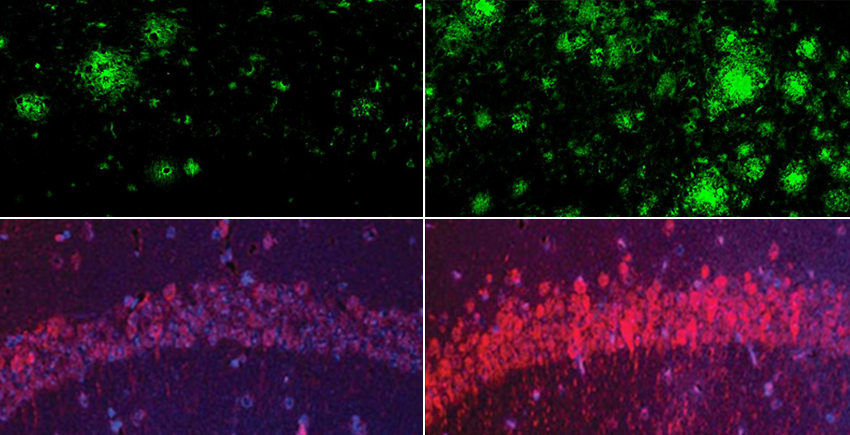
The top panels are a lithium depleted brain with Alzheimer’s. The bottom panels are from a brain with lithium and no Alzheimer’s.


A mild sense of foreboding 

A mild sense of foreboding 

I know some people are probably tired of my defense of free trade and criticisms of Trump’s tariffs. But consider that I am critical of the chaos and quixotic nature of the country negotiations. It started out with some mathematical formula to calculate a “reciprocal” tariff. Then that went out of the window and was replaced by whatever the president decided at the moment. Make him mad and your tariff was doubled. The ten percent universal base tariff was replaced by the 15 percent one. Why? Only the president knows. Our allies got higher tariffs than our adversaries. Did Trump ever place a tariff on Russia? Incredibly high tariffs were placed on India (a once ally) because they purchase Russian oil driving India closer to its ancient adversary China. Instead of building and cementing alliances, we are now forcing our once allies in trade to look elsewhere. I described this policy as Fortress America because we no longer have allies. We no longer engender respect and trust. Our leader is looked upon as unprincipled and undisciplined. It is hard to argue otherwise. We have no friends we can depend on because no one and no country can depend on us.

Trade deficits do not constitute a national emergency. The national emergency is in the continued profligate spending and undisciplined politicians who are the elected leaders of the country. The national emergency is the ever widening differences between those on the political left with those on the political right. I pray that the assassination of Charlie Kirk is not a precursor of things to come when we start killing each other’s leaders and all hell breaks loose. Kirk’s murder will likely inflame the political rhetoric rather than tone it down. The left hates Trump and his cultlike MAGA disciples. I wish the president would now tone down his bellicose tweets and someone would take away his tweeting machine, I see little change of that happening. As Elizabeth Warren said when asked that Democrats need to lower the temperature in politics, “Why don’t you start with the president of the United States, right? And every ugly meme he has posted and every ugly word.” I am not surprised that neither Trump nor his enemies are working to bring back the loyal opposition.

None on the left are willing to bend a knee to Trump and offer him fealty. That seems to be the only strategy to make him back off his attacks. Haven’t you noticed that in the trade negotiations, better deals are given to those arriving at the White House bearing gifts? It has to be infuriating to both the citizens of other countries and to their leaders to come groveling before Trump bearing gifts and kissing his ring. I am not an expert on foreign affairs but Trump humiliated Japanese prime minister Ishiba leading to Ishiba’s party suffering a historic defeat in parliamentary elections. Ishiba felt forced to accept Trump’s demands of a fifteen percent tariff and pledging to “invest” $550 billion in the US with Trump crowing that the US was keeping 90 percent of the profits. Such an arrangement apparently did not sit well with the Japanese electorate. Trump actually called the pledge a “signing bonus” adding to Ishiba’s humiliation.

For me the national emergency is rather emergencies: out of control spending, trashing alliances, creeping nationalization of industry, shakedowns of countries and companies, protectionism, willy nilly tariffs, mean tweets, use of the military domestically without the consent of elected officials are all national emergencies. It is a shame because this administration inherited a mess on the left and has made progress in purging the rot from Biden’s years. However, it must be careful in not making another mess that would have to be cleaned up by another administration. My fear is that we will go careening from one mess to another building animus as we go.

Trump wants to bring back manufacturing. I have never heard a clear statement of what manufacturing does he want to bring back. The administration keeps saying that once the illegals leave then native American unemployment will fall. Yet there are over 7 million vacant jobs in the presence of illegals. Is there just a mismatch between job vacancies and skills? The Hyundai-LG plant in Georgia said that they were using (illegal) Korean workers because of the paucity of Americans with the requisite skills to get the plant up and running. Hyundai said that it would train Americans to do the work but needed to get the plant operational first.

There are common sense ways to address those areas of national security, namely rare earth minerals. Some have suggested pharmaceuticals as well and want all drugs manufactured in this country. I don’t necessarily see that but am willing to learn and listen. What I would like to see is a listing of all of the items on which we are trade dependent whose curtailment would constitute a national emergency. Then we could deal with each one. Saying that sock companies in Lesotho are evidence of a national emergency is laughable as are most of the items that are being traded across countries. But placing punitive tariffs on agricultural imports and the restricting the import of products like wood, steel and aluminum that are inputs to our outputs makes little sense.

Again I am a laissez-faire free trade economist who favors government with a small “g”. I am confident I know what makes America great I am confident I know how to make America even greater. And protectionism ain’t it. So here we are with core inflation up, unemployment up, labor force participation down, the dollar falling, countries and foreign investors shedding dollars, gold and bitcoin being safe havens (bitcoin?) and government borrowing costs rising. Did I leave anything out? No wonder I have this mild sense of foreboding. But maybe everything is going to be ok. Maybe.

My friend Don Boudreaux is an ardent supporter of free trade and I recommend his blog Café Hayek to you. Here is a posting where he takes the MAGAapologist Larry Kudlow to task for calling Trump a free trader. I would hate to be Kudlow and having to keep apologizing for Trump. As a friend of mine says “being a Trump apologist is a full time job.”

What? Another national emergency and other things

Word is that the president may declare another national “emergency.” If so it will be his 22nd – 10 already this term. Don’t you get images of the little boy who cried “wolf”? Trump’s assertion that trade deficits constitute a “national emergency” is a joke. However, this was the only basis that could invoke his use of tariffs. Now he is contemplating invoking a national emergency in housing. Mind you there is not a shortage of housing. In fact the amount of housing units available far exceed the current demand for housing. The issue, some say, is “affordability”. This has always puzzled me. Is there a mismatch of housing demand and supply locally? One republican congressman says “When you have a housing shortage and a supply issue, it pushes up valuations, which pushes up your property taxes, because your valuation goes up. It pushes up home insurance premiums because the value of your home is more expensive if there was some kind of a claim.” Again there is no housing shortage. This issue is – dare I say – a manufactured one. Currently there are 15 million more housing units than households. So what crisis? This may just be an excuse to get Trump involved in more government interference with the market. American socialism? State capitalism? Trump socialism!

What constitutes a national emergency? No one knows. Under the 1976 National Emergencies Act, the President can declare a national emergency at his discretion. The act does not provide an explicit definition of what constitutes an “emergency.”  The simple declaration of an emergency would allow the president to bypass congress. This is all the congress’ fault. It should amend the law and mandate that a declaration be ratified by the congress. Trump loves to declare emergencies. Thus far did you know that he has declared ten of them, ranging from the trade deficit to the “crime emergency” in DC.

Don’t forget that despite the evidence, the democrats think that the climate constitutes an existential threat, i.e. a national emergency. Can you imagine what would have happened if Biden had declared a national emergency? Look for the next democrat president to do so.

If congress doesn’t change the law, its only recourse is to pass legislation terminating the emergency. Of course the president can veto it and it would take a super majority of the congress to override. Good luck with that.

Fed Governor Cook not cooked – yet

U.S. District Judge Jia Cobb has temporarily blocked President Trump’s removal of Federal Reserve Governor Lisa Cook. “The judge concluded that the alleged mortgage misconduct likely didn’t amount to ’cause’ to fire her under the Federal Reserve Act, and that the way in which she was dismissed likely violated her due process rights under the Constitution.”  Bloomberg.

This means that Cook can stay at the Fed and participate in the Open Market Committee’s meeting next week. It is widely anticipated that the Fed will cut the Fed funds rate. It will be interesting to see how Cook votes.  

The judge wrote “The best reading of the ‘for cause’ provision is that the bases for removal of a member of the Board of Governors are limited to grounds concerning a Governor’s behavior in office and whether they have been faithfully and effectively executing their statutory duties.” 

Obviously the administration will rush to appeal Judge Cobb’s ruling. But it is apparent that the judge does not view the charge against Cook sufficient to justify firing for cause. The charge against her has been referred to the Justice Department for possible prosecution. It would be interesting if a conviction on a felony would then be sufficient to justify her firing.

Again, why isn’t there a clamor for Adam Schiff to resign from the senate and Letitia James to quit as New York attorney general? Aren’t they accused of the same thing as Governor Cook? Why haven’t criminal charges been filed against them too?

By the way, I am tired of every article mentioning that Cook is the first black woman to be a Fed governor.

I am also tired of seeing those on the right asserting that Cook has no business being on the Board of Governors because she is not an expert in monetary economics. I have previously pointed out that only Governor Waller is trained in monetary economics and that if that were the criteria, then he would be the only governor. Traditionally, the Fed governors have had a variety of skills and of the ones that are economists, international economics (Cook) and labor economics (Jefferson) are commonly found on the board.

What did Elon say?

Did you see where Josh Hawley (R-Mo) wants to ban driverless cars? What about the driverless trucks that are now on some roads? Elon Musk is putting much of his fortune on driverless technology. Hawley who is somewhat of a maverick thinker is in this instance a Luddite. Like it or not, driverless technology is the future.

More bogus job numbers?

The Labor Department now says that the economy added 911,000 fewer jobs than previously estimated in the 12 months ending in March. This is no surprise to me. I know from long personal experience that job statistics are generally inflated and are revised downward. I also have seen almost daily reports of businesses shedding jobs. The question is are we ever going to be able the data coming out of this or any administration?