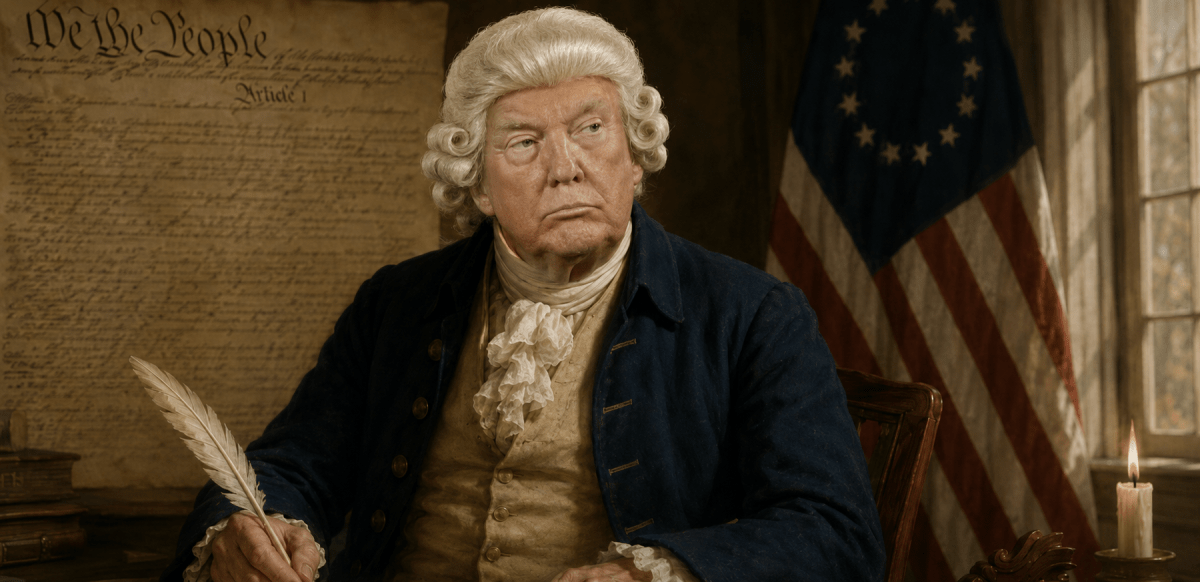
Would the Founding Fathers Impeach Donald Trump?
A Constitutional and Historical Inquiry
I. The Question the Founders Never Anticipated
The impeachment clause of the United States Constitution was not an afterthought. The Framers placed it at the heart of the republic’s design as a last line of defense against the corruption of executive power. They had read their history — they knew what unchecked rulers looked like — and they were determined to build a system that could correct itself. Yet, for all their genius, the Founders could not have imagined Donald Trump.
That is not an insult to the Founders. It is a testament to how far outside the norms of American political life Trump truly operates. Jonah Goldberg, writing for the American Enterprise Institute, has not surprisingly argued that the Founding Fathers would have moved to remove Trump from office long before the republic reached its current state of institutional exhaustion. https://www.aei.org/op-eds/the-founding-fathers-wouldve-gotten-rid-of-trump-long-ago/
That the historical and constitutional evidence support that conclusion is open to debate. And yet the mechanisms the Founders created have not produced the outcome they envisioned — a failure worth examining carefully. At the outset, my own inclination would not favor impeachment. But my academic side says that this is an issue worth investigating and discussing.
II. The Founders’ Conception of Impeachment
To understand what the Founders would have thought of Trump, we must first understand what they intended impeachment to accomplish. Alexander Hamilton, in Federalist No. 65, described impeachment as the mechanism for addressing “the misconduct of public men” and “the abuse or violation of some public trust.” Crucially, impeachment was never limited to criminal conduct. It was designed to address something broader and, in many ways, more dangerous: the betrayal of the constitutional order itself.
James Madison, the principal architect of the Constitution, was equally clear on the moral foundations that should govern a republic. In Federalist No. 10, he wrote that “no man is allowed to be a judge in his own cause; because his interest would certainly bias his judgment, and, not improbably, corrupt his integrity.” This was not merely an abstract philosophical principle. It was a load-bearing pillar of the constitutional structure Madison and his colleagues were constructing. A president who sat in judgment of himself — who used the machinery of the executive branch to settle his own legal disputes in his own favor — would have struck Madison as the precise corruption the Constitution was designed to prevent.
Edmund Burke, whose thinking deeply influenced the Founders, articulated this principle as one of the “fundamental rules” of a decent society: no man should be judge in his own cause. Burke’s political philosophy was woven into the fabric of the founding generation’s worldview. He would have been appalled by what has transpired.
III. The Settlement That Madison Never Imagined
Consider one specific episode that crystallizes these concerns that may indicate Was Burke’s prevision about Trump’s $1.766 billion settlement with himself? Trump’s settlement of a civil lawsuit against himself, brokered by attorneys operating within his own Justice Department, for the striking sum of $1,776 billion — a figure that is too cute by half. That the settlement amount is a pointed reference to the year of American independence is not a coincidence. It is a performance, a provocation dressed in patriotic numerology.
The substance beneath the theater is more troubling still. The Justice Department — nominally an independent arm of the executive branch, charged with administering the law impartially — agreed to a massive payout to the president himself at a moment when the government appeared likely to lose the underlying case. A president using the public’s legal apparatus to enrich himself while avoiding an adverse judgment is precisely the kind of self-dealing Madison warned against. It is an abuse of public trust in the most literal sense Hamilton described.
This is an impeachable offense. It does not need to rise to the level of a criminal statute — the Constitution’s framers were explicit on this point. The standard is “high crimes and misdemeanors,” a phrase drawn from British parliamentary practice that encompassed abuses of power and betrayals of public trust, not merely violations of the penal code. Trump has now been impeached twice, and yet he remains in office — a fact that would have astonished and alarmed the Founders in equal measure.
IV. Where the Founders’ Design Failed
Here we encounter the painful irony at the center of this inquiry. The Founders designed impeachment as a corrective mechanism, but they made a critical assumption: that the Senate would act as a genuinely deliberative and independent body. They did not fully anticipate the emergence of rigid partisan tribalism — or, more precisely, they hoped the constitutional structure itself would prevent it. Madison’s Federalist No. 10 is, at its core, an argument that the size and diversity of the republic would prevent any single faction from seizing total control.
They were wrong — or at least, they were not right enough. When the president’s party controls the Senate, the body designed to serve as an independent check becomes an instrument of protection. Conviction requires a two-thirds majority; a disciplined partisan minority can prevent it regardless of the evidence. Trump’s two acquittals were not verdicts on the merits of the charges. They were demonstrations of the limits of a constitutional mechanism that assumed more institutional independence than the modern party system permits.
Even if Democrats were to retake both the House and the Senate, conviction would require 67 votes — a threshold that, in the current political environment, functions as a near-absolute barrier. The Founders built a high bar for removal deliberately, to protect against purely political witch hunts. In doing so, they may have inadvertently made genuine accountability for the most powerful man in the country nearly impossible to achieve.
V. The Other Side: A Friend’s Dissent
It would be dishonest to present only one side of this argument, and a close friend of mine offers a perspective that deserves serious consideration. When I expressed my outrage at the settlement, he pushed back with conviction. His response is worth quoting at length:
“In an age of constant outrage, I save outrage for worse matters. The outrageousness perpetrated on Trump has been so many that we no longer even feel outraged about them. So I am not outraged about this settlement. The Democrat-controlled government mobilizing against Trump is beyond any precedent I think in this country previously. There is an obvious conflict of interest. But that is not his fault. He should be free from abuse from the IRS like all of the rest of us. Because he has been framed, railroaded, arrested, defamed in all manner of ways, shot, and had his entire family threatened, I give DJT lots of latitude. I do believe he loves the country and I do not believe his family is all there just to grift off the taxpayer like Biden was. Besides, Donald Trump won’t send a goon squad to kick my door in the middle of the night to seize my AR-15. If I had to write a test and had only one question on it, that would be the one. Tells me everything I need to know.”
This is not a fringe view. It reflects a sincere and deeply held conviction shared by millions of Americans: that Trump has been the victim of an unprecedented campaign of political persecution, and that whatever excesses he may commit are dwarfed by the abuses directed against him. My friend raises a legitimate point when he notes the conflict of interest inherent in a political opposition using the instruments of government to pursue a former and future president.
And yet if a previous government abuses its power in persecuting an individual who is then elected president, does the newly installed president therefore acquire the right to have that government pay him a settlement from the public treasury? My friend says no penalty should attach. I say he has a point about the conflict of interest — but that the remedy cannot be self-enrichment at public expense, adjudicated by the president’s own appointees. Two wrongs, as the Founders would have noted, do not make a constitutional republic.
VI. Conclusion: A Republic, If You Can Keep It
When Benjamin Franklin emerged from the Constitutional Convention in 1787, he was reportedly asked what form of government the delegates had created. “A republic,” he replied, “if you can keep it.” That conditional clause has never felt more weighted than it does now.
Would the Founding Fathers have impeached Donald Trump? Based on the standards they articulated and the principles they embedded in the Constitution, the answer is almost certainly yes. The more troubling question is why the system they designed has been unable to achieve what they intended. The answer lies not in the failure of the Constitution itself, but in the failure of the institutions and political culture that are supposed to give it life.
Madison feared factionalism above almost all else. He built a system designed to tame it. What he did not — could not — anticipate was a faction so cohesive, so disciplined, and so willing to subordinate constitutional principle to political loyalty that the corrective mechanisms he designed would become effectively inoperable. The Founders gave us the tools. Whether we choose to use them remains, as it has always been, our responsibility.
So I ask you, the reader: what say you?
 haroldblackphd.com
What say I? Off with their heads!!
I can see both sides of the coin in this excellent essay. But I’ll pose and offense that I find unforgivable. Trumpcoin.
The President acted worse than the Biden’s in Ukraine, and as we say in Deep South Georgia, “right in front of God and everybody.” Trump even spoke at the kickoff meeting for it, and by recent counts, the family has been enriched by $4b.
This, I believe is what most Americans hate most. An unfair playing field of politicians who lie like a rug, and enrich themselves rough their positions and power. And that’s a self-imposed sin on Trump’s part.
As for the items you and your associate called out – if congress has problems with his approach, then do as they’ve successfully done on his hundreds of EO’s….take him to court. You don’t need an impeachment to stop a train.
Impeachments have become a toothless lion…a show….a parody…a farce.
LikeLike
Trump has now lost enough support in the Senate that he is going to have to enrich himself through executive orders. When he loses the House he will have no chance of getting anything done legislatively. Then it becomes rule by fiat.
LikeLike
NO! There should not have been the original targeting of Trump. He would be gone now..
The result is a strange but predictable return to the polarity of colonialist times, where those loyal to ultimate authority were Loyalists…and the British traitors would become the Founding Fathers- which I hope will be today’s Trump challengers..
Thomas Paine in Common Sense :
..”As a long and violent abuse of power is generally the means of calling the right of it in question, (and in matters too which might never have been thought of, had not the sufferers been aggravated into the inquiry,) and as the King of England hath undertaken in his own right, to support the Parliament in what he calls Theirs, and as the good People of this Country are grievously oppressed by the Combination, they have an undoubted privilege to enquire into the Pretensions of both, and equally to reject the Usurpation of either..”
Notice what is written in parentheses.
Trump’s desire to go big or go home, has brought all onto himself, has infected America, at least some, to actually embrace Tory ideations: conservative, and loyal to the Crown.
LikeLike
Isn’t it amazing how smart were the Founding Fathers?hb
LikeLiked by 1 person
i am in your friends camp. Like Trump or hate Trump he has endured more than almost anyone could tolerate. He still stands. He loves this country and because he’s not your father’s politician his methods certainly are different. His mannerisms, words and his some of his actions are definitely not to my liking. But I don’t believe that anything he’s done rises to the level that the Democrats continuously scream about. I don’t believe that he has ever committed an impeachable offense. The fringe lunatics seem to have loudest voice in the room today. And the so called mainstream media carries their water. This country is under attack by communists, socialists and many other non- American groups out there. They think Donald Trump acts like a King. Then if so, I say “G_D SAVE THE KING”
LikeLike
Of course they are just upset that they are not in power to do what Trump is doing.
LikeLike